When Your Channel Manager Doesn't Actually Sync: The Hidden Cost of Calendar Failures
Trustpilot
TL;DR: Host's Smoobu channel manager failed to push availability restrictions to booking sites, causing impossible double bookings across portals that they now must honor to avoid penalties.
The entire point of a channel manager is deceptively simple: keep your calendars in sync so you don’t get double-booked. You pay for the software, you connect your channels, and you trust that what you set on your dashboard is what guests see on Airbnb, Booking.com, and VRBO. When that trust breaks, the fallout is disproportionate to the root cause.
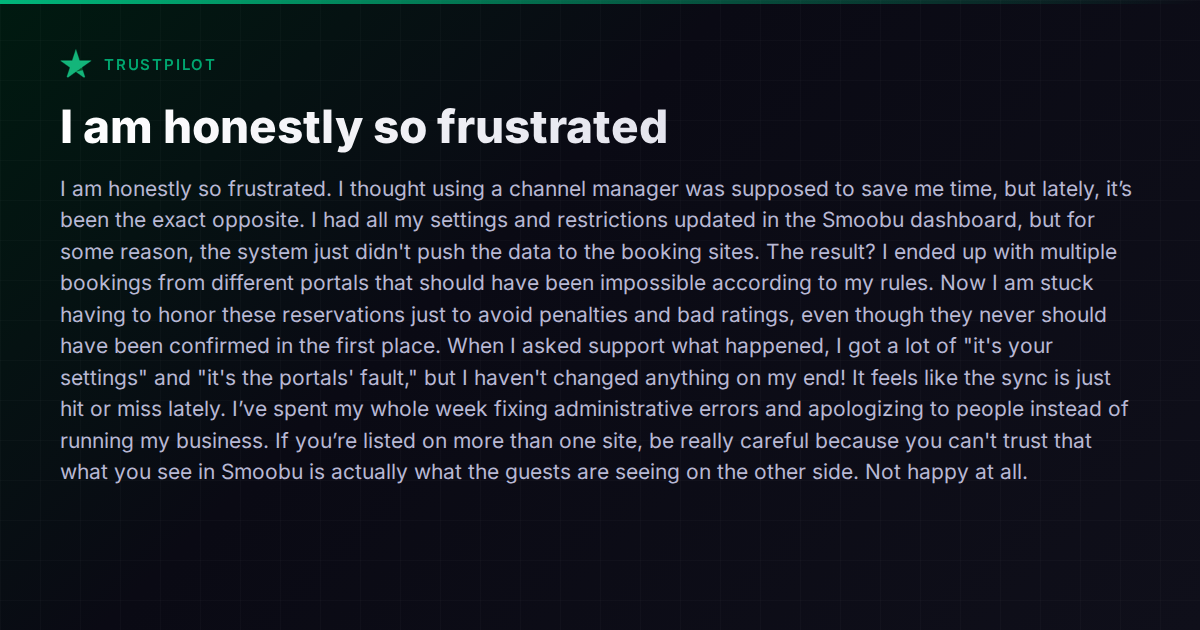
A recent Trustpilot review captures the frustration precisely. A host using Smoobu had updated all their availability restrictions in the dashboard — minimum nights, blocked dates, the usual controls. The system simply didn’t push those changes to the connected OTAs. The result: multiple bookings that violated the host’s own rules, confirmed on different portals simultaneously. The host was then stuck honoring reservations that should never have existed, just to avoid platform penalties and negative reviews. When they contacted support, the response boiled down to “it’s your settings” and “it’s the portals’ fault” — the classic finger-pointing loop that leaves operators holding the bag.
This isn’t a one-off. Sync failures are one of the most common — and most expensive — complaints across virtually every channel management tool in the STR space.
Why Sync Breaks (and Why It’s Hard to Fix)
Channel synchronization looks simple from the outside. Internally, it’s a mess of competing API behaviors, rate limits, eventual consistency windows, and platform-specific quirks.
Here’s what typically goes wrong:
- Propagation delays. Most channel managers poll or push updates on intervals — every 1, 5, or 15 minutes depending on the platform and the channel manager’s architecture. A booking that comes in during that window can slip through before the block propagates.
- Partial sync failures. Availability might update but minimum-night restrictions don’t. Or pricing pushes succeed while calendar blocks silently fail. The dashboard shows green; the OTA shows something different.
- API connection drops. OTA APIs go down, rate-limit aggressively, or change behavior without warning. A well-built channel manager retries and alerts. A poorly built one fails silently.
- iCal as a fallback. Some tools still rely on iCal feeds for certain channels. iCal is pull-based with no guaranteed refresh interval. It was never designed for real-time availability management and it shows.
The painful part: when sync fails, the host bears all the consequences. You can’t tell a guest “sorry, my software didn’t update.” You either honor the booking, eat a cancellation penalty, or risk a bad review. The channel manager vendor faces zero direct cost.
What “Support Says It’s Your Fault” Really Means
The Smoobu host’s experience with support — getting told it’s their settings or the portals’ fault — is frustratingly common across the industry. It’s worth understanding why.
Channel managers sit between you and the OTAs. When something goes wrong, there are genuinely three possible culprits: your configuration, the channel manager’s sync engine, or the OTA’s API behavior. Diagnosing which one failed requires detailed sync logs with timestamps, and many tools either don’t expose those logs to users or don’t retain them in enough detail to be useful.
So support defaults to the easiest explanation: user error. If you can’t prove it wasn’t your settings (and you usually can’t without granular logs), the conversation goes nowhere.
What to look for in any channel manager:
- Sync logs visible to you, not just to the vendor’s engineering team. You should be able to see exactly when each update was pushed, to which channel, and whether it succeeded or failed.
- Conflict detection and alerts. If two bookings overlap or a booking violates your restrictions, the system should flag it immediately — not after the guest has already confirmed.
- Automatic retry with notification. If a push fails, the system should retry and tell you it happened.
How the Major Players Handle This
No channel manager is immune to sync issues — the OTA APIs are genuinely unreliable at times — but there are meaningful differences in how platforms handle the problem.
Hostaway uses direct API integrations with Airbnb, VRBO, and Booking.com and markets itself on having “highest-status OTA connections.” Operators generally report fewer sync gaps than with iCal-dependent tools, though complaints about delayed sync on Booking.com still surface in host communities.
Guesty takes a similar direct-API approach and invests heavily in infrastructure reliability (they cite 99.99% uptime). For larger operators, Guesty’s sync engine is generally considered robust, though the platform’s complexity and opaque pricing can be barriers for smaller hosts.
Lodgify emphasizes real-time syncing and personalized onboarding, which helps catch configuration issues before they cause problems. Their approach works well for hosts who are methodical about setup but doesn’t necessarily help when the sync engine itself misfires.
Hospitable focuses on real-time calendar syncing across Airbnb, VRBO, Booking.com, Agoda, and Google. Their channel manager is tightly coupled with their messaging automation, which means the system at least knows about conflicts in the context of guest communication — though that doesn’t prevent the conflicts from happening.
Smoobu uses a combination of direct API connections and iCal depending on the channel. For hosts on a budget, it’s an accessible entry point. But the sync reliability issues described in the Trustpilot review — and echoed by other operators — suggest the system’s failure handling and user-facing transparency need work.
Vanio AI takes a different architectural approach: because the channel manager, calendar, reservation system, and messaging all share one data layer, conflict detection happens inside a single system rather than across integrations. The platform provides real-time two-way sync with Airbnb, Booking.com, and VRBO via direct API, with built-in conflict detection for overlapping reservations and missing turnover time. The Operations Watchdog feature runs automated daily checks across multiple categories and escalates issues it can’t auto-fix. Whether this architecture fully eliminates sync failures remains to be seen at scale, but the single-system design does remove one common failure point: the gap between what the channel manager knows and what the rest of your stack knows.
What You Can Do Right Now
Regardless of which tool you use, there are practical steps to reduce your exposure:
- Audit your sync method per channel. If any channel is connected via iCal rather than direct API, that’s your highest-risk link. Push your channel manager to support direct API for every platform you list on.
- Set buffer days between bookings. Even a one-day buffer gives the sync engine time to propagate. It costs you some revenue but prevents the catastrophic double-booking scenario.
- Check what guests actually see. Periodically verify your live OTA listings against your dashboard. If minimum nights, blocked dates, or pricing don’t match, you know the sync is broken before a guest finds it.
- Demand sync logs. If your channel manager won’t show you detailed push/pull logs with timestamps, you have no way to diagnose failures. That’s a red flag.
- Document everything. When sync fails, screenshot your dashboard settings with timestamps. This is your evidence if you need to dispute a penalty with the OTA or escalate with the vendor.
The Honest Trade-Off
No channel manager will give you 100% sync reliability 100% of the time. OTA APIs are a moving target, and every vendor is at the mercy of platform-side changes. The real question is: when sync fails — and it will — does your tool detect it, alert you, and give you the information you need to fix it fast?
If the answer is no, you’re not saving time. You’re just adding a middleman between you and the problem.
For a side-by-side look at how different platforms handle channel management, calendar sync, and conflict detection, the comparison hub breaks down the specifics across more than 25 tools.