When Your Channel Manager Causes the Double Booking — And Blames You for It
Trustpilot
TL;DR: Author has experienced persistent VRBO API integration failures and a double booking with Smoobu that wasn't even visible in the app, and is explicitly advising others to choose a different channel manager.
Double bookings are one of the most stressful things that can happen in short-term rental management. You get two confirmed guests for the same dates, someone has to be relocated or cancelled, and the fallout — bad reviews, platform penalties, frantic phone calls — cascades through your operation for days.
What makes it worse is when your channel manager, the tool you’re paying specifically to prevent this, is the cause. And then tells you it’s your fault.
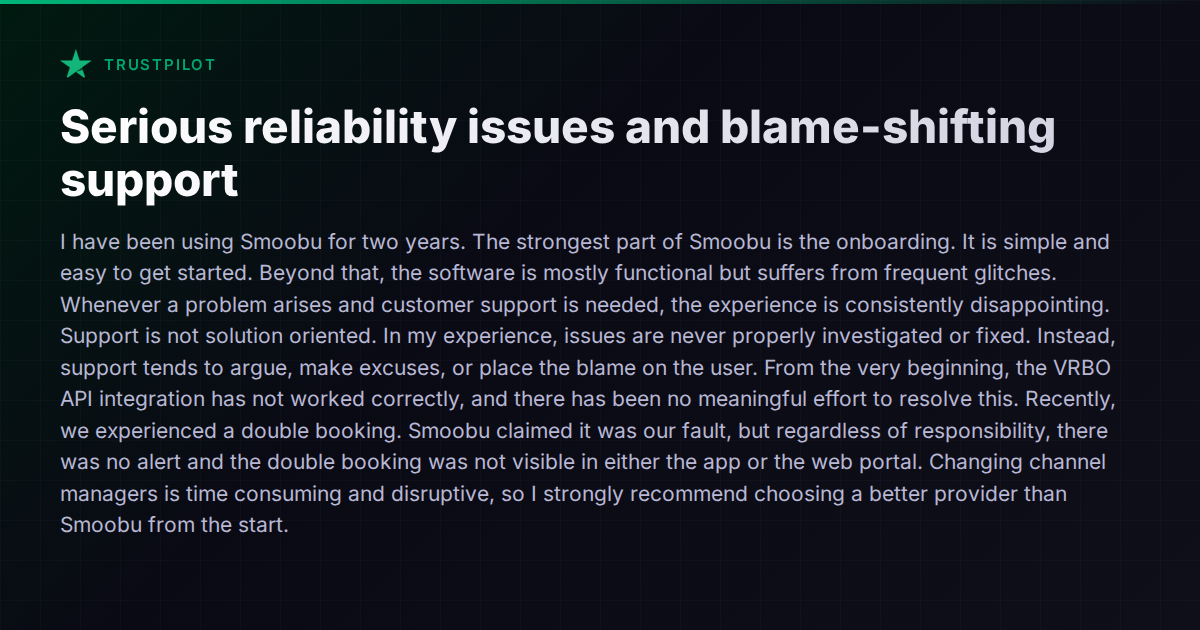
A host on Trustpilot recently described exactly this scenario after two years on Smoobu. The VRBO API integration, they said, had never worked correctly from the start. When a double booking finally happened, Smoobu’s support team claimed the host was responsible. But the host pointed out something damning: the double booking wasn’t even visible in the app or web portal. No alert. No conflict indicator. The system silently accepted two overlapping reservations and said nothing.
This is a failure at the most fundamental level of what a channel manager is supposed to do.
The Real Cost of Channel Sync Failures
Double bookings aren’t just inconvenient. On Airbnb, a host-initiated cancellation can trigger Superhost status loss, search ranking penalties, and automatic review flags. On Booking.com, it can affect your visibility score. On VRBO, it damages your Premier Host standing.
Beyond platform penalties, there’s the direct cost: finding alternative accommodation for the displaced guest (often at your expense), the time spent managing the situation, and the reputational damage that a cancellation causes regardless of whose fault it was.
For operators managing more than a handful of listings, a channel manager that occasionally fails at calendar sync isn’t a minor annoyance — it’s an existential risk. If you can’t trust that availability is accurate across Airbnb, VRBO, and Booking.com, you’re essentially running without a safety net.
The VRBO Integration Problem
VRBO integration is notoriously the most fragile connection across the PMS landscape. This isn’t unique to Smoobu. Multiple platforms have historically struggled with VRBO’s API, which has undergone significant changes over the years as the platform shifted its technical infrastructure.
That said, some platforms handle it better than others. The host’s complaint wasn’t just that the integration had issues — it was that over two years, there was “no meaningful effort to resolve this.” That’s a support and engineering prioritization problem, not just a technical one.
Hostaway and Guesty both advertise high-status VRBO connections and tend to have larger engineering teams dedicated to maintaining OTA integrations. Lodgify has also invested in VRBO connectivity. Whether these platforms are genuinely more reliable on VRBO sync depends on your specific property setup, but they do have more resources dedicated to maintaining those connections.
Hospitable takes a different approach — its channel management layer focuses heavily on real-time calendar syncing and explicitly markets double-booking prevention. For hosts whose primary concern is calendar accuracy across channels, it’s worth evaluating.
Support That Argues Instead of Investigating
The channel sync failure is bad enough. But the pattern the host describes — support that “tends to argue, make excuses, or place the blame on the user” — is arguably more damaging in the long run.
When a double booking occurs, what an operator needs is:
- Immediate acknowledgment that there’s a problem
- Root cause analysis — was it an API delay, a race condition, a sync interval gap, a user configuration error?
- A fix or workaround so it doesn’t happen again
- Transparency about what the system’s limitations are
What the host got instead was blame-shifting. This is unfortunately common with budget and mid-tier PMS platforms where support teams are trained to deflect rather than escalate to engineering. The host’s observation that “issues are never properly investigated or fixed” suggests a systemic support culture problem, not a one-off bad interaction.
Smoobu’s strength, as the host fairly acknowledged, is onboarding. It’s simple to get started. But ease of setup and reliability under pressure are very different things. The tool that’s easiest to set up on day one isn’t necessarily the tool you want when things go sideways on day 300.
What to Look for in a Channel Manager
If you’re evaluating channel managers — either for the first time or because you’ve been burned — here’s what matters most for calendar sync reliability:
- Real-time two-way sync vs. polling intervals. Some platforms sync every 15-30 minutes via iCal. Others maintain real-time API connections. The difference matters enormously for high-demand dates where two bookings can come in minutes apart.
- Conflict detection and alerts. Even if a sync delay causes an overlap, your PMS should catch it and alert you immediately. If a double booking can exist silently in the system, that’s a design flaw.
- VRBO-specific API status. Ask directly: is your VRBO integration via their official API, and what’s the average sync latency? Don’t accept vague answers.
- Support escalation paths. Can support actually escalate to engineering, or are they limited to scripted responses? Ask about their process for investigating sync failures.
- Incident history. No platform has perfect uptime. What matters is how they handle incidents — do they publish post-mortems? Do they proactively notify affected users?
Switching Is Hard, But Staying Is Harder
The host’s closing advice — “I strongly recommend choosing a better provider than Smoobu from the start” — reflects a painful truth. Switching channel managers mid-operation is disruptive. You’re migrating listings, reconnecting APIs, re-testing sync, updating automations, and holding your breath during the transition period.
But the cost of staying with a channel manager you can’t trust is higher. Every month you operate with unreliable sync is another month where a double booking can happen silently. The disruption of switching is a one-time cost; the risk of staying compounds.
If you’re running more than a few listings and need reliable multi-channel sync — especially with VRBO in the mix — Vanio AI is worth evaluating. It maintains real-time two-way sync with Airbnb, Booking.com, and VRBO through direct API integrations, and because the channel manager shares a data layer with the rest of the system (messaging, tasks, locks, payments), conflicts surface immediately in one place rather than hiding across disconnected tools. It won’t be the right fit for everyone, but the architecture is designed specifically to avoid the kind of silent failure described here.
For a broader comparison of how different platforms handle channel management, the comparison hub breaks down the major options side by side.
The Bottom Line
Channel sync is the single most critical function of any property management platform. Everything else — messaging, pricing, operations — is downstream of whether your availability is accurate across every platform where you’re listed.
When that foundation is unreliable, and the vendor’s response is to blame you rather than investigate, it’s time to move. The switching cost is real, but it’s a known, bounded cost. The cost of the next silent double booking is unpredictable and potentially much worse.