When Your Channel Manager Only Manages Some Channels
Trustpilot
TL;DR: Author finds Smoobu's channel integrations too limited (VRBO is iCal-only, no API push to channels) and too expensive for 6 rental units given the product's immaturity.
A channel manager is supposed to be the one tool that frees you from juggling tabs. You connect your listings once, and availability, pricing, and content push out everywhere in real time. That’s the pitch, anyway.
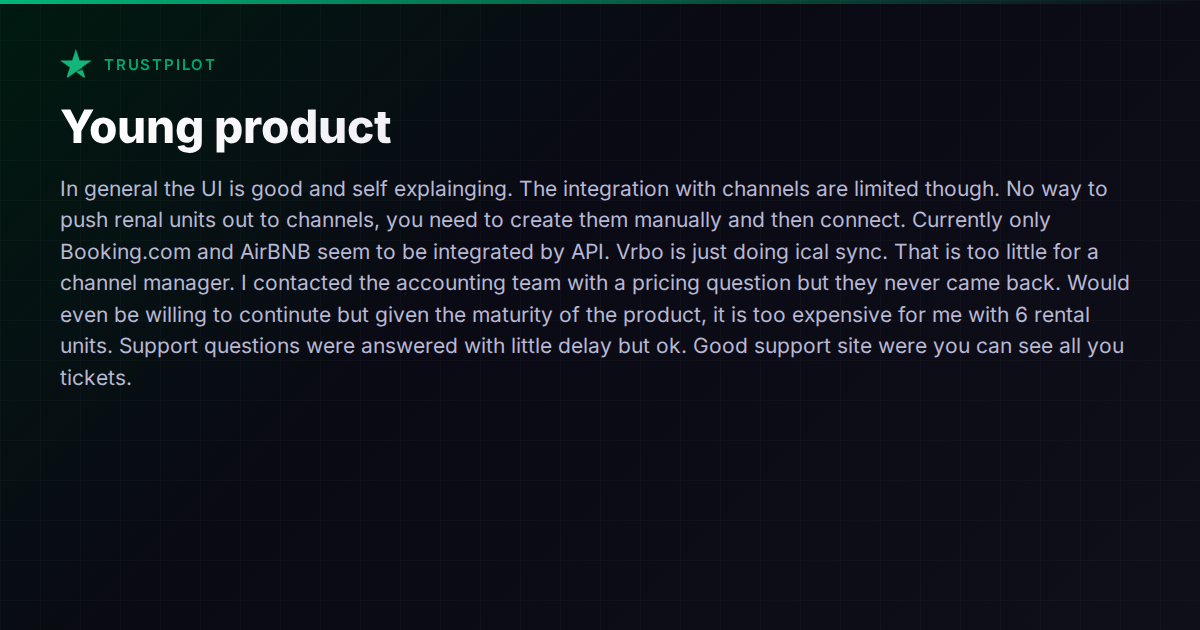
In practice, many operators discover that “channel management” can mean wildly different things depending on the platform. A recent Trustpilot review of Smoobu captures the frustration concisely: the reviewer found that only Airbnb and Booking.com had full API integrations, while VRBO was limited to iCal sync. There was no way to push new rental units out to channels — each had to be created manually on the OTA first, then connected. For a host with six units, the product felt too immature relative to its price.
This isn’t a Smoobu-specific problem. It’s a structural issue across the PMS and channel manager landscape, and it’s worth understanding before you commit to a platform.
The API vs. iCal Gap
There are two fundamentally different ways a channel manager can talk to a booking platform:
-
Full API integration means two-way, real-time sync. Availability updates flow instantly. Pricing changes push automatically. Reservation details (guest name, payment info, special requests) pull into your PMS without manual entry. Messages sync. In some cases, you can even create or update listings directly from your management tool.
-
iCal sync is a calendar feed. It tells the receiving platform “these dates are blocked” and nothing more. There’s no pricing sync, no guest data, no messaging, and updates can be delayed by 15 minutes to several hours depending on the platform’s polling frequency.
The gap between these two is enormous in day-to-day operations. An operator relying on iCal for VRBO, for example, might see a same-day booking come through on Airbnb that doesn’t block the VRBO calendar for another hour — resulting in a double booking. Or they’ll need to manually update VRBO pricing every time they adjust rates, because iCal doesn’t carry price data.
When a platform advertises “VRBO integration” but the fine print reveals it’s iCal-only, that’s not really integration in any operational sense. It’s calendar blocking with extra steps.
Why Some Channels Lag Behind
There’s a practical reason for the inconsistency. Each OTA has its own API program with its own certification requirements, and some are significantly harder to integrate than others.
Airbnb’s API is relatively well-documented and widely adopted. Booking.com has a formal connectivity partner program with certification tiers. VRBO (part of Expedia Group) has historically been more selective about API access, requiring agency-style agreements through account managers. Smaller channels like Agoda, Google Vacation Rentals, and regional platforms each have their own requirements.
The result: newer or smaller PMS platforms often launch with Airbnb and Booking.com API support, add VRBO as an iCal connection to check the box, and promise “full integration coming soon.” For a host evaluating tools, it’s critical to verify what “integrated” actually means for each channel you depend on.
What to Check Before You Commit
Before signing up for any channel manager, ask these specific questions for every OTA you use:
- Is the integration via full API or iCal? If iCal, understand the sync delay and what data doesn’t flow (pricing, guest details, messages).
- Can you push new listings to the channel from the PMS? Or do you need to create each listing manually on the OTA, then link it? For operators with more than a handful of units, this distinction matters at setup and every time you onboard a new property.
- Does messaging sync? If Airbnb messages come through the unified inbox but VRBO messages don’t, you’re still checking multiple places.
- What’s the pricing sync model? Can you set prices once and have them distribute everywhere, or do some channels require manual updates?
- Is the channel a certified partner? Booking.com and VRBO both maintain lists of certified connectivity partners. Certification doesn’t guarantee a flawless experience, but it usually means the integration has passed baseline reliability tests.
How the Major Platforms Stack Up
The landscape varies quite a bit:
-
Guesty supports full API integrations with Airbnb, VRBO, and Booking.com, along with a wide range of smaller channels. As an enterprise-focused platform, channel breadth is one of its strengths — though the pricing (quote-based, not public) reflects that.
-
Hostaway positions itself as having “highest-status OTA connections” with API integrations to Airbnb, VRBO, Booking.com, and Google. It targets professional managers who need reliable multi-channel distribution.
-
Hospitable integrates with Airbnb, VRBO, Booking.com, Agoda, and Google, with real-time calendar syncing across all connected channels. Its strength is in automated messaging and task management rather than raw channel breadth.
-
Lodgify offers booking management and real-time sync, with a focus on direct booking websites alongside OTA distribution. Specific integration depth per channel varies.
-
Smoobu, as the original reviewer noted, has full API for Airbnb and Booking.com but relies on iCal for VRBO. For operators who depend heavily on VRBO traffic, this is a meaningful limitation.
-
Beds24 is worth a look for operators who need broad channel coverage on a budget — it supports a large number of channels, though the interface has a steeper learning curve.
-
Vanio AI takes full API integrations with Airbnb, Booking.com, and VRBO (via agency-style integration through a VRBO account manager), combining channel management with an AI-native operations layer. Its architecture means the AI has direct access to reservation data, pricing, and availability across all connected channels — which matters when you want automated responses or pricing changes to actually reach every platform. For a six-unit operator like the original reviewer, the per-reservation pricing model ($5/reservation) might pencil out differently than a flat monthly fee, depending on occupancy.
The Maturity vs. Price Question
The reviewer’s complaint wasn’t just about missing integrations — it was about paying full price for a product that doesn’t yet deliver full value. This is a legitimate concern across the PMS market. Many platforms price based on where they’re headed, not where they are today. And for small operators (under 10 units), every dollar of monthly overhead is felt directly.
Before committing, run the actual math: how many reservations do you process per month, what’s your average booking value, and what does the PMS cost as a percentage of revenue? A tool that costs $30/month but causes one double booking per quarter is more expensive than one that costs $60/month and prevents them.
The Bottom Line
Channel management is one of those features where the details matter far more than the marketing. “We integrate with VRBO” can mean anything from a real-time two-way API connection to a calendar feed that updates twice an hour. The only way to know is to ask, test during a free trial, and verify with your own eyes that changes propagate the way you expect.
If you’re evaluating multiple platforms, our comparison hub breaks down integration depth, pricing models, and feature coverage across the major players. Start there, then test with your actual properties before migrating anything.