The iCal Sync Loop That Won't Die: Why VRBO and Airbnb Calendar Sync Still Breaks in 2026
Airbnb Community
TL;DR: Author is experiencing a specific iCal sync loop between VRBO and Airbnb where VRBO bookings show as blocked dates on Airbnb, which then feed back to VRBO as a false conflict — a concrete, named calendar sync failure across two named platforms.
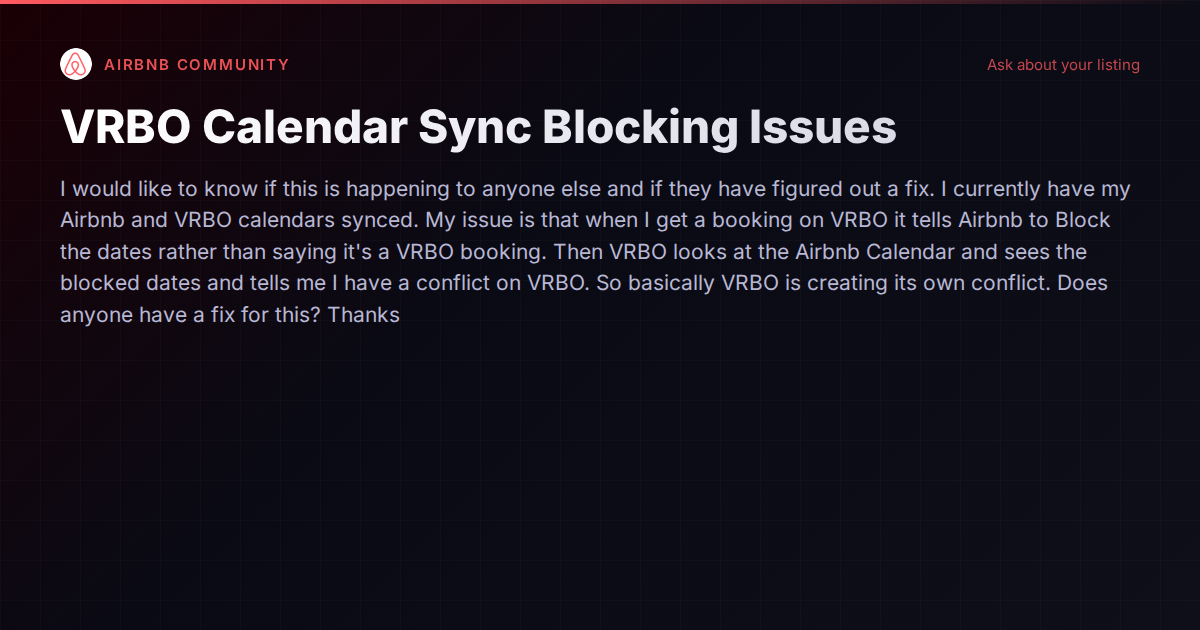
If you list on both Airbnb and VRBO, there’s a reasonable chance you’ve seen this: a guest books on VRBO, Airbnb imports the blocked dates via iCal, VRBO then sees those blocked dates reflected back from Airbnb and flags a “conflict” — against its own booking. The platform is arguing with itself.
This isn’t a new bug. Hosts have been reporting this exact loop for over two years. One host on an Airbnb community thread described it succinctly: VRBO creates a booking, Airbnb marks the dates as unavailable (labeled “unavailable per VRBO”), and VRBO reads that block back and panics. Another host noted they’d been tracking the issue since 2023 and it still persists in late 2025 and into 2026. Neither platform has claimed responsibility or shipped a fix.
The underlying cause is architectural, and understanding it helps you decide what to do about it.
Why iCal Sync Is Structurally Fragile
iCal (ICS) feeds are a decades-old calendar format. They weren’t designed for real-time booking coordination between competing marketplaces. When Airbnb and VRBO sync calendars, they’re polling static files on a schedule — typically every few hours, sometimes longer. This creates three distinct failure modes:
-
The echo loop. Platform A exports a block. Platform B imports it. Platform B re-exports it. Platform A imports it again. The block now exists as two independent entries, and deleting one doesn’t always clear the other.
-
The race condition. A booking arrives on one platform, but the other hasn’t pulled the updated feed yet. A guest on the second platform books the same dates. You now have a genuine double booking, not just a cosmetic conflict.
-
The phantom conflict. VRBO sees Airbnb’s block (which was caused by VRBO’s own booking) and shows a red conflict warning. The booking is fine — the guest checks in without issue — but the dashboard looks broken, and there’s no obvious way to dismiss it.
The host thread above captures all three. One commenter reported a double booking after Airbnb’s sync “stopped working.” Another said their VRBO guest checked in fine despite the conflict warning but they couldn’t figure out how to block the dates on Airbnb manually. A third noted they’d been living with phantom conflicts for months, unsure whether VRBO would penalize them.
To be clear: VRBO does not currently penalize hosts for these self-generated conflicts. But the visual noise is real, and the risk of an actual double booking from sync lag is non-trivial.
The “Delete and Rebuild” Workaround
One host in the thread reported a fix: delete the sync on both platforms, go into VRBO’s availability settings, adjust some restriction (they couldn’t remember which — possibly minimum nights or check-in day restrictions), then re-establish the sync. Another host tried to follow these instructions months later and couldn’t replicate the result.
This is the fundamental problem with workarounds that depend on undocumented platform behavior. They work for one person, on one day, with one browser, and are useless to everyone else. Calendar sync between Airbnb and VRBO via iCal is not a feature with a published spec and guaranteed behavior. It’s a best-effort integration where both platforms have minimal incentive to invest engineering resources.
What Actually Solves This
If you’re running more than a couple of listings across Airbnb and VRBO, relying on native iCal sync between the two platforms is a known risk. The industry has three real solutions, each with trade-offs.
1. A Property Management System with API-Level Channel Management
The most reliable way to keep calendars in sync across Airbnb and VRBO is to use a PMS that connects to both platforms via API — not iCal. API connections push and pull reservation data in near-real-time, eliminating the polling delay and the echo loop problem entirely.
Guesty offers full API connections to Airbnb and VRBO and is built for operators managing at scale. Hostaway similarly provides API-level channel management with Airbnb, VRBO, and Booking.com. Lodgify offers multi-channel sync with an emphasis on direct booking websites alongside OTA distribution. Hospitable connects to Airbnb, VRBO, and Booking.com with real-time calendar syncing and automated messaging.
All four of these platforms replace iCal feeds with proper two-way API sync, which eliminates the phantom conflict problem at its root. The trade-off is cost — you’re adding a monthly subscription and the overhead of migrating your listings into a new system.
2. A Calendar Bridge Tool
One commenter in the thread mentioned CalendarBridge, which provides a unified calendar view across platforms. Tools like this don’t change how fast Airbnb or VRBO refresh their iCal feeds, but they give you a single dashboard to spot overlaps before they become double bookings. It’s a monitoring layer, not a sync engine. If your operation is small enough that a full PMS feels like overkill, this kind of tool can reduce risk without adding much complexity.
3. An AI-Native Platform with Built-In Channel Management
Vanio AI takes a different approach: it’s an AI-native property management platform where channel management is part of a unified system. Airbnb and Booking.com connect via full API integration, and VRBO support is in progress (iCal is available now, with full sync being built out). The architectural difference is that the AI agent has access to reservation data across all channels in a single data layer — so it can detect conflicts, coordinate availability, and alert you to sync issues automatically, rather than waiting for you to notice a red warning in a dashboard.
For hosts whose VRBO volume is significant, it’s worth checking whether the VRBO integration has reached full API status before committing — iCal-based sync, even through a PMS, inherits some of the same lag risks.
The Manual Safety Net
Regardless of which tool you use, experienced multi-platform hosts almost universally recommend one habit: manually blocking dates on the secondary platform immediately after receiving a booking, rather than waiting for sync. Yes, it defeats the purpose of automated sync. But as one host in the thread put it, “It’s best to keep an eye on any calendars synced with Airbnb and monitor your bookings. It can take several hours for an Airbnb booking to appear on VRBO.”
Some hosts place a temporary manual block on all other platforms the moment a booking comes in, then remove it once the sync catches up. This is tedious at two listings and unworkable at twenty — which is exactly the inflection point where a PMS becomes not just convenient but necessary.
Where This Leaves You
The iCal sync loop between VRBO and Airbnb is not a bug that’s going to get fixed. It’s a structural limitation of a protocol that was never designed for this use case, maintained by two companies with no commercial incentive to coordinate. If you’re seeing phantom conflicts, you’re not being penalized — but you’re one sync delay away from a real double booking.
For small operators (one or two listings), manual monitoring plus a calendar bridge tool is often sufficient. For anyone managing more than a handful of properties, an API-connected PMS — whether that’s Guesty, Hostaway, Hospitable, Lodgify, Vanio AI, or another platform — is the only reliable way to keep availability accurate across channels without constant manual intervention.
The comparison hub at /compare/ breaks down how the major PMS options handle multi-channel sync if you want to dig into the specifics before choosing.