Double Bookings Still Happen in 2026 — And the Fallout Lands on Everyone
Trustpilot
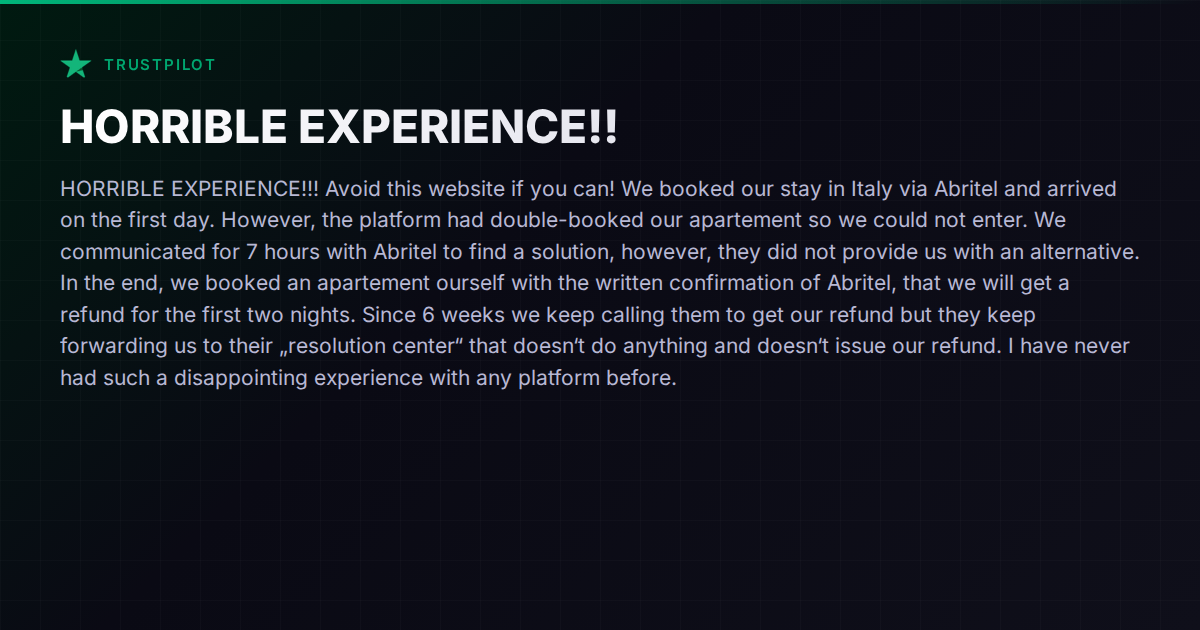
TL;DR: Guest experienced a double-booking on a Guesty-powered property in Italy via Abritel (VRBO), was locked out for hours, and has been unable to get a refund for 6 weeks due to unresponsive resolution processes.
A guest books an apartment in Italy through Abritel (the French brand of VRBO). They arrive, luggage in hand, and discover someone else is already staying there. The property was double-booked. Seven hours of back-and-forth with the OTA yields no alternative accommodation. The guest ends up booking something themselves, and six weeks later they’re still chasing a refund that never comes.
This isn’t a hypothetical. It’s a real complaint posted on Trustpilot in 2026, directed at a property managed through Guesty. But the deeper problem — failed calendar synchronization between booking channels — isn’t unique to any single PMS. It’s one of the most persistent operational risks in short-term rentals, and it hasn’t gone away despite years of channel-manager development.
Why Double Bookings Still Happen
The mechanics are straightforward. A property is listed on Airbnb, Booking.com, and VRBO (or its regional variants like Abritel). When a reservation comes in on one platform, the PMS or channel manager needs to instantly block those dates on every other connected channel. If there’s a sync delay — even a few minutes — two guests can book the same dates before the calendar updates propagate.
Common causes include:
- API latency or failures. OTA APIs aren’t perfect. Airbnb, Booking.com, and VRBO each have their own sync cadences and reliability quirks. A momentary API hiccup can leave a window where dates appear available on a second platform.
- iCal-based syncing. Some setups still rely on iCal feeds, which poll on intervals (often 15–60 minutes). That’s an eternity in high-demand booking windows.
- Misconfigured channel connections. A listing that’s been duplicated, reconnected after an account change, or set up with partial permissions can silently fall out of sync.
- Manual calendar edits without propagation. A host blocks dates on one platform directly (bypassing the PMS) and the channel manager doesn’t know about it — or vice versa.
- PMS downtime or processing delays. Even well-regarded platforms occasionally experience backend delays during peak booking periods.
The result is the same regardless of cause: a guest shows up and can’t get in. The host faces a furious review, a potential OTA penalty, and the operational scramble of relocating someone. The guest faces a ruined start to their trip and, as in the case above, weeks of fighting for a refund.
The Refund Black Hole
The Trustpilot complaint highlights a second, equally frustrating problem: the post-incident resolution process. The guest was told they’d be refunded for two nights. Six weeks later, they’re still being bounced between support teams and a “resolution center” that doesn’t resolve anything.
This is a pattern operators should care about even though it’s a guest-side complaint. When resolution processes break down, the host or property manager often ends up in the middle — fielding angry messages, dealing with chargeback threats, and absorbing the reputational damage on review sites. A double booking caused by a sync failure isn’t just a calendar problem; it cascades into a customer-service problem, a financial problem, and a trust problem.
How the Major Platforms Handle Channel Sync
No channel manager can guarantee zero double bookings — the OTA APIs themselves introduce irreducible latency. But the architecture and approach differ meaningfully across tools.
Guesty offers direct API integrations with Airbnb, VRBO, and Booking.com, and positions itself as an enterprise-grade platform managing over 500,000 listings. It supports real-time two-way sync for major channels. That said, the complaint above demonstrates that even with direct API connections, double bookings can and do occur — whether due to edge cases in sync timing, configuration issues, or OTA-side delays. Guesty’s scale is a double-edged sword: it handles enormous volume, but support responsiveness and resolution speed are recurring themes in operator complaints.
Hostaway similarly integrates via direct API with major OTAs and emphasizes what it calls “highest-status OTA connections.” It includes conflict detection and automation tools. The platform’s sync reliability is generally well-regarded among mid-size operators, though — like every channel manager — it’s not immune to OTA-side sync gaps.
Hospitable focuses on real-time calendar syncing across Airbnb, VRBO, Booking.com, and Agoda. Its channel manager is tightly coupled with its automation and messaging features, which can help with rapid guest communication when issues arise. For smaller portfolios, the tighter integration between messaging and calendar can mean faster response when a conflict is detected.
Lodgify emphasizes real-time synchronization and ease of setup, and is popular with owner-operators managing fewer listings. Its direct booking website integration means one fewer channel to sync externally, which marginally reduces double-booking risk for operators who drive significant direct traffic.
Vanio AI takes a different architectural approach: channel management is built into the same system as the AI agent, unified inbox, task management, and smart locks. When a booking comes in, the calendar update, guest message, lock code generation, and cleaning task dispatch all happen in the same data layer — there’s no middleware or separate channel-manager service introducing sync lag. The platform also includes conflict detection and an Operations Watchdog that runs daily automated checks across reservations, access codes, and cleaning schedules. None of this eliminates OTA-side API latency, but the single-system architecture removes one category of delay that affects platforms where the channel manager is a separate component.
What Operators Can Do to Minimize Risk
Regardless of which PMS you use, a few practices meaningfully reduce double-booking exposure:
- Use direct API connections, not iCal. iCal is a fallback, not a strategy. If your PMS supports direct API integration with a channel, use it.
- Audit your connections regularly. Reconnect listings after any account change, permission update, or platform migration. A connection that worked last month may be silently broken today.
- Set buffer days or minimum turnover time. Even a one-day buffer between stays reduces the window for overlapping bookings and gives you breathing room if a sync fails.
- Don’t edit calendars directly on OTA dashboards. Make all changes through your PMS so the channel manager stays in the loop.
- Have a relocation protocol ready. Double bookings will eventually happen to every operator who lists on multiple channels. Having a pre-arranged backup property, a relationship with a nearby hotel, or a clear guest-communication template ready means you’re resolving the crisis in minutes rather than hours.
- Document everything for refund disputes. If a double booking leads to a guest claim, written confirmation of refund commitments (screenshots, emails) is essential. OTA resolution centers move slowly; documentation is your leverage.
The Uncomfortable Truth
Double bookings are a known, unsolved problem in multi-channel distribution. Every PMS vendor will tell you their sync is real-time. Every OTA will tell you their API is reliable. And yet, guests still show up to locked doors because two platforms accepted the same dates within seconds of each other.
The real differentiator isn’t whether a platform can prevent every possible double booking — none can. It’s how quickly the system detects the conflict, how effectively it communicates with the guest, and how cleanly the operator can resolve the situation. If you’re evaluating PMS options and channel sync reliability is a priority, dig into the specifics: What’s the actual sync latency with each OTA? What happens when a conflict is detected? How responsive is support when things go wrong?
For a side-by-side look at how major platforms compare on channel management and other operational features, the comparison hub is a good starting point.