The Post-Checkout Narrative Flip: When Guests Say Everything's Fine, Then Claim Safety Issues for a Refund
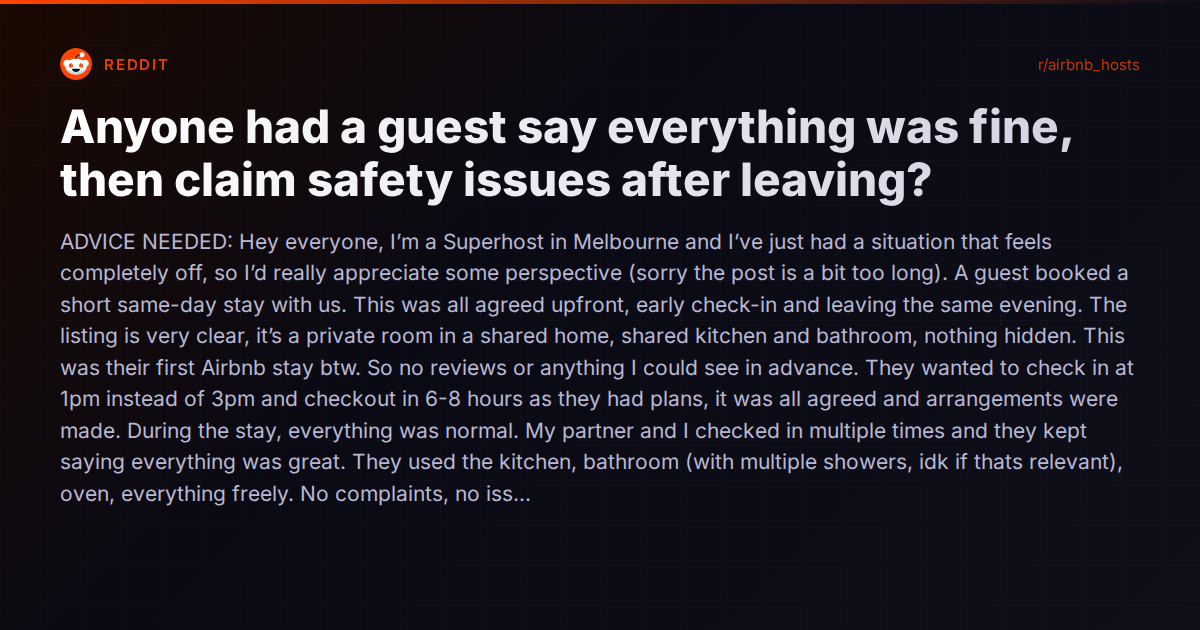
TL;DR: Superhost blindsided by a guest who claimed safety issues and left a damaging, personally attacking review after expressing zero complaints during the stay, and wants help escalating misleading reviews and protecting against post-checkout narrative flips.
There’s a pattern that experienced short-term rental hosts know all too well: a guest checks in, uses the space, says everything is wonderful, leaves cordially — and then, hours or even weeks later, files a complaint claiming safety issues, misrepresentation, or unsanitary conditions. The review that follows reads less like genuine feedback and more like a legal brief designed to justify a full refund.
This isn’t a one-off situation. It’s a recurring dynamic in short-term rentals, and it puts hosts in a difficult position. Let’s break down why it happens, what you can realistically do about it, and where technology can (and can’t) help.
The Pattern: Fine During, Furious After
A Melbourne Superhost recently shared a textbook case on Reddit. A first-time Airbnb guest booked a same-day stay in a private room within a shared home — everything clearly described in the listing. The guest checked in early by arrangement, used all the amenities, expressed satisfaction multiple times during the visit, and thanked the host warmly on departure.
Then, after checkout, things went sideways. The guest submitted a refund request citing safety issues and a “broken door” (there was no lock, which was disclosed in the listing). The review included personal attacks — words like “narcissistic” and “gaslighting” — framed in what other hosts in the thread described as a “performative, moral tone” designed to make the complaint sound grave. The guest’s story also shifted over time, with new complaints emerging weeks after the stay.
Airbnb’s support team called the host at 1 AM local time about a non-emergency situation where the guest had already checked out hours earlier, demanding a response within an hour.
As one commenter put it bluntly: “Sounds like a scammer looking for a free ride.”
Why This Keeps Happening
Several dynamics make this a systemic problem rather than just bad luck:
- Platforms incentivize guest complaints over host defenses. Airbnb and Booking.com have guest-friendly refund policies that treat safety claims with urgency. Guests have learned that invoking “safety” triggers a faster, more sympathetic response than saying “the Wi-Fi was slow.”
- First-time guests with no review history are a blind spot. Without a track record, hosts can’t assess risk. Several hosts in the thread noted they’ve stopped accepting bookings from guests with zero reviews or brand-new profiles, especially for short or same-day stays.
- Reviews are asymmetric weapons. A guest can leave a scathing public review containing personal attacks, and the host’s only recourse is a brief public response and a removal request that platforms rarely grant. One host noted: “Airbnb suuuuucks for removing reviews now.”
- There’s no real-time accountability window. If a guest doesn’t report an issue during the stay, there’s often no formal mechanism to hold them to that silence. The post-checkout complaint window is wide open.
What Platforms Actually Do (and Don’t Do)
Let’s be honest about what the major booking platforms offer here:
Airbnb has a review content policy that technically prohibits personal attacks, but enforcement is inconsistent. Hosts report that reviews containing words like “gaslighting” and “narcissistic” sometimes get removed and sometimes don’t. The appeal process is opaque. Airbnb’s safety claim investigation process tends to favor the guest’s account unless the host can provide strong counter-evidence.
Booking.com has its own version of this problem. Guests can leave reviews that don’t accurately reflect the stay, and the review removal process is similarly frustrating for property managers.
Neither platform has a built-in mechanism for documenting real-time guest satisfaction during a stay in a way that could later contradict a post-checkout fabrication.
Protecting Yourself: What Actually Works
Experienced operators have developed several practices to mitigate this risk. None of them are perfect, but layered together they create a meaningful defense:
1. Document Everything During the Stay
Send a mid-stay check-in message through the platform’s messaging system (not just in person). Something like: “Hey [Name], just checking in — is everything comfortable? Let me know if you need anything.” If the guest responds positively in writing, you now have timestamped evidence that contradicts any post-checkout claims.
This is where a unified messaging system matters. If your guest communications are scattered across Airbnb messages, WhatsApp, text, and in-person conversations, you’ll struggle to assemble a coherent record when you need one.
2. Use Guest Verification
Several property management platforms offer guest verification features that go beyond what Airbnb provides natively. Guesty offers GuestVerify with ID verification and background checks (advanced version currently US-only). Hospitable and Hostaway provide varying levels of guest screening through their platforms or integrations.
Vanio AI includes built-in guest verification with ID upload and selfie matching, plus house rules acknowledgment — all through a mobile-optimized guest portal that doesn’t require an app download. That house-rules acknowledgment step creates a documented record that the guest reviewed and accepted the listing’s conditions before check-in, which is exactly the kind of evidence you need if someone later claims misrepresentation.
3. Tighten Your Booking Requirements
Multiple hosts in the thread recommended not accepting same-day bookings from guests with no review history. You can enforce this through:
- Minimum advance booking windows (most PMS platforms and Airbnb’s native settings support this)
- Instant Book restrictions requiring guests to have at least one positive review
- Custom messaging rules that automatically ask new guests clarifying questions before confirming
4. Respond to Bad Reviews Strategically
When a review contains personal attacks but the platform won’t remove it, your public response becomes your defense. Keep it short, factual, and professional. Future guests reading the exchange will often side with the measured host over the overwrought reviewer.
Some PMS tools can help here. Vanio AI includes AI review analysis that categorizes issues, assesses sentiment, and drafts responses matching your tone — useful when you’re too frustrated to write something measured yourself. Guesty offers ReplyAI for guest communications, though its review management capabilities are more limited.
5. Build a Paper Trail with Smart Locks and IoT
If a guest claims they “had to check out early” due to safety concerns but your smart lock logs show they didn’t leave until the agreed time, that’s powerful evidence. Lock activity logs, noise monitoring data, and access code timestamps all create an objective record of what actually happened during a stay.
Most serious PMS platforms integrate with smart locks — Hostaway, Guesty, Lodgify, and others offer varying levels of lock integration. The key differentiator is whether those events appear in a unified timeline alongside messages and tasks, or whether you have to cross-reference separate systems to build your case.
The Bigger Picture: AI and Review Fraud Detection
The industry is slowly moving toward better tools for identifying suspicious review patterns. AI-driven review analysis can flag reviews where the sentiment dramatically contradicts the in-stay messaging record — exactly the scenario described above. If the guest’s messages during the stay say “everything is great” and the review says “felt unsafe from the moment I arrived,” that contradiction should be surfaced automatically.
This isn’t a solved problem yet. No platform or PMS tool currently offers a one-click “dispute this contradictory review” feature that reliably works. But the building blocks — unified message timelines, sentiment analysis, automated documentation — are increasingly available.
The Uncomfortable Truth
No amount of technology completely eliminates the risk of a bad-faith guest. Platforms have structural incentives to side with guests on safety claims, and review systems remain asymmetric. The best defense is layered: verification before check-in, documented communication during the stay, objective data from locks and sensors, and a calm public response after.
If you’re evaluating property management tools partly through the lens of dispute defense, pay attention to whether the platform creates a single, timestamped record of everything that happened during a reservation — messages, lock events, task completions, guest portal activity. When a guest tries to rewrite the story after checkout, you want the real story already assembled in one place.
For a broader comparison of how different platforms handle guest communication, verification, and review management, our comparison hub breaks down the specifics across the major tools.