Defending Against Fabricated Guest Complaints: What Experienced Hosts Actually Do
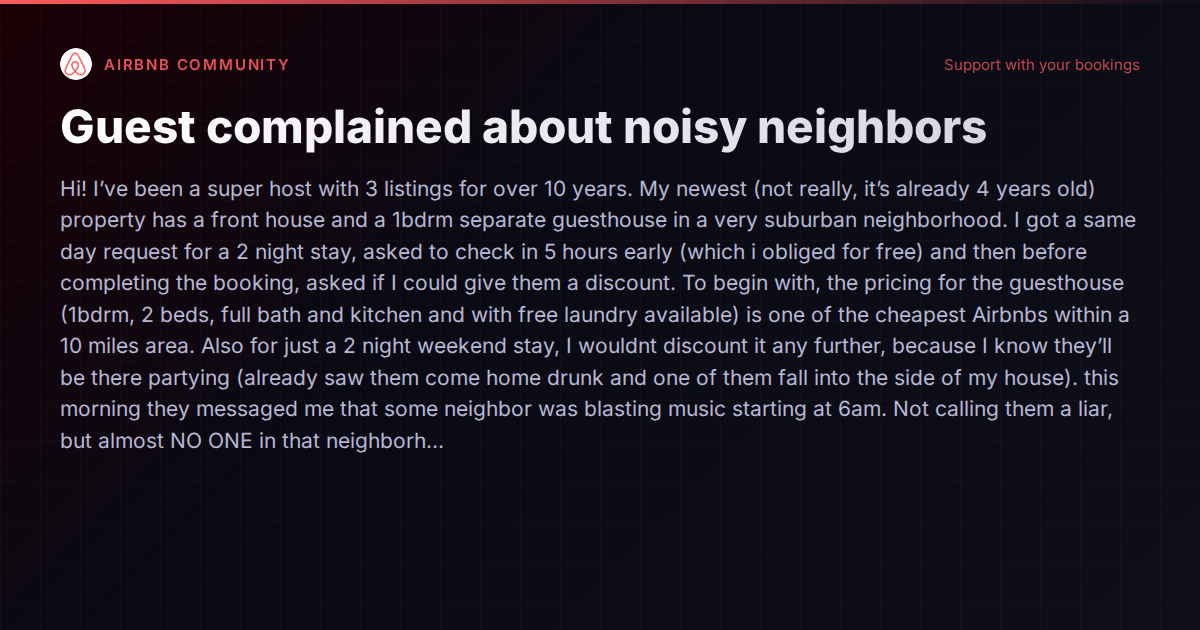
Airbnb Community
TL;DR: Experienced superhost anticipating a fraudulent refund claim from a guest fabricating a noise complaint, looking for strategies to defend against it.
A ten-year Superhost with three listings recently shared a scenario that most experienced operators will recognize instantly: a guest who negotiated for an early check-in, asked for a discount on an already competitively priced listing, and then filed a noise complaint that didn’t hold up under scrutiny — likely angling for a partial refund. The host had outdoor cameras showing no audible disturbance, the guest couldn’t identify which house the noise was supposedly coming from, and the neighborhood’s weekend rhythm didn’t match the timeline described.
This isn’t a one-off anecdote. It’s a pattern that plays out across Airbnb, Vrbo, and Booking.com thousands of times a month. And the hosts who handle it well aren’t the ones who panic — they’re the ones who’ve built systems that make fabricated claims hard to sustain.
The Anatomy of a Refund-Seeking Complaint
Experienced operators have learned to spot the behavioral pattern early:
- Pre-booking negotiation pressure. Same-day requests paired with discount asks and early check-in demands often signal guests who are optimizing for maximum value extraction — before, during, and after the stay.
- Vague, undocumentable complaints. “It’s just loud” with no ability to identify a source. No photos, no timestamps, no specific details. The complaint is designed to be impossible to verify or disprove.
- Silence after follow-up. When you offer a concrete path to resolution (“Give me the address and I’ll call the non-emergency line”), the guest goes quiet. They don’t want the problem solved; they want the refund.
- Timing. The complaint arrives midway through or near the end of the stay — after the guest has already consumed the value of the booking.
None of these behaviors are proof of fraud individually. But stacked together, they form a recognizable pattern that veteran hosts have learned to prepare for rather than react to.
The Documentation Game
The single most effective defense against fabricated complaints is contemporaneous documentation. If your evidence is stronger than the guest’s claim, platforms tend to side with you — though “tend to” is doing a lot of work in that sentence.
Here’s what matters:
Camera and Sensor Footage
Outdoor cameras with audio capture are the gold standard. The host in this case checked live camera feeds and heard nothing, which is exactly the right move. But “I checked and heard nothing” is weaker than “here’s the timestamped footage showing ambient silence at 6:15 AM.”
Noise monitoring devices — Minut, NoiseAware, Netatmo — add a data layer that cameras alone don’t provide. They log decibel levels continuously, creating a timestamped record that directly contradicts or confirms a noise claim. If a guest says music was blasting at 6 AM and your noise sensor shows 35 dB (roughly the level of a quiet room), that’s a hard claim to sustain.
Messaging Records
Every exchange should happen on-platform. The host here did the right thing by asking the guest to identify the noise source via Airbnb messages — that creates a record of the guest’s inability or unwillingness to substantiate the claim. Never move dispute-related conversations to phone calls or WhatsApp where they become he-said-she-said.
Listing Accuracy
The host mentioned that their listing explicitly describes a suburban neighborhood with families and businesses — not a quiet countryside retreat. This matters. Platforms evaluate complaints against what was promised, not against the guest’s unstated expectations. If your listing says “lively neighborhood” and a guest complains about noise, the complaint has less weight.
How PMS Tools Help (and Where They Don’t)
Most property management platforms offer some combination of automated messaging, noise monitoring integration, and guest communication logging. But the depth varies significantly.
Guesty integrates with noise monitoring tools and provides a unified inbox that keeps all guest communication in one place, which helps with documentation. Their guest verification (GuestVerify) can add a pre-booking screening layer, though it won’t catch a guest who passes verification and still files a fabricated complaint.
Hospitable focuses heavily on automated messaging workflows. You can set up pre-arrival messages that reinforce listing descriptions (“Just a reminder — our neighborhood is a lively suburban area”) which creates documentation that the guest was informed before arrival. Their smart device integrations include compatible thermostats but noise monitoring support is more limited.
Hostaway offers AI-powered automated replies and a unified inbox consolidating messages from Airbnb, Vrbo, Booking.com, email, SMS, and WhatsApp. The SLA tracking can help ensure you respond promptly to complaints — platforms penalize hosts who ignore guest concerns, even fabricated ones.
Vanio AI takes a different approach by integrating noise sensors (Netatmo, Minut, NoiseAware) directly into its core platform, logging decibel readings alongside the reservation timeline. When a guest files a noise complaint, the AI agent can cross-reference the claim against actual sensor data in the same system — no toggling between apps. The AI can also be set to Defend Mode for firm, policy-first communication when dealing with guests who appear to be angling for unwarranted refunds. Everything — messages, sensor data, camera events, guest history — lives in one timeline, which makes assembling evidence for a platform dispute significantly faster.
The Pre-Booking Filter
Several commenters on the original thread pointed out that this guest showed red flags before the booking was even confirmed: same-day request, early check-in demand, discount negotiation. One experienced host put it bluntly — this was the kind of guest who should never have been accepted.
That’s easy to say in hindsight, but it raises a real operational question: how do you filter without losing legitimate bookings?
A few approaches that work:
- Require verified profiles. Most platforms let you require government ID verification before accepting bookings.
- Set minimum-stay requirements for weekends. A three-night minimum on weekends filters out a surprising number of problematic bookings.
- Use pricing strategically. The host in this case was already priced competitively. Sometimes pricing slightly higher and offering periodic promotions attracts a different guest profile than being the cheapest option in the area.
- Review guest history. Guests with multiple negative reviews from hosts are visible on Airbnb. Take the thirty seconds to check.
None of these are foolproof, and aggressive filtering has a real cost — empty nights. The balance is personal and depends on your market, your risk tolerance, and how much you trust your documentation systems to protect you after the fact.
When the Refund Request Actually Comes
If the guest does file for a refund through the platform, here’s the playbook:
- Respond promptly and factually. Don’t accuse the guest of lying. Present your evidence: sensor data, camera footage, messaging records, listing description.
- Highlight what you offered. “I asked the guest to identify the source so I could contact authorities. They were unable to do so and did not respond to my follow-up.”
- Reference your listing description. “My listing clearly describes a suburban neighborhood. No claims of a quiet or secluded environment were made.”
- Don’t offer a preemptive refund. Some hosts try to get ahead of a bad review by offering a partial refund. This trains the behavior. If the complaint is fabricated, let the platform adjudicate.
The Honest Trade-Off
No tool or strategy eliminates this problem entirely. Platforms have a structural incentive to keep guests happy, which means hosts sometimes lose disputes they should win. Noise sensors and cameras shift the odds in your favor, but they’re not guarantees.
The hosts who handle this best are the ones who treat documentation as a routine operational practice — not something they scramble to assemble after a complaint arrives. Whether you’re using a full PMS platform or managing with spreadsheets and calendar apps, the principle is the same: if it’s not logged, it didn’t happen.
For a broader look at how different platforms handle guest disputes, noise monitoring, and automated documentation, the comparison hub at /compare/ breaks down the specifics across 25+ tools.