Building a System That Wins Guest Disputes Before They Start
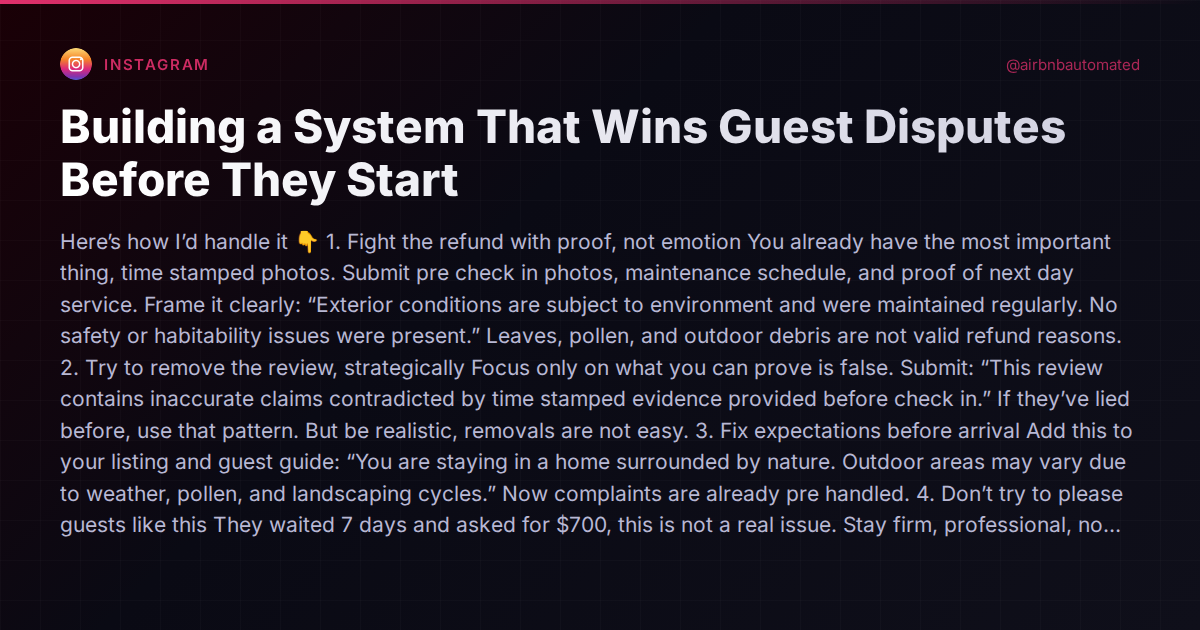
TL;DR: Host advises fighting unfair guest refund requests and bad reviews by building systematic protections like timestamped photos, disclaimers, and pre-arrival messaging into the hosting workflow.
A guest checks out after a week-long stay. Seven days later, they file a complaint about leaves on the patio and request a $700 refund. You have timestamped photos from before check-in showing the property in good condition. You have maintenance logs. You have evidence. And yet, the outcome still feels uncertain — because the platform’s resolution process doesn’t always reward the host with the better documentation.
This scenario plays out constantly across short-term rental operations. One host on Instagram laid out a detailed playbook for handling it: fight refunds with evidence not emotion, attempt strategic review removal, set expectations before arrival, and build protection into every touchpoint. The advice is solid. But the more interesting question isn’t how to win a single dispute — it’s how to build systems that make these disputes rare, and winnable by default when they do happen.
The Real Cost Isn’t the $700
The direct financial hit of a frivolous refund request matters, but it’s rarely the biggest cost. The real damage comes from three things:
- Time spent responding — drafting appeals, pulling photos, writing measured responses when you’d rather be doing anything else
- The review that lingers — even if you win the refund fight, the one-star review stays visible for months
- The operational doubt — hosts start second-guessing their own standards, over-investing in minor cosmetic details, or worse, delisting properties entirely
As one operator put it bluntly in response to the Instagram post: the fact that you have to deal with this “almost weekly” pushed them to unlist four units. That’s real revenue lost — not to bad guests, but to the friction of managing disputes without adequate systems.
Another commenter shared an even more extreme example: they denied a 75% refund, the guest called the platform two weeks later claiming someone had entered the apartment during their stay. The host provided Ring doorbell footage and door access logs proving the claim was fabricated. The platform still noted a violation on their account. Evidence doesn’t always guarantee the right outcome, but operating without it guarantees the wrong one.
Disclaimers Are Necessary but Not Sufficient
The Instagram advice to add nature-related disclaimers to your listing and guest guide is sound:
“You are staying in a home surrounded by nature. Outdoor areas may vary due to weather, pollen, and landscaping cycles.”
This kind of expectation-setting is table stakes. But disclaimers only work if guests actually read them — and if you can prove they were sent. A line buried in your listing description isn’t the same as a message delivered to the guest’s inbox three days before check-in, acknowledged in a guest portal, or embedded in a pre-arrival workflow that fires automatically.
The difference between a disclaimer and a system is automation. A system sends the right message at the right time, logs that it was delivered, and creates a paper trail you can reference later. A disclaimer is just text on a page that a guest can claim they never saw.
What a Dispute-Ready Operation Actually Looks Like
The operators who consistently win disputes aren’t doing anything exotic. They’ve just automated the boring stuff so nothing falls through the cracks:
- Pre-arrival messaging with property-specific disclaimers — triggered automatically based on the property type, season, or local conditions
- Timestamped photo documentation — taken by cleaning staff as part of their turnover checklist, uploaded before the guest arrives
- Access logs — smart lock records showing exactly who entered and when, corroborating or refuting guest claims
- Guest portal acknowledgment — house rules, property guides, and expectations delivered through a portal the guest interacts with before or at check-in
- Automated review management — requesting reviews from happy guests promptly so one bad review doesn’t define your profile
None of these elements are revolutionary on their own. The challenge is making them happen consistently across every property, every turnover, every guest — without relying on manual follow-through.
How the Tools Handle This
The PMS market has evolved significantly around dispute prevention, though the approaches vary.
Hostaway offers automated messaging templates and a unified inbox that can help with pre-arrival communication. Their automation triggers can send check-in messages with house rules and expectations on a schedule. For operators who primarily need templated messaging workflows, it’s a mature option — though the evidence-gathering side (photos, lock logs, cleaning verification) typically requires additional integrations.
Guesty takes an enterprise approach with GuestVerify for screening and damage protection built into their platform. Their AI messaging tool, ReplyAI, handles automated responses and sentiment analysis, which can help de-escalate situations before they become disputes. For larger operations that can invest in the platform’s full ecosystem, it provides substantial infrastructure.
Hospitable is strong on the automated messaging front — their system recognizes common guest questions and sends tailored replies using reservation details. Their task management features help coordinate cleaning teams, though photo verification and smart lock integration depend on your specific setup. For hosts who want messaging automation without enterprise complexity, it’s worth evaluating.
Lodgify focuses more on the direct booking and channel management side. It’s less oriented toward the operational evidence-gathering that wins disputes, but its booking management and real-time sync capabilities form a solid foundation.
Where things get more interesting is when the AI layer has native access to the full operational stack. Vanio AI takes this approach — the AI agent sits on top of reservations, smart lock data, cleaning task records, guest messaging, and the knowledge base in a single system. When a guest claims something happened during their stay, the system already has the lock access logs, the cleaner’s timestamped photos (verified through AI photo inspection), the pre-arrival messages that were sent, and the guest portal interaction history. The AI can surface this evidence or even draft a dispute response using it. Vanio AI’s Operations Watchdog also runs daily automated checks across smart locks, cleaning status, and guest verification — catching gaps before they become liability.
The architectural difference matters here: when your messaging tool doesn’t know what your lock system recorded, and your cleaning app doesn’t know what your guest portal displayed, assembling evidence for a dispute becomes a manual scavenger hunt across multiple dashboards. A unified system eliminates that friction.
The Review Problem Is Harder Than the Refund Problem
Even with perfect documentation, review removal on platforms like Airbnb remains difficult. The advice to focus only on provably false claims is correct — vague complaints about “cleanliness” or “condition” rarely meet the threshold for removal. But a guest claiming “someone entered during our stay” when you have lock logs proving otherwise? That’s a factual dispute worth pursuing.
The more practical long-term strategy is volume dilution: make sure satisfied guests leave reviews consistently. Automated review request workflows — timed to fire when the guest is most likely to respond positively — are one of the few reliable ways to keep your rating resilient against the occasional bad-faith complaint. Most PMS platforms offer some version of this; the key is actually turning it on and letting it run.
The Bottom Line
The Instagram host’s advice — fight with evidence, set expectations, don’t overreact — is correct as far as it goes. But it’s reactive. The operators who rarely find themselves in these fights have built systems where:
- Every property has automated pre-arrival messaging with relevant disclaimers
- Every turnover produces timestamped, photo-verified evidence of property condition
- Every guest interaction is logged in a single timeline
- Every smart lock event is recorded and accessible
- Every satisfied guest is prompted to leave a review
The tools to build this exist across the market at various price points and complexity levels. The choice comes down to whether you want to assemble it from parts or run it as a single system. Either way, the time to build the system is before the next guest files a complaint — not after.
For a closer look at how different platforms handle these operational workflows, the comparison hub breaks down the specific capabilities side by side.