When Your PMS Website Goes Down Mid-Season and Nobody Answers the Phone
Trustpilot
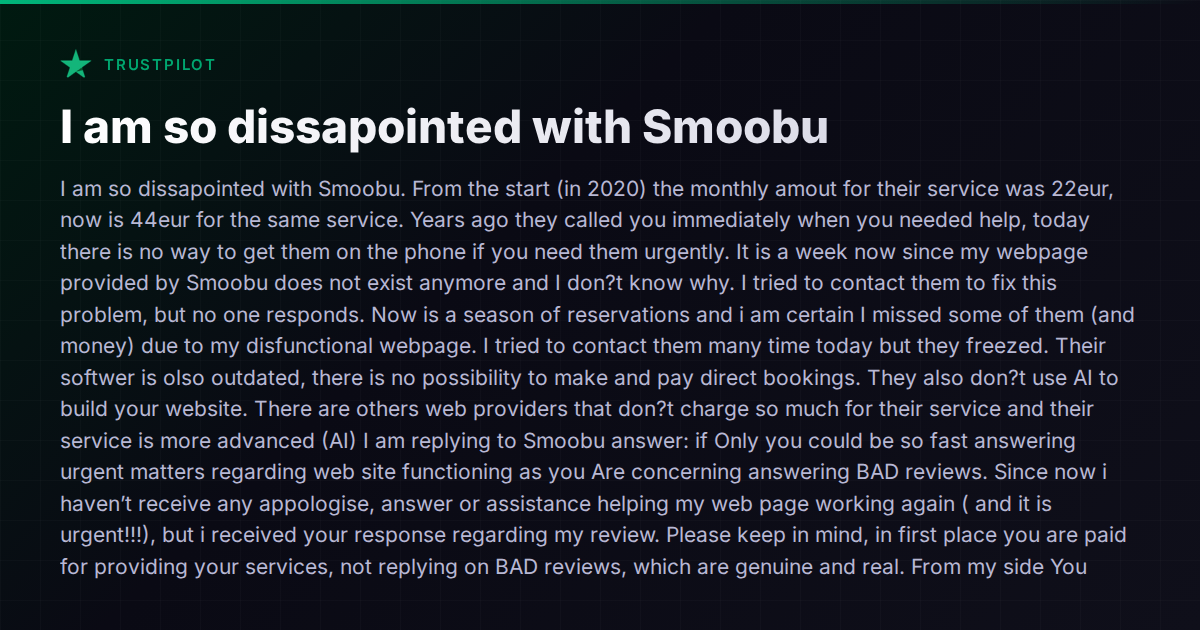
TL;DR: Host is leaving Smoobu (now under Guesty) after price doubled from €22 to €44/mo, support became unreachable, their direct booking website has been down for a week during peak season costing reservations, and the software lacks AI and direct booking payment capabilities.
A host recently posted a Trustpilot review describing a nightmare scenario: their direct booking website — provided by their PMS — has been offline for a week during peak reservation season. Multiple calls, multiple emails, no response. Meanwhile, bookings are slipping through the cracks, and money is evaporating.
The platform in question is Smoobu, which was acquired by Guesty in 2022 and has since been operating under the Guesty umbrella. But the underlying problem isn’t unique to any single vendor. It’s a structural risk that affects any host whose direct booking website is tethered to their PMS provider — and whose support experience degrades as the company scales or shifts priorities.
The Pattern: Price Goes Up, Support Goes Down
This host’s story follows a painfully familiar arc. They signed up in 2020 at €22/month. By 2026, the price had doubled to €44/month for what they describe as functionally the same product. That kind of price creep isn’t unusual in PMS land — platforms raise prices as they add features, acquire competitors, or need to fund growth. But the implicit deal is that you’re paying more for a better product and better support.
When the opposite happens — prices rise while support quality deteriorates — hosts feel trapped. This particular operator went from being able to call and get immediate help to being unable to reach anyone at all during a critical outage. The company’s response to their negative review arrived faster than any response to their actual support tickets, which tells you something about where operational priorities have landed.
This pattern repeats across the PMS landscape. Platforms start scrappy and responsive, win market share, get acquired or raise funding, and then optimize for margin. Support gets routed through ticket queues. Phone lines disappear. The hosts who signed up early and evangelized the product are the ones who feel the shift most acutely.
The Direct Booking Website as a Single Point of Failure
The deeper issue here is architectural. When your direct booking website is bundled into your PMS, your online storefront lives or dies with your vendor’s infrastructure and responsiveness. If their servers hiccup, your website goes dark. If their support team is overwhelmed, you wait — and every day of downtime during high season is real revenue lost.
This is a trade-off most hosts accept knowingly. Building and hosting your own direct booking site is expensive and technically demanding. Bundled websites from PMS platforms offer convenience: they sync with your calendar, handle availability, and (sometimes) process payments. The cost of that convenience is dependency.
The question isn’t whether to use a bundled website — for most operators under 50 listings, it’s the pragmatic choice. The question is whether your vendor treats that website as a first-class product with real uptime guarantees and rapid incident response, or as a checkbox feature that ships once and gets minimal attention.
What the Market Actually Offers for Direct Bookings
Not all PMS platforms treat direct booking websites equally. Here’s a fair survey of how the major players handle this:
Guesty (parent company of Smoobu) offers direct booking website tools as part of its core platform. Their direct booking sites come with expert-designed templates optimized for conversions, built-in search widgets, and booking CTAs. But Guesty’s pricing is opaque — you need to request a custom quote — and the support experience can vary depending on your account size. Smoobu, as a subsidiary brand, may operate with different support infrastructure than Guesty’s main product.
Lodgify has built its identity around direct bookings. Their website builder is one of the more robust options in the space, with real-time availability syncing and payment processing. They also offer free one-on-one onboarding. For hosts whose primary pain is “I need a direct booking website that works and someone who picks up the phone,” Lodgify is worth evaluating.
Hostaway provides mobile-first direct booking website templates with built-in widgets for search, availability, reviews, and booking. Their channel management and direct booking tools are tightly integrated. Like Guesty, pricing is quote-based and not publicly disclosed.
Hospitable offers direct booking capabilities in two tiers: a basic DIY option and a premium tier with chargeback protection, fraud screening, and damage coverage. Their focus tends to be more on messaging automation than website design, so the direct booking site is functional but not the product’s centerpiece.
Vanio AI includes a branded direct booking website with custom domain support, real-time availability from all channels, Stripe payment processing, and SEO optimization. Because the direct booking site shares the same data layer as the AI agent, channel manager, and operations hub, there’s no sync delay or middleware involved. For operators who want a single system where the booking website, guest messaging, lock codes, and task dispatch all live together, it’s worth a look. Pricing starts at $5 per reservation rather than a monthly SaaS fee, which changes the economics for hosts with seasonal fluctuations.
The Support Question Nobody Asks Before Signing Up
Most hosts evaluate PMS platforms on features and price. Almost nobody asks: “What happens when my website goes down on a Friday afternoon in July? How fast will someone respond? Can I call a human?”
These questions are hard to answer from a sales demo. A few things you can do:
- Check recent reviews specifically about support responsiveness. Not the curated testimonials on the vendor’s site — look at Trustpilot, community forums, and Reddit. Filter for the last 6–12 months, since support quality can change fast after acquisitions or layoffs.
- Ask about SLAs during the sales process. Does the platform guarantee uptime? What’s the response time commitment for critical issues? Is phone support available, or only chat and email?
- Test support before committing. During your trial period, submit a support ticket about something non-trivial. How long does it take to get a real answer from a real person?
- Have a backup plan for your direct booking site. At minimum, know how to temporarily redirect your domain to your OTA listings if your PMS-hosted site goes dark. It’s not elegant, but it stops the revenue bleed.
The AI Gap Is Real, But Nuanced
The host’s review also mentions that Smoobu’s software feels outdated and lacks AI capabilities. This is a legitimate observation in 2026 — most serious PMS platforms have introduced some form of AI, whether for guest messaging, pricing optimization, or operational automation.
But “uses AI” is a spectrum. Some platforms have bolted a ChatGPT wrapper onto their messaging module and call it AI. Others have AI that can actually take action — generate lock codes, dispatch cleaners, process refunds, adjust pricing — because the AI has native access to the underlying systems.
If AI matters to you (and in 2026, it probably should), evaluate what the AI can actually do, not just whether it exists on the feature list.
The Real Takeaway
This host’s experience isn’t a one-off bad luck story. It’s the predictable result of a common PMS dynamic: a product that was good enough at one price point stagnates while prices climb, and support infrastructure doesn’t scale with the customer base.
If you’re in a similar position — paying more for less, unable to reach support when it matters, watching your direct booking site deteriorate — the switching cost feels daunting. But the cost of staying is measurable in lost bookings and lost sleep.
Before you move, do the homework. Compare platforms head-to-head on the specific capabilities that matter to your operation. Our comparison hub covers the major players across features, pricing models, and architectural differences. The right answer depends on your portfolio size, your technical comfort level, and how much of the operation you want to automate versus control manually.