Direct Booking Sites for Small STR Portfolios: When the Math Works and When It Doesn't
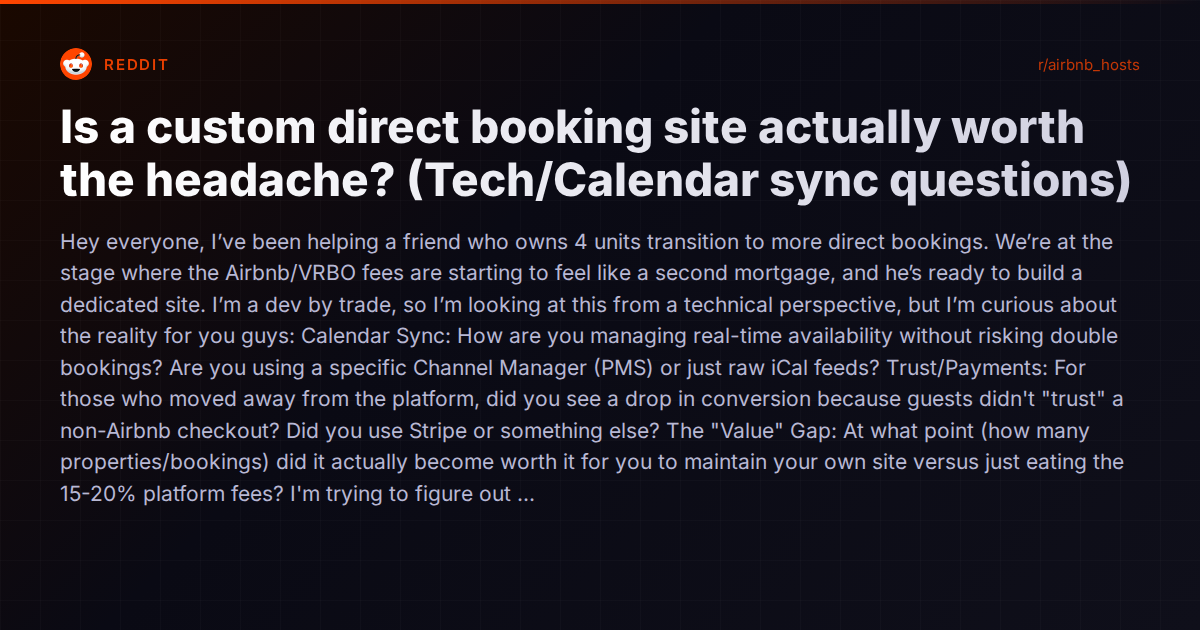
TL;DR: A developer helping a 4-unit host build a direct booking site to escape 15-20% OTA fees, but worried about calendar sync, payment trust, and whether it's worth the setup headache.
A developer recently posted on Reddit about helping a friend with four units build a direct booking website. The motivation was familiar: OTA fees running 15–20% per booking feel like a “second mortgage.” The questions were sharp — how do you handle calendar sync without double bookings, how do you earn guest trust outside Airbnb’s checkout flow, and at what scale does maintaining your own site actually pencil out?
The thread that followed was unusually candid. It’s worth unpacking because most direct-booking advice online comes from people selling direct-booking tools.
The Real Problem: iCal Is Not Real-Time
Calendar synchronization is the first technical obstacle every direct-booking operator hits, and it’s the one most underestimated by developers who assume they can solve it in a weekend.
iCal feeds — the standard way platforms share availability — update on a polling interval, typically every few hours. That creates a double-booking window. One commenter described going with a “simpler approach” for their small portfolio: treating the direct booking site as the source of truth and manually blocking dates on Airbnb. “Not elegant, but for 4 units it works and avoids the monthly channel manager fee.”
Another commenter pushed back: “the manual approach works until it doesn’t, and at 4 units you’re probably right at the edge where the time spent blocking dates starts to add up.”
This is the core tension. For 2–3 units with low booking velocity, manual calendar management is tedious but survivable. At 4+ units, especially during high season when bookings cluster, the probability of a costly overlap rises meaningfully. The fix is a channel manager with real API connections — not iCal polling — to Airbnb, VRBO, and Booking.com.
Several commenters noted you should still enforce a hard backend constraint: don’t confirm a direct booking until you re-check availability programmatically, even with a channel manager running. Belt and suspenders.
Trust: The Underrated Conversion Killer
The original poster asked about payment trust, and the thread surfaced a nuance that matters more than most hosts realize: the trust gap isn’t about the payment processor. Stripe Checkout, with its recognizable branding and card logos, solves the “is my credit card safe” question adequately. The real trust gap is everything around it.
One commenter framed it well: “real trust boosters are: clear cancellation policy, real contact info, an address map… the boring stuff.” Another suggested PCI-compliance badges and merchant-of-record indicators, but then added what’s arguably more effective for small operators — an “about you” section with actual photos of you working on the properties. At four units, you’re not a faceless corporation; lean into that.
A separate commenter raised a concern that rarely gets enough attention: “The part I’ve hesitated on for direct booking has always been around the identity verification, guest reviews, and setting up/signing the rental contract terms.” This is Airbnb’s actual value proposition at this point — not the booking engine, not the payment processing, but the identity layer and the review ecosystem. Without it, you’re flying blind on who’s booking your property.
The Discoverability Question Nobody Wants to Hear
One of the sharpest comments in the thread came from someone addressing the developer directly: “If you’re a dev by trade, I’m surprised you don’t seem aware of the difficulty in merely making a direct booking site visible in the first place.”
This is the uncomfortable truth about direct booking. Building the site is the easy part. Getting qualified traffic to it is the hard part, and it’s getting harder as AI-generated search results reshape how travelers discover accommodation.
Direct booking sites work best for repeat guests — people who’ve already stayed with you through an OTA and now book directly to save the guest-side service fee. Multiple commenters echoed this: “Direct booking is great for repeat guests. It should grow organically.” That’s honest advice. If you’re imagining a direct site as a customer acquisition channel competing with Airbnb’s SEO budget, recalibrate.
The ROI framing that resonated most in the thread: saving 15% on even one fringe-season booking that would have otherwise gone vacant can pay for your tech stack for the year. The direct site isn’t replacing OTAs — it’s capturing the margin on guests who already know you.
Build vs. Buy: The “It Turned Into Weeks” Problem
One commenter who went the custom-build route admitted: “I went down a similar rabbit hole thinking I’d just spin something up in a weekend and it turned into weeks real quick.” This matches what most developers discover. The booking engine itself is straightforward. The calendar sync, payment handling, email confirmations, cancellation logic, tax calculation, guest communication, and mobile responsiveness compound into a project that’s more SaaS product than weekend hackathon.
For a four-unit portfolio, the options roughly break down like this:
Custom build: Full control, no monthly fees, but significant upfront dev time and ongoing maintenance. Realistic only if you (or your dev friend) genuinely enjoy maintaining a side project indefinitely.
PMS with built-in direct booking site: Most property management platforms now include a direct booking website as part of the package. This is the path of least resistance for most operators. The site won’t win design awards, but it handles calendar sync, payments, and availability natively because it’s the same system managing your OTA channels.
Template/builder tools: Services like Boostly, Craftedstays, and others generate direct booking sites quickly, sometimes from your existing Airbnb listing. These get you live fast but vary in how deeply they integrate with your calendar and payment stack.
How the Major Platforms Handle This
If you’re already evaluating a PMS, it’s worth understanding what the direct booking site looks like across the main options:
Lodgify has historically made direct booking websites a central feature — it’s arguably where they started before expanding into broader PMS functionality. If a direct site is your primary concern and you want a polished, SEO-oriented booking website, Lodgify is worth evaluating.
Hostaway includes a direct booking website builder with mobile-first templates and built-in widgets (search, availability, reviews). It’s designed more for operators who want a functional site without touching code.
Hospitable offers two tiers of direct booking: a basic DIY option (you handle taxes and chargebacks) and a premium option that includes tax calculation, chargeback protection, and damage coverage. The tiered approach is honest about the complexity gap between “having a site” and “running a real booking operation.”
Guesty supports direct bookings as part of its broader enterprise-oriented platform, though it’s likely overkill for a four-unit portfolio given its positioning toward larger operators.
Vanio AI includes a direct booking website builder (custom domain, real-time availability sync, Stripe payments, SEO optimization with server-side rendering) as part of its core platform. Because it’s the same system handling your OTA channels, AI messaging, and guest verification, there’s no sync gap to manage — the direct site reads from the same calendar and guest database as everything else. The built-in guest verification (ID upload, selfie matching) addresses that trust and identity concern raised in the thread without requiring a third-party tool. For operators who want the direct site plus the operational infrastructure behind it in one system, it’s a legitimate option.
The Honest Math for Four Units
Here’s how to think about this without kidding yourself:
- Average booking value: $1,000 (adjust for your market)
- OTA commission saved per direct booking: ~$150 (15%)
- Direct bookings you’ll realistically capture in year one: Mostly repeat guests. Optimistically, 10–20% of your total bookings.
- Cost of the tech stack: $50–200/month depending on your PMS, or $0/month if custom-built (but count your dev hours honestly)
At four units doing maybe 150 bookings per year, if 20 of those go direct, you’re saving roughly $3,000 annually. That comfortably covers a PMS subscription. It does not cover the opportunity cost of a custom build unless you value your development time at very little.
The calculus changes meaningfully at 10+ units, or when your repeat guest rate climbs, or when you start capturing Google search traffic in a niche market.
Where to Dig Deeper
If you’re evaluating PMS options with direct booking built in, most of the platforms above publish feature comparisons on their sites. Lodgify’s website builder documentation is worth reading if the direct site is your primary driver. Hospitable’s direct booking tiers are clearly documented and transparent about what you’re responsible for at each level. Vanio’s direct booking website docs cover the technical specifics of their implementation, and their comparison pages offer candid side-by-side breakdowns against alternatives.
The thread’s best advice came from the commenter who said to focus on SEO for your direct site descriptions and lean into the personal trust signals that OTAs can’t replicate. A direct booking site isn’t a replacement for Airbnb. It’s a margin-capture tool for the guests who already trust you.