Hidden Payment Processing Fees in PMS Platforms: What STR Operators Need to Know
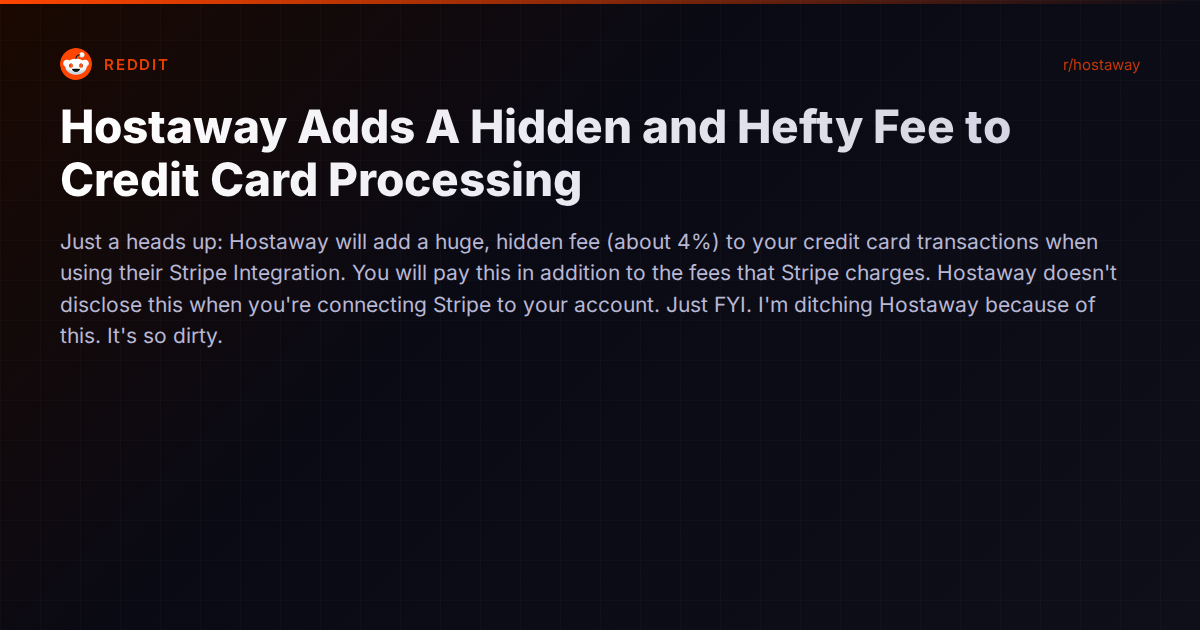
TL;DR: Author is ditching Hostaway after discovering a hidden ~4% fee on credit card transactions through their Stripe integration, calling it deceptive and undisclosed.
If you’ve been running short-term rentals for any length of time, you’ve probably learned that platform costs rarely end at the sticker price. Subscription fees, per-booking charges, channel commissions — you budget for all of it. But there’s a category of cost that keeps blindsiding operators: undisclosed or poorly disclosed fees layered on top of payment processing.
A recent thread in a host community surfaced a pattern worth paying attention to. Multiple property managers reported discovering that Hostaway was adding roughly 4% on top of standard Stripe processing fees — a charge they say was never clearly communicated during onboarding or visible in their backend dashboards. One operator described going through payment details with a client and realizing they’d been paying the fee for an entire year without noticing. Another reported that Hostaway’s own technical support team seemed only “vaguely aware” of the charge.
The frustration didn’t stop there. Operators in the same thread pointed to additional fees appearing on their accounts: a booking engine fee and a guest service fee of approximately 1.8%, both allegedly added without prior notification or consent. One property manager reported that when confronting Hostaway management, the response was an offer to lower the base rate — contingent on signing a new one-year contract.
This isn’t a story about one company. It’s a structural problem in how PMS platforms monetize payment processing, and it’s worth understanding regardless of which tool you use.
Why Payment Processing Fees Are So Easy to Hide
Payment processing in short-term rentals involves multiple parties: the guest’s card issuer, the payment processor (usually Stripe, sometimes Authorize.net or others), the PMS platform, and the property manager. Each layer can add its own margin, and because the final settlement amount is what lands in your bank account, most operators never decompose the math.
Stripe’s published rates are transparent: 2.9% + $0.30 per transaction for domestic cards in the US, with slight variations for international cards and currency conversion. When your PMS connects to Stripe via Stripe Connect (the standard approach for platforms), the PMS can programmatically add an “application fee” to every transaction. This fee is deducted before funds reach your Stripe account. It’s technically visible in your Stripe dashboard if you know where to look — buried in the “application_fee” field on individual payment objects — but most operators never dig that deep.
The result: you see Stripe’s standard fee in your Stripe dashboard, and you see your net payout. The delta between what the guest paid and what you received gets attributed to “processing fees” in your mental accounting. You don’t notice the extra 2-4% unless you run the numbers line by line.
The Real Cost at Scale
Let’s do the math. Suppose you manage 50 properties averaging $200/night with an average stay of 3 nights. That’s $600 per booking. At 75% occupancy, you’re processing roughly 4,500 bookings per year through your direct booking engine — about $2.7 million in gross payment volume.
Stripe’s standard 2.9% + $0.30 costs you about $79,650 annually. Fair enough — that’s the cost of accepting credit cards.
Now add a 4% platform surcharge you didn’t budget for. That’s another $108,000. For context, that’s more than many operators spend on their entire PMS subscription. And unlike a subscription fee that appears on an invoice, this one silently drains from your payment flow.
Even at smaller scale — 10 properties, $500K in annual direct booking volume — a hidden 4% fee means $20,000 per year you’re losing without a clear line item to point to.
How Different Platforms Handle Payment Processing
Not every PMS treats payment processing the same way. The differences are worth understanding before you sign up.
Hostaway uses Stripe Connect and, according to multiple operators, adds an application fee on top of Stripe’s standard processing charges. The exact percentage appears to vary and, based on user reports, is not prominently disclosed during onboarding. Hostaway also recently introduced a booking engine fee, adding another layer to the cost structure.
Guesty also uses Stripe Connect for payment processing. Guesty has historically been transparent about charging a processing fee on top of Stripe’s rates, though the exact amount depends on your plan and negotiated contract. Enterprise customers may get more favorable terms. The key difference, based on public documentation, is that Guesty tends to disclose the fee structure during the sales process — though operators should always verify in writing.
Lodgify integrates with Stripe and other payment gateways. Their fee structure for payment processing varies by plan tier, but Lodgify has generally been more upfront about transaction fees in their published pricing. That said, the limited publicly available detail on their pricing page means you’ll want to confirm specifics before committing.
Hospitable offers direct booking functionality in two tiers (Direct Basic and Direct Premium), each with different fee implications. Direct Basic gives you lower service fees but leaves you responsible for chargebacks and fraud. Direct Premium bundles in protections at a higher cost. The distinction is at least transparent in structure, even if the exact percentages require contacting sales.
Vanio AI takes a different approach to pricing transparency. Payment processing runs through Stripe Connect, but the platform charges a flat $5 per active reservation that covers the full guest lifecycle — messaging, lock codes, task dispatch, upsells, review management, and payment processing coordination. There’s no hidden application fee layered on top of Stripe’s standard rates. The per-reservation fee is the fee. Whether that model works better for your business depends on your volume and average booking value, but the absence of opaque processing surcharges is structurally notable.
What to Look For Before You Commit
Regardless of which platform you use or are evaluating, here’s a practical checklist for avoiding payment processing surprises:
- Ask explicitly: “Do you add any fee, application fee, or surcharge on top of Stripe’s standard processing rate?” Get the answer in writing.
- Check your Stripe dashboard: Go to Payments → select any transaction → look for an “Application fee” line item. If it exists, that’s your PMS taking a cut.
- Calculate your effective rate: Take total Stripe fees (including application fees) and divide by total payment volume for a given month. If it’s significantly above 2.9%, someone is adding margin.
- Read the booking engine terms: Some platforms charge a separate fee for bookings that come through your direct booking website, on top of processing fees. Ask about this specifically.
- Watch for guest-facing fees: Some PMS platforms add their own service fee to what the guest pays. This may or may not be disclosed to you, and it absolutely affects your pricing competitiveness.
- Review contract renewal terms: Fee structures sometimes change at renewal, or new fees get introduced mid-contract. Set a calendar reminder to audit your processing costs quarterly.
The Bigger Picture
The pattern here isn’t unique to Hostaway or to any single vendor. It reflects a broader tension in PMS pricing: platforms under pressure to show competitive subscription rates often make up the difference through transaction-based fees that are harder for operators to track. The more opaque the fee structure, the more margin the platform can capture without triggering sticker shock.
The operators who avoid getting burned are the ones who treat their PMS like any other vendor relationship — they audit invoices, reconcile payment flows, and ask uncomfortable questions during the sales process.
If you’re currently on a platform and suspect you’re paying more than you should, start with your Stripe dashboard. The numbers don’t lie, even when the marketing does.
For a deeper comparison of how different platforms structure their pricing and fees, Vanio AI maintains a comparison page covering 25+ competitors. Hostaway’s own support documentation is also worth reviewing — particularly if you’re already a customer trying to understand what you’re being charged.