Hidden Fees, Confusing Payments, and the Trust Gap in Property Management Platforms
Trustpilot
TL;DR: Host experienced confusing multi-channel payment instructions from Guesty, hidden extra taxes on Booking.com deducted from deposits, and dishonest communication from Guesty representatives when escalating the issue.
When you run a short-term rental business, you expect your property management software to simplify money — not make it harder to track. Yet a recurring theme across host communities and review sites in 2026 is operators discovering charges, taxes, or fee structures they didn’t anticipate, delivered through communication channels that feel disjointed and, at times, outright misleading.
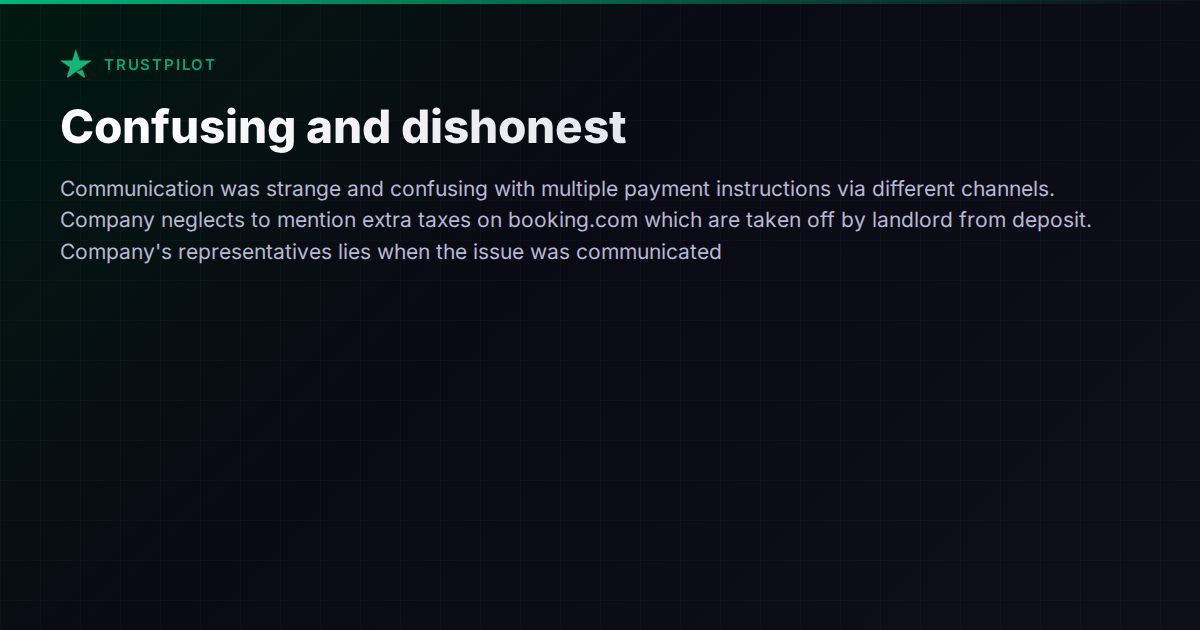
A recent Trustpilot review of Guesty captures the frustration well: the host described receiving “confusing and multiple payment instructions via different channels,” only to discover that extra taxes on Booking.com bookings were being deducted from the landlord’s deposit — something Guesty’s platform apparently hadn’t made clear upfront. When the host raised the issue, they felt the company’s representatives were dishonest in their response.
This is not a one-off grievance. It points to three systemic problems worth examining: opaque tax and fee handling, fragmented payment communication, and what happens when trust breaks down between a PMS vendor and its users.
The Tax Transparency Problem
Booking.com’s fee structure is notoriously complex. The platform charges commissions, applies local tax regulations differently by jurisdiction, and in some cases handles virtual credit card (VCC) payments that introduce their own reconciliation challenges. A property manager using a PMS to connect to Booking.com reasonably expects the software to surface all of these costs clearly — ideally before the booking is confirmed, and certainly before the payout lands.
But many platforms don’t do this well. Some display the gross booking amount without itemizing channel commissions, local taxes, or currency conversion fees. Others handle Booking.com’s VCC charges in a separate workflow that’s easy to miss. The result: a host sees one number in the PMS dashboard and a different (lower) number in their bank account, with no obvious explanation.
Guesty, to its credit, supports Booking.com integration at scale and handles VCC processing. But the complaint above suggests the tax deduction wasn’t communicated clearly — and that’s a UX problem, not a technical one. When a platform handles the money flow but doesn’t explain the math, operators end up feeling blindsided.
This isn’t unique to Guesty. Hostaway users have reported similar confusion around Booking.com payouts and commission reconciliation, particularly during onboarding when the fee structure isn’t yet intuitive. Lodgify takes a more hands-on onboarding approach (they offer free one-on-one setup support), which can help surface these issues early — but it still depends on the onboarding specialist knowing the operator’s specific tax situation.
Multi-Channel Payment Instructions: A Symptom of Platform Fragmentation
The second part of the complaint — “multiple payment instructions via different channels” — speaks to a deeper architectural issue. When a PMS sends payment-related information via email, in-app notification, and dashboard alert without a unified thread, operators can receive conflicting or overlapping instructions. Which one is current? Which one supersedes the other?
This happens more often than vendors admit, especially in platforms that have grown through acquisitions or bolt-on modules. If the billing system, the channel manager, and the guest communication layer are separate subsystems with separate notification pipelines, the operator becomes the integration layer — manually reconciling messages across channels to figure out what they actually owe or are owed.
The platforms that handle this best tend to be the ones with a single, chronological timeline per reservation where every financial event — payment collected, commission deducted, tax withheld, refund issued — appears in sequence with clear context. Hospitable keeps things relatively simple by focusing on messaging automation and task coordination, though its payment and tax handling is less comprehensive than enterprise-oriented tools. For operators who need deep financial visibility, the question isn’t just “does the platform connect to Booking.com?” but “can I trace every dollar from guest payment to my bank account in one view?”
Vanio AI takes the single-timeline approach seriously: every reservation gets a unified timeline that includes messages, payments, refunds, lock events, and task completions in one chronological feed. Because the payment layer (Stripe Connect) and the channel manager share the same data layer, there’s no scenario where the billing system sends one message while the channel manager sends a contradictory one. The platform also handles Booking.com VCC processing natively, so the tax and commission math is visible in the same place as the guest conversation. That said, Vanio AI is a newer entrant, and operators managing hundreds of properties on Guesty’s enterprise tier may find Guesty’s reporting and accounting integrations more mature for their specific needs.
When Trust Breaks Down
The most damaging part of the original complaint isn’t the taxes or the confusing instructions — it’s the claim that company representatives were dishonest when the issue was escalated. Whether that means the rep gave incorrect information, deflected blame, or contradicted earlier communication, the effect is the same: the operator no longer trusts the platform.
This is a critical inflection point in any vendor relationship. PMS platforms handle your money, your guest relationships, and your reputation. Once you suspect the vendor isn’t being straight with you about how fees work, every future discrepancy becomes a potential conflict.
Guesty doesn’t publicly disclose its pricing — the website directs operators to request a custom quote. This approach is common among enterprise-focused platforms (Hostaway does the same), and it has legitimate reasons: pricing varies by portfolio size, feature bundle, and contract terms. But opacity in pricing combined with opacity in fee handling creates a compounding trust problem. If you can’t easily verify what you’re paying and why, every surprise deduction feels intentional.
Platforms that publish transparent pricing — per-reservation, per-listing, or tiered — tend to avoid this particular trust trap. The math is verifiable. When something doesn’t add up, you can point to a specific line item and ask why.
What to Look for When Evaluating a PMS on Financial Transparency
If you’re shopping for a PMS or considering switching, here’s a practical checklist for evaluating how a platform handles the money side:
- Tax itemization: Does the platform break down channel commissions, local taxes, and platform fees per reservation — before payout?
- Unified financial timeline: Can you trace every financial event (charge, commission, tax, refund, payout) in one view per reservation?
- Booking.com VCC handling: Does the platform process VCCs natively, or do you need a separate workflow?
- Published pricing: Can you calculate your total cost from the pricing page, or do you need to request a quote and negotiate?
- Support accountability: When you escalate a billing issue, do you get a documented response with specific numbers — or vague reassurances?
- Owner reporting: If you manage for owners, can you generate statements that clearly show gross revenue, deductions, and net payout?
The Bigger Picture
The short-term rental industry in 2026 runs on thin margins. A 2% tax surprise on Booking.com bookings, compounded across dozens of reservations per month, can materially impact profitability. When your PMS makes it hard to see those costs — or worse, when support deflects when you ask about them — you’re not just losing money. You’re losing the ability to make informed business decisions.
No platform is perfect on this front. But the gap between platforms that treat financial transparency as a core product feature and those that treat it as a support ticket is widening. If you’re evaluating tools, start with the money. Everything else is downstream.
For a broader comparison of how different platforms handle pricing, payments, and operational transparency, the comparison hub breaks down specific feature differences across the major players.