Direct Booking Websites: Can You Really Ditch OTA Commissions with a Monthly Tool?
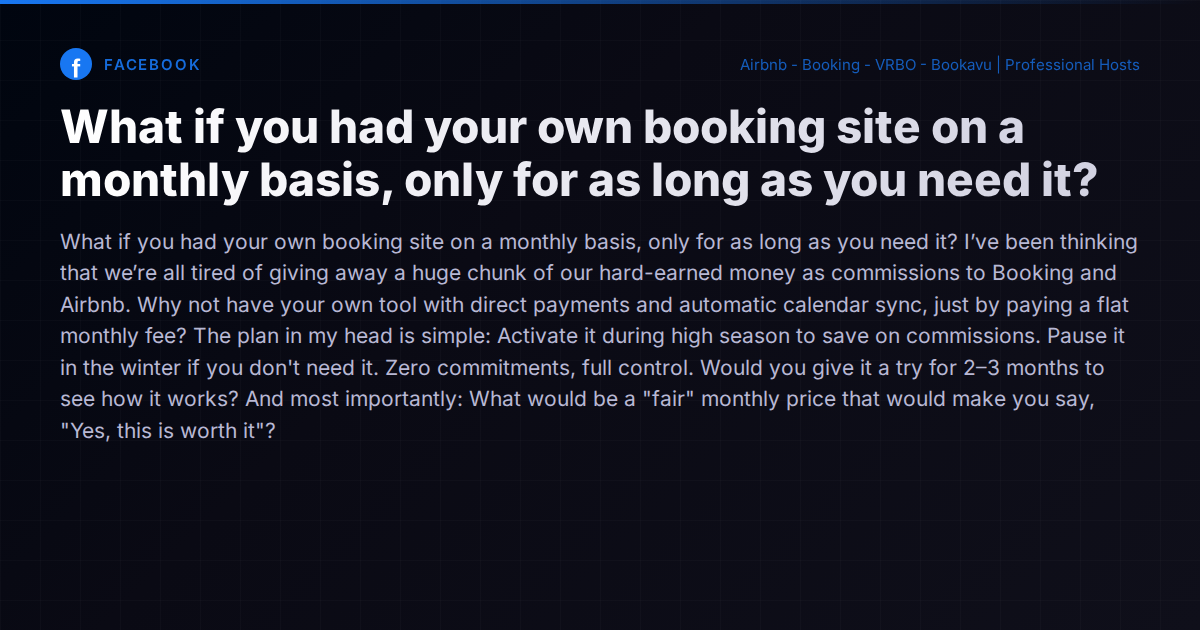
Facebook forum
TL;DR: Host is frustrated with OTA commissions and wants an affordable, flexible direct booking website with payment processing and calendar sync to bypass Airbnb/Booking.com fees during high season.
A host recently floated a simple idea in a Facebook group for professional hosts: what if you could spin up your own direct booking website during high season, pause it in winter, and stop bleeding commissions to Airbnb and Booking.com? The responses were predictably split — some hosts loved the concept, others pointed out the cold reality that a booking website nobody visits is just a website.
The underlying frustration is real, though. OTA commissions — typically 3% host-side on Airbnb (plus 14–16% guest-side), 15% on Booking.com, and similar on VRBO — add up to thousands per property per year. For a host doing $50K in gross bookings, that’s easily $5K–$8K flowing to platforms. The appeal of direct bookings is obvious.
But the gap between “I want a booking website” and “I have a profitable direct booking channel” is wider than most hosts expect.
The Real Cost Isn’t the Website — It’s the Traffic
Building a direct booking site in 2024 is the easy part. A dozen tools will give you a serviceable one in an afternoon. The hard part is getting anyone to visit it.
OTAs don’t just process payments. They’re marketing machines. Airbnb spent over $1.8 billion on sales and marketing in 2023. When a guest searches “beach house in Crete,” Airbnb and Booking.com are already ranking on page one. Your standalone website is competing with that.
Hosts who succeed with direct bookings typically drive traffic through one of three channels:
- Repeat guests. Your existing guest list is your cheapest traffic source. If you collect emails and phone numbers (within platform ToS), you can market directly to past guests.
- Social media and content. Instagram, TikTok, and local blogs can drive bookings, but it’s a long game.
- Google Ads or meta-search. Paid traffic works, but it’s not free — you’re trading OTA commissions for ad spend, often at similar effective rates.
The seasonal on/off model the original poster described — activate in summer, pause in winter — actually undermines the one channel that scales best for small operators: organic search. Google rewards consistency. A site that goes dark for six months loses whatever SEO traction it built.
What You Actually Need in a Direct Booking Setup
If you’re serious about capturing even 10–20% of your bookings directly, the minimum viable stack includes:
- A booking engine with real-time availability. Calendar sync to your OTA listings is non-negotiable — double bookings will cost you more than commissions ever did.
- Payment processing. Stripe or a similar gateway that handles pre-authorizations, security deposits, and multi-currency.
- Guest communication. Automated confirmation emails, check-in instructions, and the ability to handle questions outside OTA messaging.
- Trust signals. Reviews, professional photos, cancellation policies, and ideally some form of damage protection or guest verification. Guests booking directly are taking a leap of faith — you need to lower that bar.
- Legal compliance. Depending on your jurisdiction: tax collection, short-term rental permits displayed, GDPR consent, and proper invoicing.
A bare-bones WordPress site with a booking plugin can technically cover items 1 and 2. But it leaves you duct-taping the rest — and it won’t talk to your PMS, your cleaning schedule, or your smart locks.
How the Major Platforms Handle Direct Bookings
Most property management systems now offer some form of direct booking website. The quality and depth vary significantly.
Lodgify has historically positioned itself as a direct-booking-first platform. Their website builder is one of the more polished options, with templates, SEO tools, and integrated payment processing. If your primary goal is a standalone booking site and you’re managing a smaller portfolio, Lodgify is worth evaluating. The trade-off: their PMS and channel management capabilities are less feature-rich than competitors focused on operational depth.
Hostaway includes a direct booking website with expert-designed templates and built-in widgets (search, availability, reviews). It’s tightly integrated with their channel manager, so availability stays synced. The website is part of the broader PMS package, which means you’re paying for the full platform — there’s no option to use just the booking site.
Hospitable offers direct booking in two tiers: a basic DIY option where you handle taxes, chargebacks, and guest screening yourself, and a premium tier that includes tax calculation, chargeback protection, fraud screening, and up to $5M in damage protection. The tiered approach is smart — it lets hosts start lean and add safeguards as volume grows.
Guesty provides direct booking tools as part of their enterprise-oriented platform. For operators managing dozens or hundreds of listings, Guesty’s direct booking capabilities integrate with their broader channel and operations infrastructure. But Guesty doesn’t publicly disclose pricing, and the platform is generally overkill (and overpriced) for a host running five properties.
Vanio AI includes a direct booking website builder with custom domain support, SEO optimization, real-time availability, and Stripe-powered payments. Because it’s part of an all-in-one system, the booking site is natively connected to the guest portal, messaging, smart locks, cleaning task dispatch, and upsells — meaning a direct booking guest gets the same automated experience as an Airbnb guest without any middleware. The per-reservation pricing model ($5/booking) means you’re not paying a percentage commission on direct bookings either, which changes the economics compared to tools that charge a percentage of direct revenue.
Standalone website builders like Boostly, Booklee, and Craftedstays focus exclusively on the direct booking site itself. They can be more affordable and purpose-built, but they don’t manage your operations — you’ll still need a PMS, a channel manager, and a way to connect everything.
The “Fair Price” Question
The original poster asked what hosts would pay per month for a seasonal booking site. The honest answer: the monthly fee is almost irrelevant compared to the cost of acquiring traffic and the revenue you’d lose to double bookings if the calendar sync breaks.
A $29/month tool that drives zero bookings costs you $29/month. A $99/month platform that captures five direct bookings per month at $200 average — saving you $150 in commissions per booking — pays for itself three times over.
The better question isn’t “what’s a fair monthly price?” It’s “what’s my cost per direct booking, all-in, including the tool, the ads, the time I spend on it, and the operational overhead?” If that number is lower than your OTA commission, scale it. If it’s higher, the OTAs are earning their fee.
The Realistic Path Forward
For most hosts, the practical approach isn’t to replace OTAs with a direct booking site. It’s to supplement them:
- Start collecting guest contact info from every stay (business cards in the unit, a follow-up email after checkout, a QR code linking to your site).
- Choose a platform that includes a booking site as part of your existing PMS, rather than paying for a separate tool that adds integration complexity.
- Set a modest goal — capturing 10–15% of your bookings directly within the first year is realistic. 50% is aspirational and takes years of brand-building.
- Don’t go seasonal. If you build a direct channel, keep it running year-round. The compounding effect of repeat guests, reviews, and search indexing only works with consistency.
The OTA commission frustration is legitimate. But the solution isn’t a tool you toggle on and off — it’s a long-term channel strategy backed by the right infrastructure. Whether that infrastructure is a dedicated website builder or a full PMS with built-in direct booking capabilities depends on where you are in your hosting journey.
For a side-by-side look at how different platforms handle direct bookings alongside channel management and operations, the comparison hub breaks down the trade-offs across the major options.