When Your PMS Quietly Overcharges You: The Hidden Cost of Opaque Billing
Trustpilot
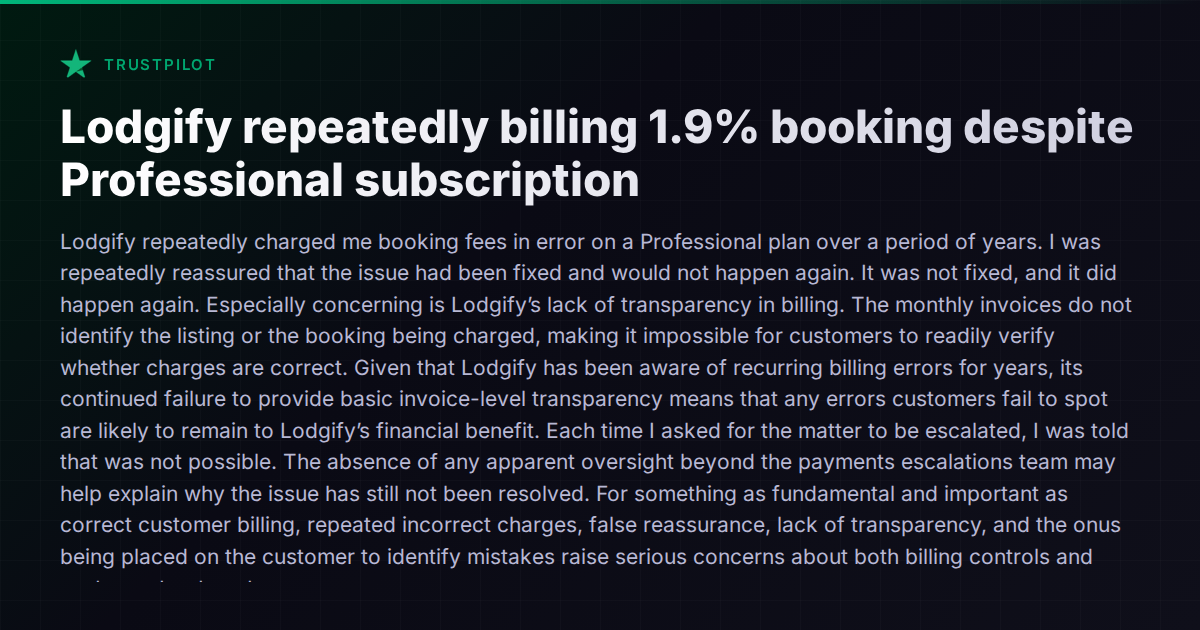
TL;DR: Author has been repeatedly overcharged by Lodgify with erroneous booking fees on their Professional plan for years, with opaque invoices that make it impossible to verify charges and no meaningful escalation path.
Running a short-term rental business means tracking dozens of line items — cleaning fees, channel commissions, dynamic pricing adjustments, damage deposits, and the platform fees you pay to your property management software. Most operators assume the last one is the simplest: you pick a plan, you know the rate, the billing is correct. But what happens when it isn’t — and the invoices themselves make it nearly impossible to tell?
One host recently shared a cautionary tale on Trustpilot about Lodgify repeatedly charging booking fees that should have been waived under their Professional plan — a pattern that persisted for years despite multiple complaints and reassurances that the issue was resolved. What made the situation worse wasn’t just the overcharges themselves, but the structure of the invoices: they didn’t identify which listing or which booking was being charged, making it functionally impossible to audit the bill without cross-referencing external records.
This isn’t a story about one host and one platform. It’s a structural problem across the PMS industry, and it’s worth understanding whether your current tool — or the one you’re evaluating — sets you up for the same trap.
Why PMS Billing Is Harder to Audit Than It Should Be
Short-term rental software pricing comes in several flavors: flat monthly fees, per-listing fees, percentage-of-revenue commissions, per-reservation charges, and hybrids that blend two or more of those models. Each model has its own audit challenge.
Percentage-based commissions are the hardest to verify. If your PMS charges 1.9% per booking on your direct reservations, you need to confirm three things for every line item: which reservation was charged, what the gross booking value was, and whether the percentage was applied correctly. If the invoice only shows a lump sum — or doesn’t even reference the underlying booking — you’d need a spreadsheet, your reservation records, and free time you almost certainly don’t have.
Per-listing tiers seem simpler but introduce their own opacity. If you’re paying for a Professional plan that covers up to 50 listings and your provider also offers a per-booking commission on lower tiers, billing logic errors can quietly apply the wrong rate. You might never notice a $12 charge tucked into a $400 monthly invoice — especially if the invoice doesn’t break it down.
Per-reservation flat fees are arguably the most transparent model, because the math is simple: count the reservations, multiply by the fee. Even here, though, clarity depends on the invoice showing which reservations were counted.
The Lodgify case highlights the worst-case intersection: a percentage-based fee that should have been zero under the host’s plan, applied to bookings that weren’t identified on the invoice, over a multi-year period. The host had to discover the error themselves each time, report it, get reassured it was fixed, and then discover it had happened again.
What to Look for in PMS Billing Transparency
If you’re evaluating a new platform — or auditing your current one — here’s a practical checklist:
- Line-item detail: Does the invoice show each charge mapped to a specific reservation or listing? If it only shows a lump sum labeled “booking fees,” that’s a red flag.
- Self-service billing history: Can you pull up historical invoices, see charge breakdowns, and export the data without contacting support?
- Plan enforcement logic: If your plan waives certain fees (like per-booking commissions), is there a clear mechanism that prevents those charges from being applied at all — versus relying on manual overrides or credits?
- Escalation path: When billing disputes arise, can you reach someone beyond first-tier support? The Lodgify host reported being told escalation “was not possible,” which is a structural failure in dispute resolution.
- Credit or refund policy: How are overcharges handled? Automatic credit? Manual request? And what’s the lookback window — can you recover charges from six months ago, or only the current billing cycle?
How the Major Platforms Handle This
Let’s be honest about the landscape. Billing transparency varies significantly across the PMS market, and no platform is immune to the occasional billing error. What differs is how easy they make it to catch one.
Guesty uses custom, quote-based pricing — they don’t even publish rates publicly. This makes billing auditing inherently opaque for prospective buyers, though existing customers have access to invoicing within the platform. The lack of public pricing also makes it difficult to compare what you’re paying against what you should be paying.
Hostaway similarly doesn’t publish pricing, directing prospects to request a custom quote. Once you’re a customer, billing visibility depends on what’s included in your contract and your account dashboard. The quote-based model itself isn’t a transparency problem, but it does shift the burden onto the operator to track their agreed terms.
Hospitable uses tiered plans, and their billing is generally tied to the number of properties and features selected. Their pricing is more visible than Guesty’s or Hostaway’s, though the specifics of per-booking fees (if any apply to your tier) still require careful review.
Lodgify — the platform at the center of this particular complaint — offers tiered plans that include or exclude per-booking commissions depending on the subscription level. The core issue reported wasn’t just that the billing was wrong; it was that the invoices lacked sufficient detail for the customer to verify charges independently. That’s a systemic transparency problem, not just a one-off bug.
Vanio AI uses a flat $5-per-reservation model, which is about as simple as billing math gets: count the reservations, multiply by five. The per-reservation charge is mapped to identifiable bookings, which makes auditing straightforward. That said, simplicity of pricing model doesn’t automatically guarantee perfect invoicing — what matters is whether the invoice maps cleanly to the charges and whether discrepancies are easy to spot.
The Deeper Problem: Misaligned Incentives
Here’s what makes opaque billing particularly corrosive in the PMS industry: the platform has no financial incentive to make overcharges easy to detect. If a billing bug consistently favors the vendor and the invoice doesn’t break down charges by reservation, the error can persist indefinitely — caught only by the most diligent customers.
This doesn’t require malice. A poorly designed invoicing system combined with a percentage-based pricing model and a support team without escalation authority will produce exactly the outcome described in the Trustpilot review. The host bears the audit burden, the platform bears no penalty for repeated errors, and the cycle continues.
What Operators Should Do
If you’re managing more than a handful of listings, billing auditing isn’t optional — it’s a cost-of-doing-business task that should happen monthly, not annually. Here’s a minimum viable approach:
- Download every invoice and store it outside the platform. If the vendor changes their billing portal or you lose access during a dispute, you need independent records.
- Cross-reference charges against your reservation data at least quarterly. If the invoice doesn’t make this easy, that’s information about the platform’s priorities.
- Document every billing dispute in writing — email, not phone. Create a paper trail. Note the date, the error, the amount, and the resolution promised.
- Ask about billing transparency during your next platform evaluation. Request a sample invoice before you sign. If they won’t show you one, ask yourself why.
The STR tech stack has matured significantly in the last few years, but billing transparency hasn’t kept pace. Whether you’re on Lodgify, Guesty, Hostaway, or anyone else, the lesson is the same: trust but verify — and choose platforms that make verification possible.
For a broader look at how major PMS platforms compare across pricing, features, and operational fit, the comparison hub is a good place to start.