The Hidden Cost of Canceling Your PMS: Zombie Charges, Slow Support, and What Hosts Can Do
Trustpilot
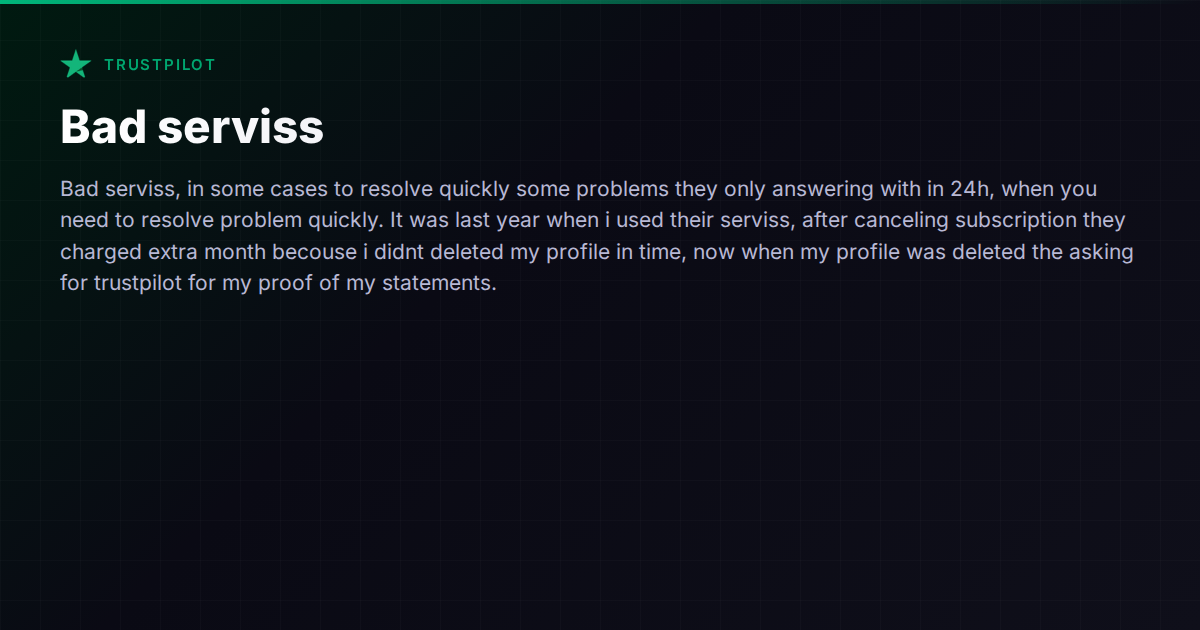
TL;DR: Author left Guesty after experiencing slow 24h-only support response times for urgent issues, and was charged an extra month after cancellation due to profile deletion timing.
Switching away from a property management platform should be the end of the story. But for a surprising number of short-term rental operators, the cancellation process turns into its own mini-crisis — unexpected charges, unclear timelines, and support teams that go quiet right when you need them most.
A recent Trustpilot review about Guesty captures the pattern neatly: the host left the platform after finding that urgent operational issues were met with 24-hour response windows. Then, after canceling their subscription, they were charged for an extra month because their profile wasn’t deleted within some undisclosed window. When they tried to dispute the charge publicly, the platform asked them to prove their claims. It’s a small story, but it echoes a much bigger one.
The 24-Hour Problem in a 2-Minute Industry
Short-term rentals operate on guest-time, not business-time. A guest locked out at 11 PM doesn’t care that your PMS vendor’s SLA says “response within 24 hours.” A double-booking discovered Friday evening can’t wait until Monday’s first support shift.
This is one of the most common complaints across the PMS landscape in 2026. Operators on forums and review sites routinely report that the urgency of their operational reality doesn’t match the pace of their platform’s support. The frustration isn’t that a bug exists — every software has bugs — it’s that the escalation path is slow when the stakes are high.
Some platforms handle this better than others:
- Guesty offers 24/7 support, and its enterprise tier reportedly includes faster response commitments. But the experience varies. Multiple reviewers note that the general support queue can still feel sluggish for time-sensitive issues, especially for smaller accounts.
- Hostaway doesn’t publicly disclose response-time SLAs either. Like Guesty, it uses a quote-based pricing model, which can mean that support tiers and priority access are negotiated rather than guaranteed.
- Hospitable provides automated messaging that reduces the frequency of support-critical moments (since the system handles routine guest messages), but when the platform itself has an issue, operators are still dependent on the support queue.
- Lodgify emphasizes personalized onboarding and proactive support in its marketing, with customer testimonials highlighting quick responses. That said, onboarding attentiveness and ongoing support responsiveness aren’t always the same thing.
The honest takeaway: no PMS has truly solved real-time operational support at every price tier. If you manage enough properties that a 24-hour support lag can cost you real money, you need to explicitly ask about escalation paths, priority support options, and guaranteed response times before you sign.
Zombie Charges After Cancellation
The second part of this story — being charged after canceling — is unfortunately common across SaaS in general, and PMS tools are no exception. The mechanics vary:
- Auto-renewal clauses: Many platforms auto-renew monthly or annually. If you cancel mid-cycle but don’t complete every step in their cancellation flow, the system treats you as still subscribed.
- Profile vs. subscription distinction: Some platforms differentiate between “canceling your subscription” and “deleting your account.” If you do one but not the other, billing may continue.
- Cancellation notice periods: Annual contracts often require 30-60 days’ notice before a renewal date. Miss the window by a day and you’re locked in for another cycle.
- Opaque pricing structures: When pricing isn’t publicly disclosed (as is the case with both Guesty and Hostaway), operators may not fully understand their billing terms until they try to leave.
This isn’t a Guesty-specific problem. Hosts have reported similar friction leaving other platforms. But the pattern is worth calling out because it disproportionately affects smaller operators who may not have reviewed the fine print with a lawyer before signing up.
What to Look for Before You Commit
If you’re evaluating a PMS in 2026, here’s a short checklist that addresses both of these pain points:
On support responsiveness:
- Ask for the SLA in writing, not just the marketing page promise.
- Specifically ask: “If I have a guest-facing emergency at midnight on a Saturday, what happens?”
- Check recent reviews (Trustpilot, G2, Capterra) filtered to the last 6 months. Support quality can change quarter to quarter.
On cancellation and billing:
- Before signing, ask: “What is the exact process to cancel, and what happens to my billing on the day I cancel?”
- Ask whether cancellation stops billing immediately or at end-of-cycle.
- Confirm whether there’s a distinction between canceling a subscription and deleting an account.
- If the pricing is quote-based and undisclosed, get the contract terms in writing — especially auto-renewal and notice periods.
- Favor platforms with transparent, publicly listed pricing. If a vendor won’t tell you what it costs until you’re on a sales call, treat the billing terms with extra scrutiny.
The Case for Transparent, Usage-Based Pricing
One structural way to avoid zombie charges is to use a platform with usage-based pricing rather than fixed subscriptions with auto-renewal traps. If you’re charged per reservation or per action rather than per month, the billing naturally scales to zero when you stop using the platform.
Vanio AI takes this approach with a $5-per-reservation model that covers the full operational lifecycle — messaging, lock codes, task dispatch, reviews, and more. There’s no annual contract lock-in, and billing is tied to actual usage rather than calendar cycles. That doesn’t make it the right platform for everyone, but the pricing structure itself eliminates the specific cancellation friction described here.
Other platforms like Hospitable use tiered subscription models that are at least publicly listed, which gives you visibility into what you’re agreeing to even if the structure is traditional.
When Platforms Challenge Your Reviews
One detail in the source complaint is worth a broader comment: the host reported that after posting their review, the platform asked them to provide proof of their statements. Review platforms like Trustpilot have verification processes that allow companies to flag reviews, and this can feel adversarial to a host who’s already frustrated.
This is standard practice — companies have a legitimate interest in ensuring reviews are accurate. But it creates an asymmetry: the company has full access to billing records and support logs, while the former customer may have already lost access to their account (especially if their profile was deleted as part of the cancellation). If you’re leaving a platform and anticipate a dispute, screenshot your billing history, cancellation confirmation, and any relevant support conversations before your account is closed.
The Bottom Line
Slow support and opaque cancellation processes aren’t the most dramatic PMS failures, but they’re among the most common. They erode trust in a way that’s hard to recover from — and they tend to surface only after you’ve already committed time and money to a platform.
Before you choose your next PMS, stress-test the exit as much as the entry. Ask hard questions about support SLAs, read the cancellation terms, and favor transparency over slick demos. The best indicator of how a platform treats you when things go wrong is how clearly they communicate before anything goes wrong.
For a broader comparison of how major platforms stack up on pricing, support, and contract terms, the comparison hub covers 25+ tools side by side.