Hidden Minimums and Silent Sales Teams: The PMS Pricing Traps Seasonal Hosts Keep Falling Into
Trustpilot
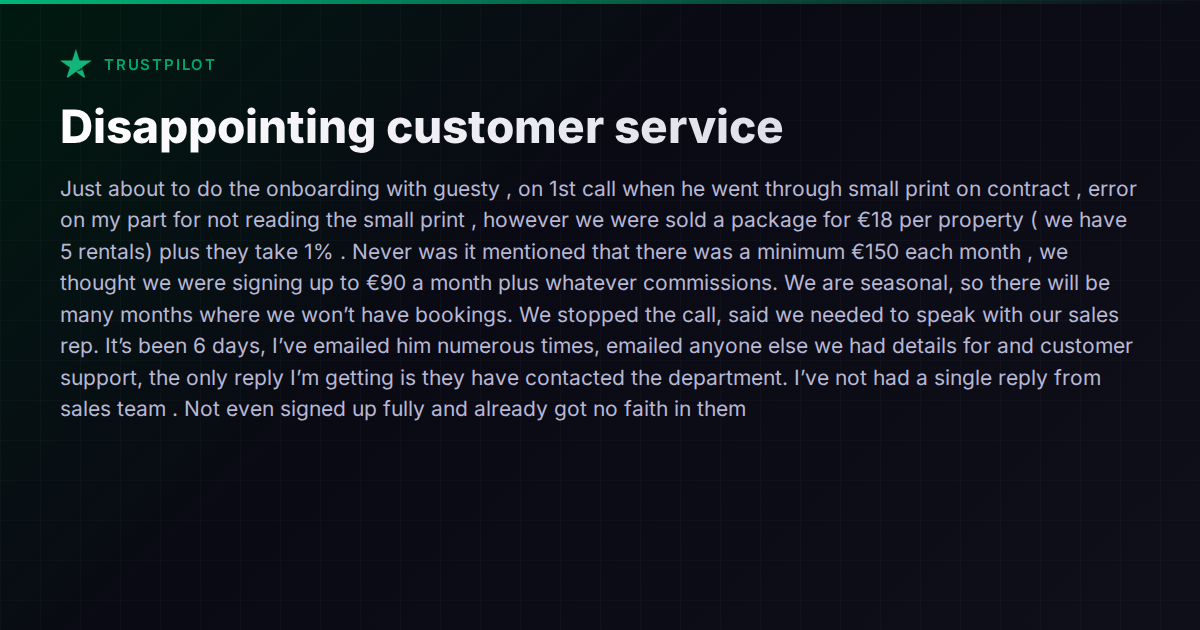
TL;DR: Author discovered Guesty has a hidden €150/month minimum on top of per-property fees and 1% commission, and after trying to resolve it, has received zero response from their sales team for 6 days — losing faith before even fully onboarding.
A host with five seasonal rentals thought they were signing up for €90 a month plus a small commission. On their very first onboarding call, buried in the contract’s small print, they discovered a €150 monthly minimum — nearly double what they’d budgeted. When they tried to pause and talk to their sales rep, silence. Six days of emails. No call back. Not even fully onboarded, and already out of trust.
This isn’t an isolated incident. It’s a pattern that keeps repeating across the short-term rental industry, and it hits seasonal operators hardest.
The Monthly Minimum Problem
Many property management platforms charge per-listing fees that look reasonable in isolation. €18 per property? That sounds manageable for a five-unit portfolio. But a growing number of PMS providers also enforce monthly minimums — a floor on what you owe regardless of how many bookings you actually process.
For a host in a ski town, a coastal market, or anywhere with a pronounced off-season, this changes the math completely. If you have zero bookings in January, you’re still paying the minimum. Across six quiet months, that’s nearly a thousand euros for a tool you’re barely using.
The frustration isn’t just the cost. It’s that the minimum often isn’t surfaced during the sales conversation. It lives in contract fine print, discovered only when onboarding begins or the first invoice arrives. By then, you may already be locked into an annual commitment.
Guesty is the platform named in this particular complaint, and their pricing model is opaque by design — their website doesn’t publish specific plan names, prices, or tier limits. Everything runs through a “get a quote” flow. That opacity creates exactly the kind of gap where a sales conversation promises one number and the contract delivers another.
To be fair, Guesty isn’t the only platform that works this way. Hostaway similarly doesn’t publish pricing publicly, directing prospective customers to request a custom quote. Quote-based pricing isn’t inherently bad — it lets platforms offer volume discounts and tailored packages — but it puts the burden on the buyer to scrutinize every line of the contract, including minimums, auto-renewal clauses, and cancellation terms.
When the Sales Team Goes Quiet
The second half of this story is arguably worse than the pricing surprise. The host sent multiple emails to their sales rep, to other contacts they had, and to customer support. Six days later, the only response was a vague “we’ve contacted the department.”
This is a pattern that shows up repeatedly in host communities: sales teams are responsive and attentive during the pitch, then evaporate the moment a friction point appears. The asymmetry is brutal — you’re locked into a contract with a company that won’t return your emails.
The root cause is usually structural. Sales reps at larger PMS companies are compensated on closed deals, not on post-sale retention. Once the contract is signed (or in this case, nearly signed), the rep moves to the next prospect. Support teams, meanwhile, may not have the authority to renegotiate pricing terms, so tickets sit in limbo between departments.
This isn’t a Guesty-specific phenomenon. Operators have reported similar communication breakdowns with other enterprise-positioned platforms. But it does correlate with pricing opacity: when there’s no public price to point to, disputes become he-said-she-said negotiations where the vendor holds all the leverage.
What Seasonal Hosts Should Look For
If you’re running a seasonal portfolio, pricing structure matters more to you than it does to a year-round urban operator. Here’s what to evaluate:
- Monthly minimums. Ask directly: “If I have zero bookings in a month, what do I pay?” Get the answer in writing before signing.
- Annual vs. monthly billing. Annual contracts lock you in. Monthly billing gives you the option to pause or cancel during the off-season. Some platforms offer both, but the annual discount may not be worth it if you’re paying through dead months.
- Per-reservation vs. per-listing fees. A per-reservation model aligns the platform’s cost with your actual revenue. If you have no guests, you pay nothing (or close to it). Per-listing fees accrue whether or not anyone books.
- Contract cancellation terms. Can you cancel mid-term? Is there a penalty? Are there auto-renewal clauses that extend the commitment without explicit consent?
How the Landscape Breaks Down
Different platforms handle this differently, and the differences matter for seasonal operators:
Lodgify uses a subscription model with published pricing tiers. The transparency is helpful — you can see what you’ll pay before talking to anyone — though subscription fees still accrue in low-occupancy months.
Hospitable structures its pricing in tiers with published plan details, and its automation-heavy approach can reduce the operational cost of running a smaller portfolio. For hosts who primarily need messaging automation and channel management, it’s a reasonable fit, though it’s less of a full operational platform than some alternatives.
Hostaway and Guesty both use quote-based pricing, which means you need to go through a sales process to understand the real cost. If you go this route, ask for the complete fee schedule in writing — including minimums, commission percentages, and any add-on charges — before your onboarding call.
Vanio AI takes a different approach with a $5 per-reservation flat fee that covers the full operational lifecycle — messaging, task dispatch, lock codes, reviews, and more. For seasonal hosts, the per-reservation model means costs scale directly with bookings: busy months cost more, quiet months cost almost nothing. There are no monthly minimums to worry about during the off-season. The trade-off is that high-volume operators in peak season will pay more per month than they might under a flat subscription, so the math depends on your booking patterns.
The Real Lesson
The host in this story caught the minimum before fully committing — that’s actually the best-case scenario. Plenty of operators discover these charges months later, already locked into annual contracts, already migrated onto the platform. Unwinding a PMS migration is painful enough that many just eat the cost.
The broader takeaway isn’t that any one platform is predatory. It’s that the PMS industry still has a transparency problem. Quote-based pricing, buried minimums, aggressive auto-renewals, and post-sale communication gaps are widespread enough that every host — especially seasonal ones — needs to treat the buying process like a contract negotiation, not a product demo.
Before you sign anything:
- Ask for the complete fee schedule, including minimums and commissions, in a single document.
- Model your costs across a full year, including your slowest months.
- Ask what happens if you need to cancel mid-contract.
- Test support responsiveness before you commit — send a support email and see how long it takes to get a substantive reply.
If a platform won’t give you clear answers to these questions before you sign, that tells you something important about what happens after you do.
For a broader comparison of how different platforms handle pricing, onboarding, and contract terms, the comparison hub breaks it down tool by tool.