When Your PMS Holds Your Money: The Real Risk of Payment Processing Lock-Ups
Trustpilot
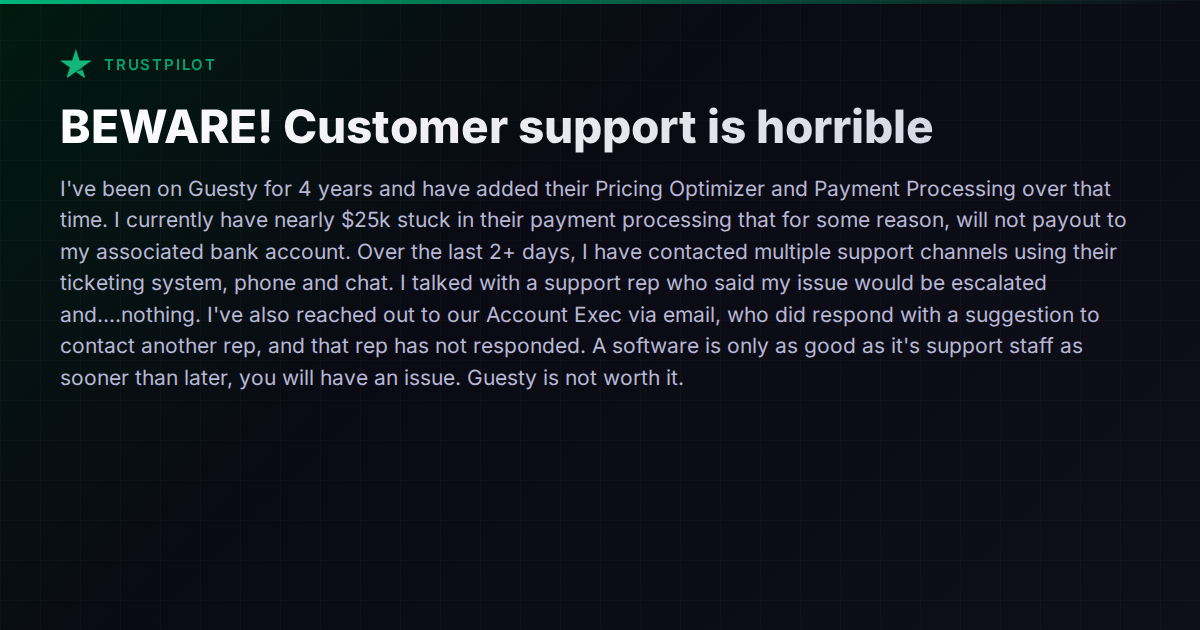
TL;DR: Long-time Guesty customer has nearly $25k stuck in Guesty's payment processing with no payout and zero meaningful support response across multiple channels over days.
A property manager recently shared a sobering experience on Trustpilot: after four years on Guesty, they had nearly $25,000 stuck in the platform’s built-in payment processing — funds that simply wouldn’t pay out to their bank account. Across two days of tickets, phone calls, chat sessions, and emails to their account executive, the response was effectively silence. The escalation went nowhere.
This isn’t a one-off horror story. It’s a structural risk that every short-term rental operator should understand before choosing where their guest payments flow.
The Growing Trend: PMS Platforms as Payment Processors
Over the last few years, property management platforms have increasingly added their own payment processing — sometimes built in-house, sometimes white-labeling Stripe or another provider. The pitch is compelling: fewer tools, unified financials, automatic reconciliation. And for the most part, it works fine.
Until it doesn’t.
The problem is that when your PMS is also your payment processor, a single vendor failure can freeze your entire cash flow. If Stripe holds your funds directly, you deal with Stripe — a company whose entire business depends on moving money reliably. If your PMS sits between you and Stripe (or runs its own processing), you’re now dependent on that PMS’s support team to resolve payment issues. And as we’ve seen, support capacity varies wildly.
Why Funds Get Stuck
There are several common reasons a PMS payment payout might stall:
- Identity verification issues: The underlying processor (often Stripe Connect) flags the account for additional KYC documentation. The PMS may not surface this clearly.
- Risk holds: Large transaction volumes, sudden spikes in bookings, or high refund rates can trigger automated risk reviews.
- Bank account mismatches: A change in banking details, an expired account, or routing number errors can silently block payouts.
- Platform bugs: Sometimes it’s just a software defect — a failed webhook, a stuck queue, a database inconsistency.
- Processor-level holds: The underlying payment processor itself may freeze funds due to compliance triggers, and the PMS has limited ability to accelerate resolution.
In every case, the operator is stuck waiting. And when you’re managing 10, 50, or 200 properties, $25,000 isn’t an abstract number — it’s payroll, it’s owner distributions, it’s your mortgage.
The Support Bottleneck
What makes this particular pain so acute is the intersection of two failures: the payment issue itself, and the inability to get meaningful help resolving it.
The operator in this case tried every channel available — the ticketing system, phone, live chat, their dedicated account executive. The account exec responded but simply redirected to another rep, who didn’t respond at all. The escalation was acknowledged but produced no action.
This pattern is common across property management platforms. Payment issues are inherently cross-functional — they involve the PMS’s billing team, the underlying processor’s risk team, sometimes even compliance and legal. Most front-line support reps can’t resolve them. They can only escalate. And escalation queues, especially at companies managing hundreds of thousands of listings, can move slowly.
Guesty, to be fair, serves a very large customer base and has invested in 24/7 support with a claimed 99.99% uptime. But uptime isn’t the same as resolution speed, and a platform being “up” doesn’t help when your money is stuck in it.
How Other Platforms Handle Payments
It’s worth understanding the landscape, because not every platform handles this the same way.
Guesty offers its own payment processing as an add-on. The advantage is tight integration with their PMS. The risk, as illustrated above, is that payment issues become support issues at a company whose core competency is property management, not financial infrastructure.
Hostaway integrates with third-party payment providers and also offers native processing. Their approach is similar to Guesty’s — convenient when it works, but you’re still routing through the PMS layer.
Lodgify takes a similar bundled approach. Their focus on direct bookings means payment processing is a core workflow, but the same intermediary risks apply.
Hospitable handles payments differently depending on your plan tier. Their Direct Premium tier includes built-in payment processing with chargeback protection, while the Basic tier lets you handle payments yourself — giving you more control but less convenience.
Vanio AI uses Stripe Connect directly, meaning each operator has their own Stripe account. The PMS facilitates the connection and triggers charges, refunds, and payouts, but the funds flow through your Stripe account — not Vanio AI’s. If there’s a payout issue, you deal with Stripe directly (and Stripe’s support, while imperfect, is purpose-built for financial operations). This architecture also means Vanio AI can’t accidentally become a bottleneck in your cash flow.
This distinction matters more than most operators realize when evaluating platforms. Ask specifically: Do funds pass through your company’s accounts, or do they go directly to mine?
What Operators Should Do to Protect Themselves
Regardless of which platform you use, there are practical steps to reduce your exposure to payment processing lock-ups:
-
Understand the payment flow. Before signing up, ask exactly how money moves from guest to your bank account. How many intermediaries are involved? Who holds funds and for how long?
-
Keep a direct relationship with the processor. If possible, choose a platform that gives you your own Stripe, PayPal, or processor account rather than pooling funds through the PMS.
-
Maintain a cash reserve. This is basic business hygiene, but especially critical when your payment flow depends on software. Have at least two weeks of operating expenses accessible outside your PMS.
-
Document your payout schedule. Know when payouts are supposed to hit. Set up alerts. If a payout is late by even 24 hours, escalate immediately — don’t wait.
-
Get your escalation contacts early. Don’t wait until you have $25,000 stuck to find out who can actually help. During onboarding, ask for a direct contact for payment issues specifically — not general support.
-
Diversify if you can. Some operators run OTA bookings through the OTA’s own payment system (Airbnb pays you directly, for instance) and only use PMS payment processing for direct bookings. This limits your exposure.
The Uncomfortable Truth
The operator who shared their story put it simply: “A software is only as good as its support staff, as sooner than later, you will have an issue.”
This is exactly right. Every platform will have outages, bugs, and edge cases. The question isn’t whether something will go wrong — it’s how quickly and competently it gets resolved when it does. And when the issue involves your money, “we’ll escalate it” isn’t an answer. It’s a delay.
Before you add payment processing to any PMS, understand the architecture, the support model, and the worst-case resolution timeline. Your choice of payment flow is, quietly, one of the highest-stakes decisions you’ll make as an operator.
For a deeper comparison of how different platforms handle payments and the broader PMS landscape, Vanio AI’s comparison pages offer a detailed breakdown — and they’re honest about where competitors have strengths, which makes them worth reading even if you don’t end up choosing Vanio AI.