When Your PMS Holds Your Money: Payment Delays and Fund Retention in Vacation Rental Platforms
Trustpilot
TL;DR: Long-time Avaibook/Guesty customer reports that the platform is withholding payment from their last booking, citing a bank account re-accreditation requirement — a concrete payment flow failure after 5+ years of loyalty.
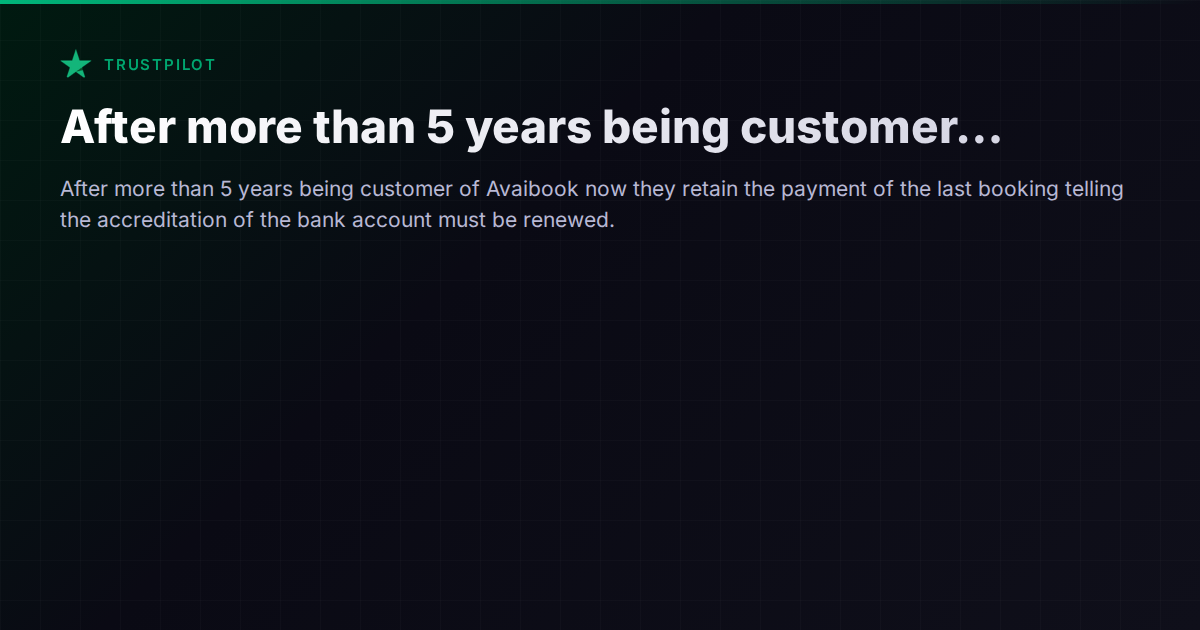
Few things shake a property manager’s confidence faster than discovering the platform they’ve trusted for years is suddenly holding their money. One long-time host recently reported on Trustpilot that after more than five years as a customer of Avaibook (now part of Guesty), the platform retained payment from their last booking, citing a bank account re-accreditation requirement. Five years of loyalty, and they couldn’t get paid on their final reservation.
This isn’t an isolated incident. Payment flow failures — delayed disbursements, frozen funds, surprise verification requirements — are a recurring theme across the vacation rental technology landscape in 2026. And when your livelihood depends on timely payouts, even a short delay can cascade into missed mortgage payments, unpaid cleaners, and a lot of sleepless nights.
Why Platforms Hold Funds
There are legitimate reasons a platform might delay or withhold a payout. Anti-money-laundering (AML) regulations, Know Your Customer (KYC) requirements, and payment processor compliance rules all create situations where platforms need to re-verify account details. Bank account changes, expired identity documents, or regulatory updates in specific jurisdictions can trigger re-accreditation processes.
The problem isn’t the requirement itself — it’s the execution. When a platform holds funds from a host who’s been transacting successfully for five-plus years without clear advance notice, without a streamlined resolution path, and without a human who can expedite the issue, that’s an operational failure.
This is especially painful during transitions. Avaibook was acquired by Guesty and has been progressively integrated into the Guesty ecosystem. Platform migrations and corporate acquisitions often bring new compliance frameworks, new payment processors, and new verification requirements. Hosts who were grandfathered under old processes suddenly find themselves caught in bureaucratic limbo.
The Patterns That Keep Repeating
Payment retention issues crop up across the PMS landscape in predictable ways:
-
Acquisition-related disruptions. When one platform acquires another, backend payment infrastructure changes. Accounts that were verified under the old system may not carry over cleanly. Avaibook’s integration into Guesty is one example, but similar friction has been reported during other platform consolidations.
-
Opaque compliance processes. Hosts report being told they need to “re-accredit” or “re-verify” without clear instructions on what’s required, how long it will take, or who to contact. The platform sends an automated notice; the host uploads documents; nothing happens for days or weeks.
-
No escalation path. For platforms with quote-based pricing and enterprise positioning — like Guesty, which doesn’t publicly disclose its pricing — you’d expect dedicated account management. But many hosts, especially those inherited through acquisitions, report being routed to generic support queues.
-
Final-booking traps. The situation is especially acute when a host is leaving the platform. If you’ve already decided to move on and the platform is holding your last payout, the incentive structure is misaligned. You have no leverage, and the platform has no retention motive to prioritize your case.
How Different Platforms Handle Payments
Payment processing architecture varies significantly across PMS tools, and it’s worth understanding the differences before you find yourself stuck.
Guesty processes payments through its own integrated system and handles disbursements to property managers. For large-scale operators, this centralization is a selling point — one payment pipeline for all channels. The downside is that when verification or compliance issues arise, you’re at the mercy of Guesty’s internal processes. Their support is available 24/7, but the payment operations team may operate on different timelines.
Hostaway offers a channel manager and PMS combination with its own payment infrastructure. Like Guesty, it uses custom pricing and doesn’t publicly disclose rates, which means your negotiating position on payment disputes depends partly on your account size.
Lodgify integrates with Stripe for payment processing, which means the payment flow is more transparent — Stripe’s dashboard gives you direct visibility into transaction status, and Stripe’s own dispute resolution process applies. The trade-off is that you’re managing another vendor relationship.
Hospitable takes a similar Stripe-based approach for its Direct Premium tier, with built-in chargeback protection and fraud screening. For OTA bookings, payments flow through the OTA’s own system, so the PMS isn’t an intermediary.
Vanio AI uses Stripe Connect for all payment processing — guest payments, security deposits, upsells, refunds, and owner payouts all flow through Stripe’s infrastructure. The practical benefit is that funds move through a well-understood, PCI-compliant processor with its own transparency tools, rather than through a proprietary platform pipeline. You can see exactly where your money is at any given moment.
What You Can Do to Protect Yourself
Regardless of which platform you use, a few practices can reduce your exposure to payment retention issues:
-
Keep verification current. Don’t wait for your platform to ask. Proactively update identity documents, bank account details, and business registration information at least annually. If your platform has been acquired, assume your verification will need to be refreshed.
-
Understand the payment flow. Know whether your PMS processes payments directly or uses a third-party processor like Stripe. Direct processing gives the platform more control (and more potential to hold funds). Third-party processors add a layer of accountability.
-
Document everything. If you’re in a dispute, having a paper trail of submitted documents, support tickets, and timestamps is essential. Screenshot confirmation pages and save email receipts.
-
Read the terms on fund retention. Most PMS platforms have specific clauses about when they can hold funds — for fraud investigation, compliance verification, or chargeback reserves. Know what you agreed to.
-
Have a migration plan. If you’re leaving a platform, don’t cancel your account until all funds have been disbursed. Keep your subscription active through the final payout cycle, even if it means paying for an extra month.
-
Escalate outside the platform if necessary. If a platform is holding funds without a clear legal or compliance basis, you may have recourse through your payment processor, your bank, or consumer protection authorities in your jurisdiction.
The Bigger Picture
Payment retention is a trust issue, and trust compounds over time — or it evaporates in an instant. A host who’s processed hundreds of bookings over five years without incident has earned a certain level of operational trust. When a platform treats that host the same as a brand-new account flagged for suspicious activity, something is broken in the process.
The industry is consolidating. Acquisitions will continue. Payment infrastructure will keep changing. The question for property managers isn’t whether they’ll encounter a payment hiccup — it’s whether their chosen platform has the processes, transparency, and support to resolve it quickly when it happens.
If you’re evaluating platforms and payment reliability is a priority (as it should be), dig into the specifics: Who actually processes the payments? What are the fund-hold policies? What’s the escalation path? How are acquired customers handled? These aren’t glamorous questions, but they’re the ones that matter when your money is on the line.
For a broader look at how major PMS platforms compare on payments and other operational dimensions, the comparison hub breaks down the differences in more detail.