When Dynamic Pricing Tools Just Set Everything to Your Minimum: The Hidden Costs of Autopilot Revenue Management
Trustpilot
TL;DR: Author is furious with Beyond Pricing for offering no real price variation (always hitting minimum), predatory invoicing that charges commission on security deposits, and near-nonexistent customer support.
Dynamic pricing is supposed to be the closest thing short-term rental operators have to a money printer. Connect your listings, set your guardrails, and watch the algorithm respond to demand signals in real time — lifting rates on high-demand weekends, dropping them just enough on slow midweeks to keep occupancy healthy.
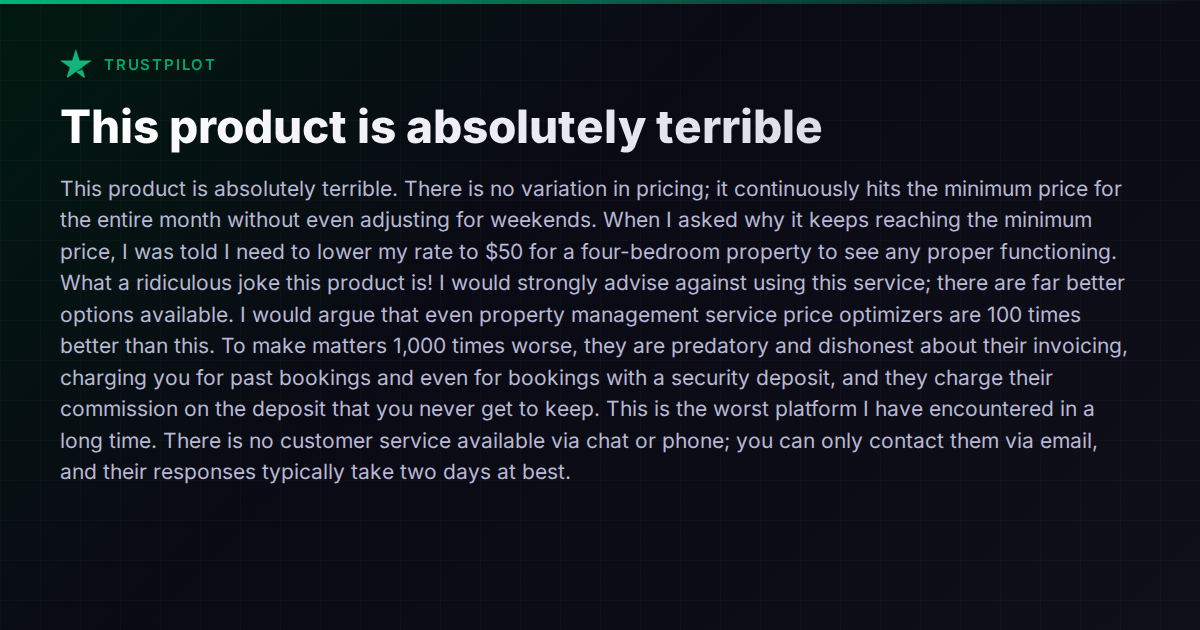
That’s the pitch. The reality, for a significant number of hosts, looks more like this: you connect the tool, set a minimum price, and watch it park every single night at that minimum — weekdays, weekends, holidays, all of it. No variation, no upside capture, just a flat line at the floor you set. One operator on Trustpilot recently described exactly this experience with Beyond Pricing, noting that the tool hit the minimum price for an entire month on a four-bedroom property without adjusting for weekends. When they asked support why, they were told to lower their minimum to $50 per night to “see proper functioning.” That’s not dynamic pricing — that’s a race to the bottom with extra steps.
The complaint didn’t stop at pricing logic. The host also reported commission charges on security deposits (money the host never keeps) and invoices for past bookings that predated the connection. With support limited to email and multi-day response times, they had no fast way to dispute the charges.
This isn’t a one-off rant. It points to three structural problems that affect the broader dynamic pricing landscape.
Problem 1: “Dynamic” Pricing That Doesn’t Move
Every revenue management tool — Beyond Pricing, PriceLabs, Wheelhouse, DPGO — relies on comparable data: local market rates, booking pace, seasonal patterns, event calendars, and your own historical performance. The problem is that these models need sufficient comp data to generate meaningful variation. If your property is in a thinner market, has an unusual configuration, or is newly listed with no booking history, the algorithm may lack confidence in any rate above your floor.
When that happens, the tool defaults to the safest answer: your minimum price. You get billed for “dynamic pricing” that is, in practice, a static rate. Operators in secondary markets, rural destinations, or with unique property types (think yurts, treehouses, large homes sleeping 12+) report this most often.
PriceLabs tends to give operators more manual control through customization rules, neighborhood-level adjustments, and orphan-day minimums, which can help compensate when the base algorithm underperforms. Wheelhouse offers a “risk tolerance” slider that lets you explicitly choose between occupancy-focused and revenue-focused strategies — useful if you want to force the tool away from always recommending the floor price. Beyond Pricing, by contrast, has historically offered a simpler, more hands-off approach. That simplicity is a selling point for some, but it becomes a liability when the algorithm doesn’t have enough signal to make smart decisions on its own.
The takeaway: if your dynamic pricer is consistently parking at your minimum, it’s not broken in a way support will fix. The model is telling you it doesn’t know what to do with your property. You either need a tool with more manual override capability, or you need to supplement algorithmic pricing with your own market knowledge.
Problem 2: Commission on Gross Booking Value (Including Deposits)
This is where pricing tools can quietly become expensive. Most charge a percentage of booking revenue — typically 1% to 2%. The question is: what counts as “revenue”?
Beyond Pricing charges on gross booking value, which can include cleaning fees and, as the host above discovered, security deposits. A security deposit is an authorization hold that gets released if no damage occurs. The host never realizes that income. Paying a commission on money you don’t keep is a genuine cost that many operators don’t notice until they audit their invoices.
PriceLabs avoids this entirely by charging a flat monthly fee per listing (starting around $20/month for smaller portfolios) rather than a percentage of revenue. You pay the same whether your property books $500 or $5,000 in a given month. DPGO also uses a flat-fee model. Beyond Pricing and Wheelhouse both use percentage-based models, but the specifics of what’s included in the revenue calculation differ — and it’s worth reading the fine print before connecting.
If you’re using a percentage-based tool, audit your invoices line by line for at least one billing cycle. Check whether cleaning fees, extra guest fees, and security deposits are being included in the commission base. If they are, calculate what you’re actually paying per listing per month and compare it against flat-fee alternatives.
Problem 3: Support Bottlenecks at Scale
Email-only support with two-day response times is manageable when things are working. It becomes a serious operational risk when they’re not — especially when billing disputes are involved. The host’s frustration isn’t just about slow support; it’s about having no synchronous channel to resolve a time-sensitive issue.
This is a broader pattern across the STR tool ecosystem. Many SaaS tools that serve the vacation rental market were built for a self-serve model and never invested in real-time support infrastructure. If you rely on a tool for a critical function (pricing is about as critical as it gets), you should know before you commit whether they offer chat, phone, or only email — and what their actual SLA is, not just what they promise on their marketing page.
What Operators Should Actually Do
If you’re evaluating or already using a dynamic pricing tool, here’s a practical checklist:
- Test with eyes open for the first 30 days. Don’t set it and forget it. Compare the tool’s recommendations against what you would have priced manually. If there’s no meaningful variation from your minimum, the tool isn’t adding value for your property.
- Understand the billing model completely. Percentage of what, exactly? Are deposits included? Are canceled bookings still invoiced? Is there a retroactive charge for bookings that existed before you connected?
- Prefer tools with manual override layers. The best pricing tools let you set rules on top of the algorithm: weekend minimums, event-date bumps, last-minute discounts, orphan-day logic. If the tool only offers a min/max slider and a “trust us” attitude, you have no recourse when the algorithm misjudges your market.
- Check support channels before you pay. Send a test email or chat message during business hours and see how long it takes to get a real answer. This tells you more than any review.
Where Does AI-Native PMS Pricing Fit?
Some operators are moving away from standalone pricing tools entirely, opting instead for property management platforms with built-in pricing controls. Hostaway and Guesty both integrate with third-party pricing tools (PriceLabs, Beyond Pricing, Wheelhouse) but also offer their own basic pricing features — per-date overrides, weekend pricing differentials, length-of-stay discounts, and last-minute adjustments. Lodgify provides similar built-in controls for hosts who want to manage pricing without a separate tool.
Vanio AI takes a different approach: instead of integrating with external pricing engines, it provides per-date price overrides, per-channel markups, weekend pricing, and length-of-stay discounts natively within the calendar, paired with an AI agent that can reason about pricing context when handling guest inquiries (for example, autonomously offering a last-minute discount on an orphan night). It’s not a replacement for a full-blown revenue management algorithm — if you need market-comp-driven dynamic pricing, you still need a dedicated tool — but it eliminates the need for a standalone pricing layer for operators who prefer manual control augmented by AI.
The Bottom Line
Dynamic pricing tools can genuinely increase revenue — when they work. The problem is that “when they work” has more caveats than the marketing pages suggest. Thin markets, unusual properties, opaque billing, and nonexistent support can turn a revenue optimization tool into a cost center that actively hurts your bottom line.
Before you commit to any pricing tool, test it with a critical eye, audit your first invoice carefully, and make sure you have a way to get a human on the line when something goes wrong. For a broader look at how different platforms handle pricing, revenue management, and the tools that integrate with them, the comparison hub is a good starting point.