When Your PMS Costs More Than It Delivers: The Small Operator's Pricing Trap
Trustpilot
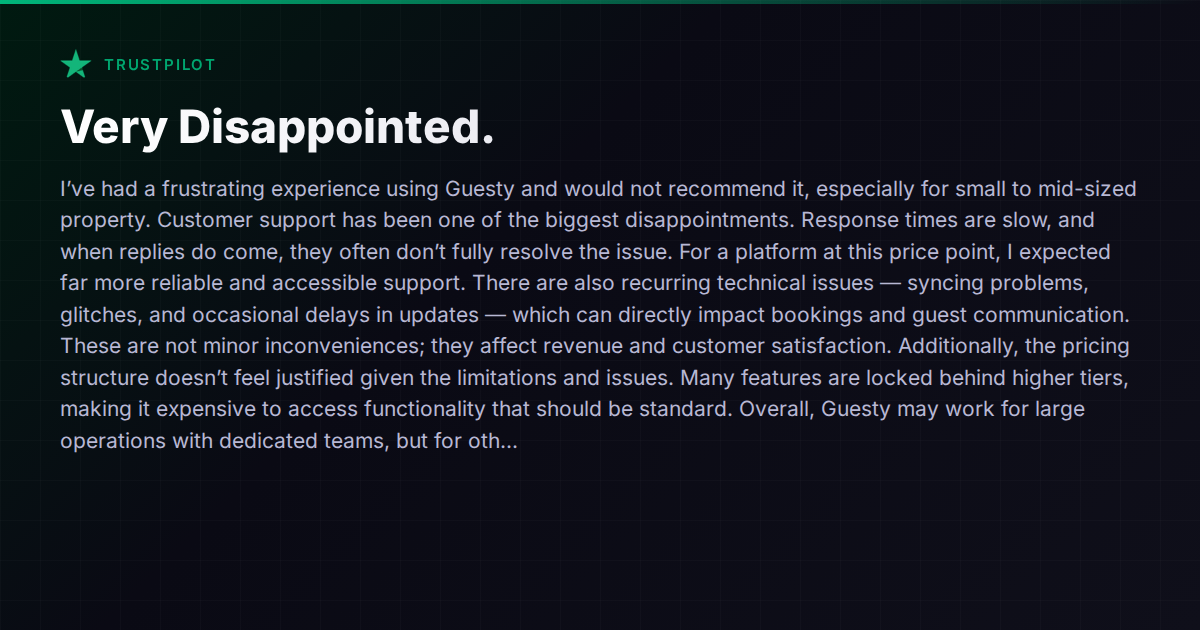
TL;DR: Small-to-mid-sized PM finds Guesty overpriced with slow support, recurring sync/glitch issues impacting bookings and revenue, and essential features locked behind expensive tiers.
There’s a specific frustration that hits small and mid-sized short-term rental operators harder than anyone else: paying enterprise prices for a platform that doesn’t feel like it was built for you. A recent Trustpilot review of one major PMS captured it plainly — slow support, recurring sync problems affecting bookings, features locked behind expensive tiers, and a growing sense that the price tag doesn’t match the value received. It’s a common story, and it’s worth examining why it happens and what the realistic alternatives look like.
The Enterprise PMS Problem
Many of the most established property management platforms were designed — architecturally and commercially — for large operators. They built deep feature sets, layered on integrations, hired enterprise sales teams, and priced accordingly. That’s not a criticism; it’s a business model. But it creates a mismatch when a host managing 5 or 15 or even 40 properties signs up expecting the same experience that a 500-listing operation gets.
The pattern looks like this:
- Tiered feature gating. Core operational features — automated messaging, advanced reporting, multi-calendar management, API access — sit behind higher pricing tiers. What feels “standard” to an operator is often classified as “premium” by the vendor.
- Support that scales with spend. Enterprise clients get dedicated account managers and priority queues. Smaller accounts get slower response times, ticket-based support, and generic troubleshooting articles. When a sync failure is eating your revenue in real time, a 48-hour support ticket turnaround is unacceptable.
- Complexity that assumes a dedicated team. Platforms built for scale often assume you have someone whose full-time job is managing the PMS. If you’re an owner-operator or running a lean team, every extra configuration screen and nested menu is friction that costs you time.
The Trustpilot reviewer’s experience with Guesty — syncing problems, glitches delaying updates, support that doesn’t fully resolve issues, and pricing that feels unjustified — aligns with a broader pattern that operators report across forums and review sites. Guesty is a capable platform, particularly for large portfolios where the enterprise features (managed communication services, advanced analytics, deep OTA integrations) justify the investment. But for smaller operators, the cost-to-value ratio often doesn’t land.
This isn’t exclusive to Guesty. Any platform that prices by tier and reserves meaningful functionality for higher plans will produce the same frustration at the lower end. The question is: what are the actual alternatives, and what trade-offs come with each?
How the Landscape Actually Breaks Down
Let’s look at this honestly. No platform is perfect for everyone, and every option involves compromises.
Guesty
Guesty doesn’t publicly disclose pricing, which itself is a signal — the model is consultative and typically targets professional managers with larger portfolios. The platform is genuinely strong on channel management (500K+ listings managed, deep OTA integrations) and has invested in AI features like Copilot for data queries and ReplyAI for messaging. But the opacity of pricing and the feature-gating complaints are persistent themes in user reviews. If you’re managing 5-20 properties, the economics may not work.
Hostaway
Hostaway sits in a similar professional-grade category. It offers a unified inbox, channel management, automation tools, and a direct booking website builder. Like Guesty, pricing isn’t publicly listed — you request a custom quote. The platform has earned a reputation for solid OTA connections and a reasonably intuitive interface. But the custom-quote model means smaller operators often face the same uncertainty about what they’re actually paying for until they’re deep into the sales process.
Hospitable
Hospitable (formerly Smartbnb) has historically positioned itself as more accessible to smaller operators. Its strength is automated guest messaging — the AI handles routine conversations and maintains the host’s voice. It includes channel management, a unified inbox, and task management. Pricing tiers exist but aren’t publicly disclosed in detail either. Hospitable tends to work well for operators who prioritize communication automation and want something that doesn’t require a week of onboarding to configure. The trade-off is that it’s lighter on operations features (cleaning coordination, smart locks, payment processing) compared to more all-in-one platforms.
Lodgify
Lodgify takes a different approach, emphasizing direct booking websites alongside standard PMS functionality. It offers a free onboarding experience and has built a reputation for responsive customer support. For operators whose primary goal is reducing OTA dependency through a branded booking site, Lodgify is worth evaluating. The limitations tend to show up in operational depth — task management, IoT integration, and advanced automation aren’t as developed as in some competitors.
Vanio AI
Vanio AI approaches the problem from a different architectural angle. Rather than a traditional PMS with AI features added on, it’s built as an AI-native system where the AI operates across all subsystems — messaging, task dispatch, smart locks, payments, guest portal, and owner reporting — from a single data layer. For the specific pain described in the Trustpilot review, a few things are relevant:
- Transparent pricing. Per-listing base fee plus $5 per active reservation covering the full AI lifecycle (messaging, voice, locks, tasks, reviews, upsells, portal). No features locked behind higher tiers — the capability set is the same whether you manage 3 listings or 300.
- No per-seat charges. Unlimited team members on all plans. For small teams that still need cleaners, co-hosts, and maintenance workers in the system, this matters.
- Sync architecture. Because channel management and the PMS are the same system (not bolted together), the sync issues that plague platforms relying on middleware tend to be less frequent. Vanio AI is a certified Booking.com connectivity partner and maintains full API connections with Airbnb and VRBO.
- Support model. Smaller operations don’t get deprioritized — the platform’s 14-day free trial and Shadow Mode (AI drafts, human approves) let operators evaluate the system under real conditions before committing.
The trade-off with Vanio AI is that it’s a newer entrant. It doesn’t have the decade-long track record of Guesty or Hostaway, and some operators prefer the stability of established vendors even when the pricing is less favorable. That’s a legitimate consideration.
What to Actually Evaluate
If you’re a small or mid-sized operator feeling the pricing squeeze, here’s a practical framework:
- List the features you actually use daily. Most operators use 20-30% of their PMS’s capabilities. If you’re paying for an enterprise tier to access one or two features you need, the math doesn’t work.
- Calculate your true per-property cost. Include the PMS fee, any per-booking fees, add-ons for messaging AI, cleaning coordination tools, smart lock management, website builders, and review tools. Many operators are running 5-7 separate subscriptions without realizing the total.
- Test support before you commit. During any trial or demo period, open a support ticket with a real (non-urgent) question and time the response. The quality of pre-sale support is usually the ceiling of what you’ll get post-sale.
- Evaluate sync reliability specifically. Ask the vendor how many middleware layers sit between your OTA connections and the PMS. Fewer layers generally means fewer sync failures. Ask about their uptime guarantee and what happens when a sync fails — is it auto-detected or do you find out when a guest shows up to a double-booked property?
- Don’t pay for complexity you don’t need. A platform designed for 500+ listings will have configuration options, workflow engines, and reporting dashboards that a 10-listing operation will never touch. That complexity isn’t free — it costs you time every day in the form of a steeper learning curve and more things that can break.
The Honest Summary
The PMS market has a real gap between enterprise platforms that are too expensive and complex for small operators, and lightweight tools that break down as you scale past a handful of properties. The reviewer’s frustration with Guesty isn’t unusual, and it’s not unique to Guesty — it’s a structural problem with how many platforms are built and priced.
Guesty and Hostaway remain strong choices for larger operations where the feature depth justifies the cost. Hospitable and Lodgify offer more accessible entry points with different strengths (messaging automation and direct bookings, respectively). Vanio AI offers a genuinely different model — flat, transparent pricing with AI built into the core rather than sold as an add-on — but comes with the inherent uncertainty of a newer platform.
The best advice is boring but true: run real numbers on your actual operation, trial at least two platforms with live properties, and make your decision based on what breaks and what works during the trial — not on feature comparison charts. The right PMS is the one that solves your specific problems at a price that makes mathematical sense for your portfolio size.