When Your Pricing Tool Costs More Than It Earns: The Small Operator's Dynamic Pricing Dilemma
Trustpilot
TL;DR: Single-property host was charged $60/month by PriceLabs for only a few days of use, calling the pricing model unviable for small operators and actively seeking alternatives.
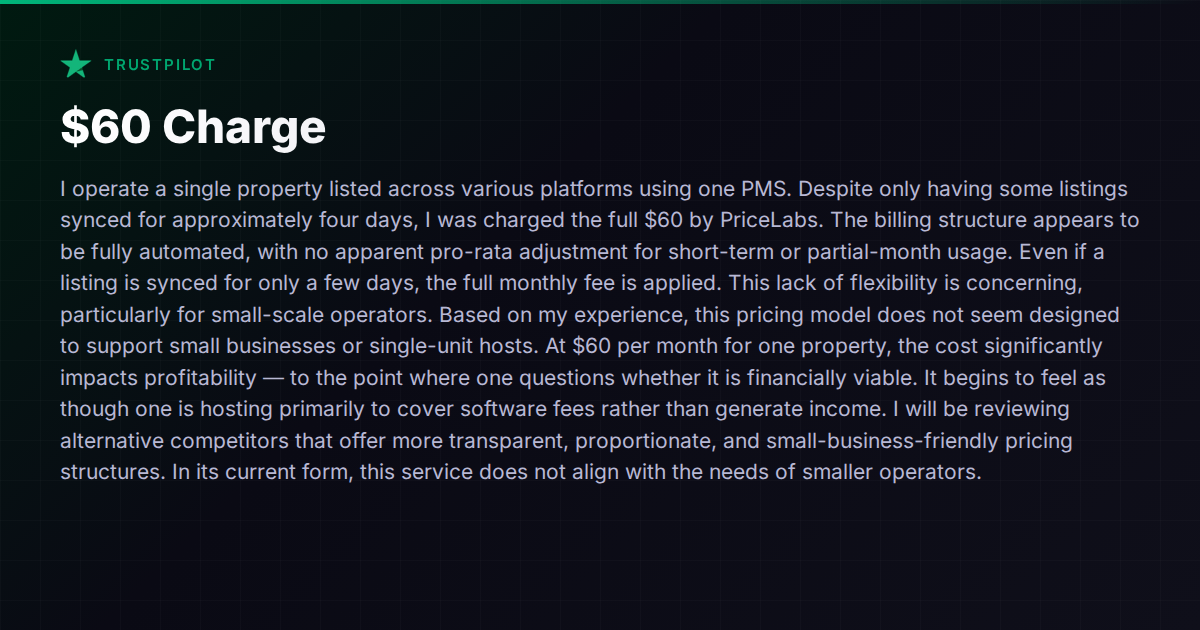
A single-property host recently shared their experience on Trustpilot after syncing their listing with PriceLabs for roughly four days. The bill: a full $60 monthly charge, with no pro-rata adjustment for partial usage. Their summary was blunt — at that price point for one property, you start to wonder whether you’re hosting to make money or just to cover software fees.
It’s a complaint that resonates with a specific but enormous segment of the short-term rental market: operators managing one to five properties who need smarter pricing but can’t justify enterprise-grade costs.
The Math That Doesn’t Work
Dynamic pricing tools exist because they genuinely help. A well-calibrated algorithm that adjusts nightly rates based on demand, seasonality, local events, and competitor pricing can meaningfully increase revenue — sometimes by 20-40% according to vendor claims, though real-world results depend heavily on market and execution.
But the value equation flips when the tool’s cost represents a significant percentage of your gross revenue. A single property earning $1,500/month in a mid-tier market is giving up 4% of gross revenue to a pricing tool alone — before PMS fees, channel commissions, cleaning costs, and maintenance. For a host earning $800/month on a modest listing, that $60 is 7.5% of top-line revenue, and the dynamic pricing lift may not even cover the subscription.
The broader issue isn’t that PriceLabs is a bad product. It’s that most dynamic pricing tools were designed — architecturally and commercially — for operators managing dozens or hundreds of listings. The per-listing cost drops as you scale, and the absolute dollar gain per listing justifies the fee. At one property, the math simply doesn’t pencil.
How the Major Dynamic Pricing Tools Actually Price
Let’s look at the landscape honestly.
PriceLabs uses a tiered per-listing model. Their published pricing starts lower per listing at higher volumes, but for a single property with listings across multiple platforms, costs can escalate quickly depending on how many synced connections count as separate “listings.” The Trustpilot complaint specifically notes that multiple platform listings from one PMS drove the bill to $60 — a detail that matters for hosts who cross-list on Airbnb, VRBO, and Booking.com.
Beyond Pricing (now part of the Guesty ecosystem after acquisition) charges a percentage of booked revenue rather than a flat fee. For small operators, percentage-based pricing at least scales with actual income — you pay more when you earn more, less when you don’t. The downside: when your property is performing well, the fee can exceed what a flat subscription would have cost.
Wheelhouse offers a free tier with limited features and paid tiers that start modestly. For a single-property host, the free tier may be enough to get basic market data and pricing suggestions without any ongoing cost.
DPGO (now Rategenie) and Smartpricing also compete in this space with varying pricing structures, some more friendly to small portfolios than others.
The key question isn’t just “how much does it cost?” but “does the billing model align with how I actually use the tool?” A host who syncs for four days and gets charged for a full month has every right to question the alignment.
The PMS Angle: When Pricing Is Already Bundled
One underappreciated alternative is choosing a PMS that includes basic pricing intelligence as part of the core platform rather than requiring a separate subscription.
Hostaway includes built-in pricing tools alongside its channel management — though their pricing isn’t publicly disclosed, so you’d need a quote to understand the total cost. Lodgify also bundles pricing features into its vacation rental platform, with a focus on making the all-in-one experience accessible to smaller operators.
Guesty offers revenue management tools as part of its enterprise platform, but their pricing is quote-based and historically positioned for larger portfolios — not typically the first stop for a single-property host.
Hospitable integrates with external dynamic pricing tools rather than building its own, so you’d still face the third-party subscription question, though their platform fee is structured with smaller operators in mind.
For hosts who want AI-driven operations beyond just pricing, Vanio AI takes a different approach to the cost question entirely. Rather than charging per listing per month, its pricing is $5 per reservation — covering the full operational lifecycle including messaging, task dispatch, smart locks, and guest communication. It doesn’t include a standalone dynamic pricing engine, but its per-reservation model means you never pay for months when your property sits empty, and the cost scales directly with actual bookings. For a single-property host doing 10-15 bookings per month, that’s $50-75 for an entire operations platform versus $60 for pricing alone.
The Real Trade-Off for Small Operators
Small-portfolio hosts face a genuine dilemma with dynamic pricing:
Option 1: Pay for a dedicated pricing tool. You get sophisticated algorithms, market data, and potentially meaningful revenue uplift — but the fixed cost may eat a significant share of that uplift on a single property.
Option 2: Do your own pricing research. Check competitor rates on Airbnb, review AirDNA or Mashvisor market data, adjust manually for seasons and events. Time-consuming but free. For one property in a market you know well, this can be surprisingly effective.
Option 3: Use a PMS with built-in pricing features. Less sophisticated than a dedicated tool, but eliminates the separate subscription. The quality varies dramatically between platforms.
Option 4: Use a tool with usage-aligned billing. Percentage-of-revenue models, free tiers, or per-reservation pricing that naturally scales with your actual business activity.
There’s no universally right answer. A single-property host in a competitive urban market with high rate volatility will benefit more from dynamic pricing than a rural cabin with steady demand and limited competition.
What to Actually Look For
If you’re a small operator evaluating pricing tools — or any STR software — here are the questions that matter:
- How does the billing count listings? If you cross-list on three platforms through one PMS, are you charged for one listing or three? This is where unexpected costs often hide.
- Is there pro-rata billing or a trial period? Being charged a full month for four days of usage is a policy choice, not a technical limitation. It tells you something about how the company views small customers.
- What’s the minimum viable plan? Some tools technically support one property but price the entry tier assuming five or ten.
- Can you pause or cancel without penalty? Seasonal hosts who only operate six months a year shouldn’t pay for twelve.
- Does the revenue uplift justify the cost for your specific property? Run the numbers with conservative assumptions, not the vendor’s best-case scenarios.
The Bigger Picture
The STR tool market was built during a period of rapid portfolio growth, when operators were scaling from five to fifty to five hundred properties. The pricing models reflect that era — they reward scale and inadvertently penalize the single-property host who represents the vast majority of Airbnb’s supply.
That’s slowly changing. Per-reservation pricing, free tiers, and bundled platforms are all responses to the reality that most hosts aren’t running property management companies. They’re individuals with one or two properties trying to generate supplemental income without spending all of it on software.
The host who posted that Trustpilot review isn’t wrong that the current model doesn’t serve them. The good news is they have options. The relevant comparison pages at /compare/ break down how different platforms handle pricing and bundling across the PMS landscape — worth reviewing before committing to another subscription.