When Your Dynamic Pricing Tool Needs You to Do the Pricing
Trustpilot
TL;DR: Multi-listing operator found Beyond Pricing's automated rates significantly out of market, requiring constant manual overrides, and was still charged commissions despite doing the pricing work themselves.
The pitch from every dynamic pricing vendor sounds roughly the same: hyperlocal data, machine learning, set-it-and-forget-it optimization. You plug in your listings, the algorithm does its thing, and occupancy goes up while ADR stays strong. But a growing number of multi-listing operators are reporting a very different experience — one where the “automated” rates are so far off-market that the host ends up doing the pricing work manually, while the vendor still collects its fee.
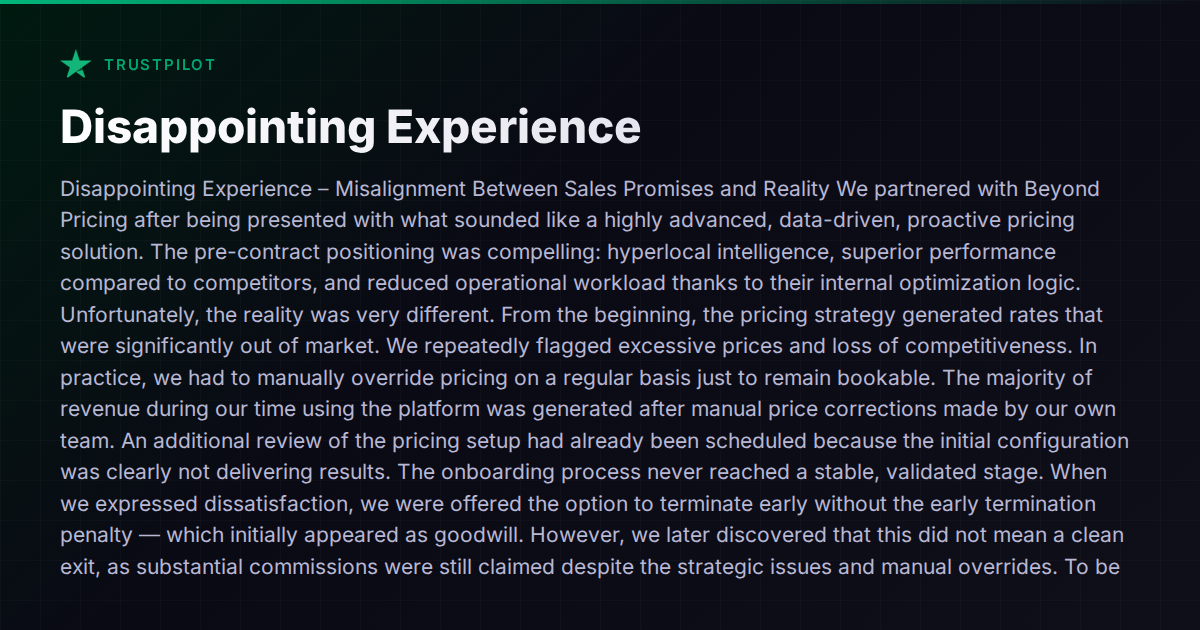
A recent Trustpilot review from a multi-property operator captures the pattern precisely. After signing with Beyond Pricing based on pre-sales claims of hyperlocal intelligence and superior performance, the team found the generated rates “significantly out of market.” They spent months manually overriding prices just to stay bookable. The majority of their revenue, by their own account, came from corrections made by their in-house team — not the algorithm. When they tried to exit, they discovered that commissions were still owed on bookings where the tool’s pricing had been manually replaced.
This isn’t a one-off story. It’s a structural pattern worth understanding before you commit to any revenue-share or commission-based pricing tool.
The Core Problem: Revenue-Share on Influence You Can’t Measure
Most dynamic pricing tools charge either a flat subscription fee or a percentage of revenue. The subscription model is straightforward — you pay regardless of performance. The commission model sounds more aligned with your interests (“we only win when you win”), but it introduces a subtle and often painful misalignment: the vendor claims credit for revenue even when you’ve overridden their prices.
This happens because “influence” is loosely defined. If the tool set the initial price and you adjusted it downward by 30% to actually get a booking, did the tool influence that booking? The vendor says yes. You, having done the analysis and made the correction, say no. The contract language almost always favors the vendor.
Before signing any commission-based pricing agreement, get answers in writing to these questions:
- What constitutes a “managed” booking? Is it any booking on a listing connected to the tool, or only bookings where the tool’s recommended price was accepted within a defined threshold?
- How are manual overrides treated? If you override the price by more than X%, does the booking still count toward their commission?
- What’s the exit clause? Early termination penalties are common, and “waiving the penalty” may still leave you on the hook for trailing commissions.
Why Algorithms Miss — and Why It Matters More at Scale
Dynamic pricing tools generally work best in dense, well-indexed markets where the algorithm has plenty of comparable data: urban apartments in major tourist cities, beach condos in established resort areas. The further you get from those archetypes — boutique rural properties, unusual unit types, markets with thin booking data — the worse the models perform.
Beyond Pricing, PriceLabs, Wheelhouse, and similar tools all rely on comparable property data, seasonal patterns, and demand signals. When the comp set is wrong or the market is thin, the algorithm can consistently overshoot or undershoot. The operator in the Trustpilot review described rates that were “significantly out of market” — a classic symptom of a poorly calibrated comp set that nobody caught during onboarding.
The problem compounds at scale. A solo host with two listings can eyeball rates every morning and catch errors. An operator with 20, 50, or 200 listings cannot manually audit every rate every day — which is exactly why they bought the tool in the first place. When the tool requires daily manual oversight to function, it hasn’t reduced your operational workload. It’s added a layer of complexity on top of it.
The Onboarding Gap Nobody Talks About
Most pricing tools require meaningful configuration: setting base prices, minimum and maximum rate boundaries, defining your competitive set, adjusting for property-specific factors (views, amenities, proximity to attractions). This setup phase is critical, and it’s where many engagements go sideways.
The operator in the review noted that “the onboarding process never reached a stable, validated stage” — meaning the tool was live and affecting real bookings before the configuration was dialed in. This is more common than vendors admit. Sales cycles are fast, onboarding teams are stretched, and there’s pressure to go live quickly so the commission meter starts running.
If you’re evaluating a pricing tool, ask:
- How long does onboarding typically take for a portfolio your size?
- Is there a “validation period” where rates are reviewed before going live?
- Who on their team is responsible for ongoing rate quality, and what’s their portfolio load?
Surveying the Landscape
The dynamic pricing space is crowded, and no single tool is universally best. Here’s a honest lay of the land:
PriceLabs is popular among operators who want granular control. It offers extensive customization — neighborhood-level comp sets, rule-based adjustments, orphan-day management — but it demands operator engagement. It’s a power tool, not autopilot. Pricing is subscription-based (per listing, per month), which avoids the commission trap entirely.
Wheelhouse takes a similar approach with a choice between subscription and revenue-share models. It’s transparent about the trade-off: pay flat and keep full control, or pay a percentage for a more managed experience.
Beyond Pricing, as noted in the review, uses a commission-based model. The upside is low upfront commitment; the downside is the misalignment described above when manual overrides are needed.
Several PMS platforms have started building pricing features directly into their systems. Hostaway integrates with multiple third-party pricing tools and has its own pricing capabilities. Guesty similarly connects to pricing tools and offers some in-platform rate management. Lodgify provides basic pricing rules within its platform. These integrations mean you can often swap pricing tools without changing your entire stack — useful if your first choice doesn’t perform.
Vanio AI takes a different angle: its calendar supports per-date price overrides, weekend pricing, channel-specific markups, and discount rules (weekly, monthly, early bird, last minute) within the platform itself. For operators who prefer manual control with structured rules rather than full algorithmic delegation, this can reduce dependency on a separate pricing tool. It doesn’t replace a dedicated dynamic pricing engine for operators who want demand-responsive rates, but it eliminates the need for one if your strategy is rule-based.
The Real Cost of a Bad Pricing Tool
The financial damage from a poorly calibrated pricing tool isn’t just the commission or subscription fee. It’s the bookings you didn’t get because rates were too high, the margin you left on the table when rates were too low, and the hours your team spent manually correcting what was supposed to be automated.
For the operator in the review, the real cost was months of lost competitiveness plus commissions paid on revenue they generated themselves through manual corrections. That’s a double hit — underperformance plus fees on the fix.
What to Do Before You Sign
- Start with a subscription model if possible. Commission-based pricing creates misaligned incentives when manual overrides are needed.
- Define override rules in writing. If you adjust prices by more than a set percentage, that booking should not count toward the vendor’s commission.
- Demand a validation period. No live bookings until both sides agree the configuration is producing reasonable rates.
- Audit weekly, not monthly. Check a sample of your listings against actual market rates every week for the first 90 days.
- Have an exit plan. Understand trailing commission obligations, data portability, and how quickly you can disconnect.
Dynamic pricing tools can genuinely improve revenue when properly configured and monitored. But “data-driven” doesn’t mean “correct,” and “automated” doesn’t mean “hands-off.” The operators who get the most value from these tools are the ones who treat the algorithm as a starting point, not a finished answer — and who make sure their contract reflects that reality.
For a broader look at how different platforms handle pricing and operational automation, the comparison hub at /compare/ breaks down features across the major PMS and operational tools in the space.