When Your PMS Raises Prices 27% and You're Still Filing Support Tickets Every Other Day
Trustpilot
TL;DR: Author is fed up with Smoobu after a 27% price hike and frequent support tickets, signaling readiness to switch.
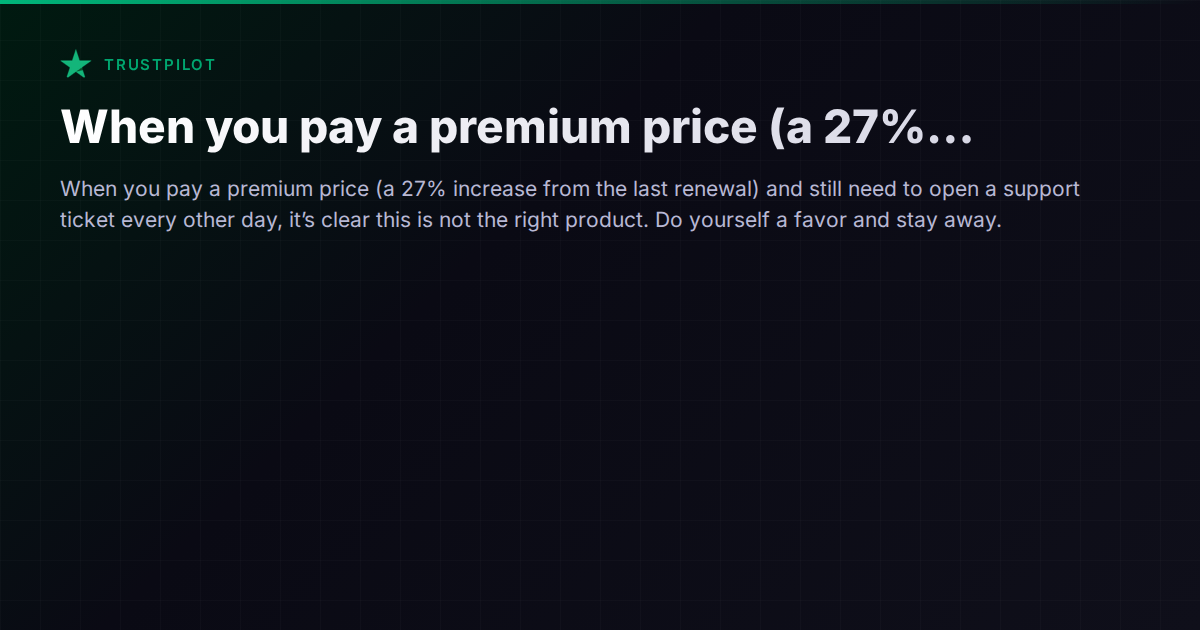
A recent Trustpilot review of Smoobu distilled a frustration that many short-term rental operators know intimately: “When you pay a premium price (a 27% increase from the last renewal) and still need to open a support ticket every other day, it’s clear this is not the right product.”
One sentence. Two distinct problems. And the combination is more toxic than either issue on its own.
The Two-Headed Problem: Price Increases + Persistent Bugs
Most operators can tolerate a price hike if the product is getting meaningfully better. And most can forgive rough edges in a tool that’s priced affordably enough to justify the friction. What breaks the relationship is when both happen simultaneously — you’re paying more, and you’re still spending hours every week managing the tool that’s supposed to be managing your properties.
This isn’t unique to Smoobu. Across the PMS landscape, operators regularly report renewal-time sticker shock paired with stagnant or regressing product quality. The pattern typically looks like this:
- Year one: The platform works well enough. You invest time migrating listings, training staff, configuring automations.
- Year two: Price increases by 15-30%. A few new features ship, but the bugs you reported months ago are still open.
- Year three: You realize you’re spending as much time working around the tool’s limitations as you’re saving by using it.
By year three, switching costs feel enormous — you’ve built workflows, your team knows the interface, your channel connections are wired in. The platform knows this. That’s why the price goes up.
Why PMS Support Tickets Pile Up
Filing a support ticket “every other day” isn’t normal. But it’s not uncommon either, especially with platforms that have grown faster than their engineering and support teams can keep up. The usual culprits:
- Channel sync failures: Calendar or pricing data doesn’t propagate correctly to Airbnb, Booking.com, or VRBO. You catch it manually (or worse, a guest catches it for you via a double booking).
- Automation misfires: A scheduled message doesn’t send, a task doesn’t trigger, a pricing rule applies incorrectly.
- UI/UX regressions: A product update breaks something that was working. The changelog announces a new feature; the side effect is a broken workflow.
- Slow or template-driven support: Responses take days, or worse, you get a canned reply that doesn’t address your specific issue.
When you’re managing 10, 20, or 50+ properties, each support ticket isn’t just an inconvenience — it’s an operational risk. A sync failure on a Friday night can mean a double booking, a bad review, and a refund.
How the Major Platforms Stack Up on Price Transparency and Stability
Let’s be honest about the landscape.
Smoobu has historically attracted smaller operators with competitive entry pricing and a relatively straightforward feature set. But as the review illustrates, renewal pricing can jump significantly, and the support experience doesn’t always scale with the price tag.
Hostaway doesn’t publish pricing at all — you have to request a quote. This gives them flexibility to negotiate, but it also means you have limited leverage when renewal time comes. Operators with larger portfolios generally report decent support, but smaller hosts sometimes feel deprioritized.
Guesty targets the professional and enterprise end of the market. Their pricing is also opaque (quote-based), and the platform is feature-rich but complex. If you need enterprise-grade tools, Guesty delivers. If you’re a 5-15 property operator, you may find yourself paying for capabilities you don’t use while still dealing with the learning curve.
Hospitable takes a different approach — tiered plans with relatively clear feature gates. The product focuses heavily on automated messaging and task management, which keeps the scope tighter and (in theory) the bug surface smaller. It’s a solid option for operators who primarily need communication automation and channel sync.
Lodgify emphasizes its direct booking website builder alongside standard PMS features. They offer personalized onboarding (free one-on-one setup), which can reduce the “filing tickets every other day” problem early on. Pricing isn’t fully transparent either, but they do run subscription-based plans rather than purely quote-based models.
Beds24 is worth mentioning for operators who prioritize configurability over polish. It’s deeply flexible but has a steep learning curve. The trade-off: fewer surprise price hikes, but more time invested in self-service setup.
What to Evaluate Before Your Next Renewal
If you’re in the position described in that Trustpilot review — paying more, filing tickets constantly, questioning the ROI — here’s a practical framework before you either renew or migrate:
1. Quantify your support burden
Count the tickets you’ve filed in the last 90 days. Categorize them: sync issues, billing, bugs, feature requests. If more than half are bugs or sync failures, the platform has a reliability problem that price increases won’t fix.
2. Calculate your real cost
The subscription fee is the floor, not the ceiling. Add up the hours you or your team spend on workarounds, manual interventions, and support correspondence. A $100/month platform that costs you 10 hours of labor per month isn’t cheap.
3. Check the pricing model structure
Per-listing fees scale linearly with your portfolio and create predictable cost increases. Per-reservation fees (like Vanio AI’s $5/reservation model) scale with actual business activity instead. Quote-based pricing gives you no visibility until the renewal email lands. Understand which model aligns with how your business grows.
4. Evaluate whether AI reduces the support surface
Many support tickets exist because the operator is doing something manually that should be automated — or because an automation failed silently. Platforms with AI-native architectures (where the AI has direct access to every subsystem rather than sitting on top via integrations) can catch and resolve issues before they become tickets. Vanio AI’s Operations Watchdog, for instance, runs a daily automated check across messaging, access codes, cleaning, and payments — fixing what it can and escalating what it can’t. That’s fundamentally different from a system where you discover the problem yourself and then file a ticket about it.
5. Negotiate or walk
If you decide to stay, use your support ticket history as leverage. Platforms don’t want to lose an established customer. If the response is “this is the new price, take it or leave it,” that tells you everything about the relationship going forward.
The Uncomfortable Truth About Switching
Migrating PMS platforms is genuinely painful. Channel connections need to be re-established. Automations need to be rebuilt. Staff need to be retrained. There’s always a transition period where things break.
But staying on a platform that’s charging more while delivering less is its own kind of pain — it’s just the slow, chronic kind that’s easy to normalize until a double booking or a missed guest message forces the issue.
The operator who left that Trustpilot review arrived at a clear conclusion: the product wasn’t worth the price. Whether you’re in the same position depends on your own support ticket count, your renewal notice, and your honest assessment of whether the trend line is improving or getting worse.
For a side-by-side look at how the major platforms compare on pricing transparency, automation depth, and support quality, the comparison hub is a good starting point.