PMS Price Hikes Are the New Normal — How to Think About What You're Actually Paying For
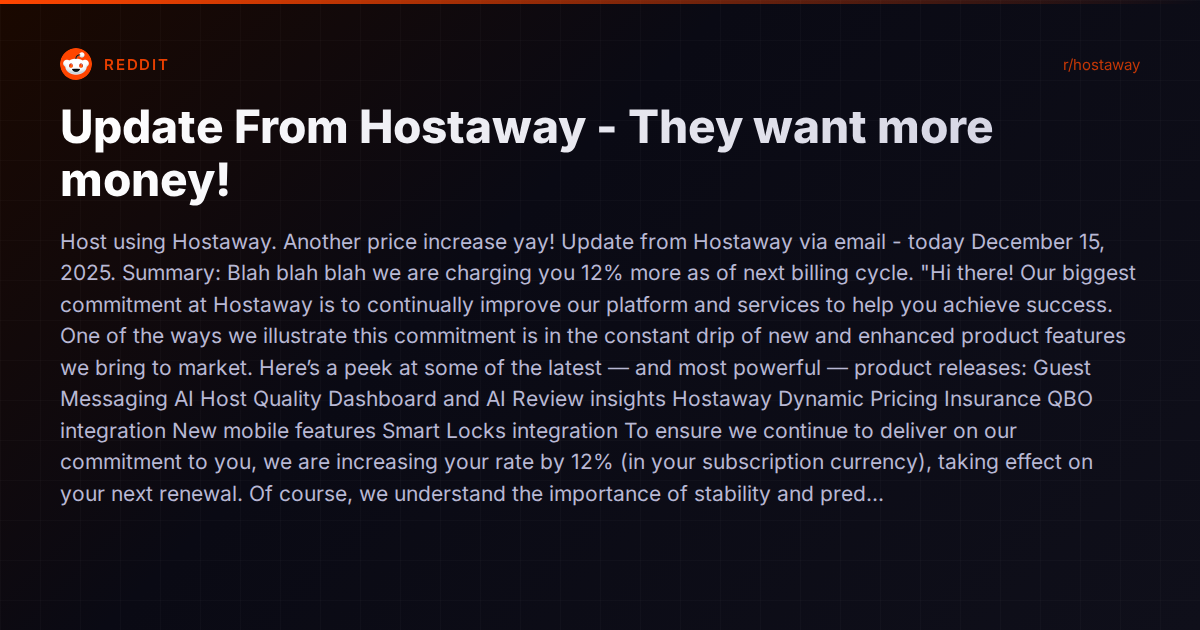
TL;DR: Hostaway user frustrated by a 12% price hike and feels the company is adding 'nonsense features' while charging more, expressing distrust of all PMS companies' pricing practices.
If you manage short-term rentals long enough, you’ll eventually open an email that reads something like: “We’re increasing your rate by 12%, effective on your next renewal. But great news — you can lock in this new rate for 12 months by switching to an annual plan!”
That’s almost exactly what Hostaway sent its users in late 2025. And based on the reaction in host communities, the frustration wasn’t just about the dollar amount. It was about the pattern: new features get shipped that operators didn’t ask for, and then the bill goes up to pay for them.
One property manager put it bluntly: “I probably wouldn’t mind as much if customer service was top notch, I was a property manager that passed the cost on to a client, or these were things I wanted or asked for. But they aren’t.”
This isn’t a Hostaway-specific problem. It’s an industry-wide dynamic that’s worth understanding clearly — especially if you’re evaluating whether to stay with your current platform or move.
The Pattern: Ship Features, Raise Prices, Repeat
Most PMS companies follow a similar lifecycle. In the early days, pricing is aggressive — they need market share. As the product matures and the company takes on investors or pursues profitability, prices creep upward. The justification is always the same: we built new things, those things cost money, and you benefit from them.
Sometimes that’s true. Sometimes you get a genuinely useful capability — better channel sync, a real direct booking engine, smarter automation. But just as often, the new features are things the company wanted to build for strategic reasons (AI features for marketing positioning, insurance products for new revenue streams, enterprise dashboards for upmarket sales) rather than things the existing customer base was requesting.
The 12% increase Hostaway announced came bundled with a list of new capabilities: Guest Messaging AI, a Host Quality Dashboard, dynamic pricing, insurance, QuickBooks integration, smart locks integration, and new mobile features. For some operators, several of those are genuinely valuable. For others — particularly smaller hosts who just need reliable sync, a clean inbox, and competent support — it feels like paying for someone else’s roadmap.
The Lock-In Problem
What makes PMS price increases especially painful is the switching cost. Moving platforms means re-connecting channels, re-building automations, re-training staff, and enduring weeks of instability during the transition. PMS companies know this, which is why the standard play is to offer an annual commitment as a “price lock” — framing the increase as an opportunity to secure stability.
One Hostaway user described it perfectly: “It sucks being all set up and having to figure out if making a move is worth it or not.” And then added the kicker: when they replied to the price increase email to explore options, they never got a response.
This is the structural incentive problem in PMS pricing. Once you’re embedded, the vendor’s cost to retain you is almost zero — even mediocre retention effort works because migration is so painful. That asymmetry makes annual price increases nearly friction-free for the vendor.
What’s Actually Happening at the Major Platforms
Let’s be honest about the landscape:
Hostaway doesn’t publicly disclose pricing — you have to request a quote. This opacity makes it hard to benchmark, and when increases arrive, users have no reference point for whether they’re paying market rate or a loyalty penalty. That said, several operators in the same thread acknowledged that the platform’s channel sync and unified inbox genuinely save them time. The product isn’t bad. The pricing communication is.
Guesty has historically targeted larger operators and doesn’t publish pricing either. Their enterprise positioning means prices tend to be higher, but they offset this with add-on services like managed guest communications and extensive integrations. If you’re running 50+ units and need an enterprise-grade tool, Guesty delivers — but you’ll pay for it, and the cost structure can be opaque.
Hospitable has generally been perceived as more affordable and transparent, particularly for smaller portfolios. Its strength is automated guest messaging and straightforward channel management. It’s a leaner tool — fewer bells and whistles, but also fewer surprises on the invoice.
Lodgify publishes pricing tiers and has historically been on the lower end of the cost spectrum, with a strong focus on direct booking websites. For hosts who prioritize driving direct bookings and want a simpler tech stack, Lodgify is a reasonable option, though its feature set for operations management is less comprehensive.
The Real Question: What Are You Paying Per Reservation?
The most useful way to evaluate PMS pricing isn’t the monthly subscription — it’s the fully loaded cost per reservation. That means: base subscription + per-listing fees + add-ons (messaging tools, cleaning coordination, lock management, payment processing, review management) ÷ total reservations per month.
Most operators running the math discover they’re spending $8-$20+ per reservation across their full tool stack once you add the third-party bolt-ons that the PMS doesn’t cover natively. The PMS subscription itself is often only 30-50% of the total cost.
This is where the “all-in-one vs. best-of-breed” debate gets real. A platform that charges more per listing but eliminates three separate subscriptions (cleaning coordination, smart lock management, AI messaging) might actually cost less per reservation than a cheaper PMS plus Turno plus a lock manager plus a messaging bot.
Vanio AI takes this approach explicitly: a per-listing base fee plus $5 per active reservation that covers the full guest lifecycle — messaging across all channels, voice calls, lock codes, task dispatch, upsells, review management. Whether that math works for your portfolio depends on your current tool stack and volume, but the model is at least transparent and auditable. You can calculate your monthly cost on a napkin before you sign up.
How to Protect Yourself From PMS Price Creep
A few practical principles:
1. Know your total cost, not just your PMS cost. List every tool you pay for that touches the guest experience or operations. Calculate cost per reservation. This is the number that matters when comparing platforms or evaluating a price increase.
2. Treat annual commitments with skepticism. A 12-month price lock sounds appealing until you realize it’s usually just locking in the new, higher price. Run the math: is the annual discount actually cheaper than your current rate, or just cheaper than the increased rate?
3. Evaluate migration cost honestly. Switching PMS platforms typically takes 2-4 weeks of active work and 1-2 months of stabilization. For a 5-unit host, that might be worth avoiding a $40/month increase. For a 50-unit operator, it might be worth it. Know your number.
4. Ask what you’re not using. If your PMS ships 10 new features and you’d use two of them, you’re subsidizing capabilities built for other customers. That’s not inherently wrong — every SaaS works this way — but it’s worth acknowledging when the price goes up.
5. Watch support quality as the leading indicator. Several operators in the Hostaway thread noted that support responsiveness had declined even as prices increased. When a PMS company stops investing in support to fund feature development, that’s a signal about where their priorities lie.
The Uncomfortable Truth
Every PMS will eventually raise prices. The question isn’t whether it happens — it’s whether the value you’re getting scales proportionally. If your PMS is genuinely saving you hours per week, preventing double bookings, and enabling you to manage more properties without more staff, a 12% increase might be a reasonable cost of doing business. If it’s delivering the same sluggish experience with a fancier dashboard, it’s a tax on your switching costs.
The operators who navigate this best are the ones who audit their tech stack annually, know their cost per reservation, and maintain enough documentation that switching platforms — if it ever comes to that — is measured in days, not months.
No platform is forever. Know your numbers, and you’ll always have options.