Locked Into a PMS Contract Before You Even Open: How to Avoid the Vendor Lock-In Trap
Trustpilot
TL;DR: Small motel owner locked into a 12-month Operto contract for a tool that turned out to be incompatible with their software, and Operto refuses to release them despite widespread bugginess reported by peers.
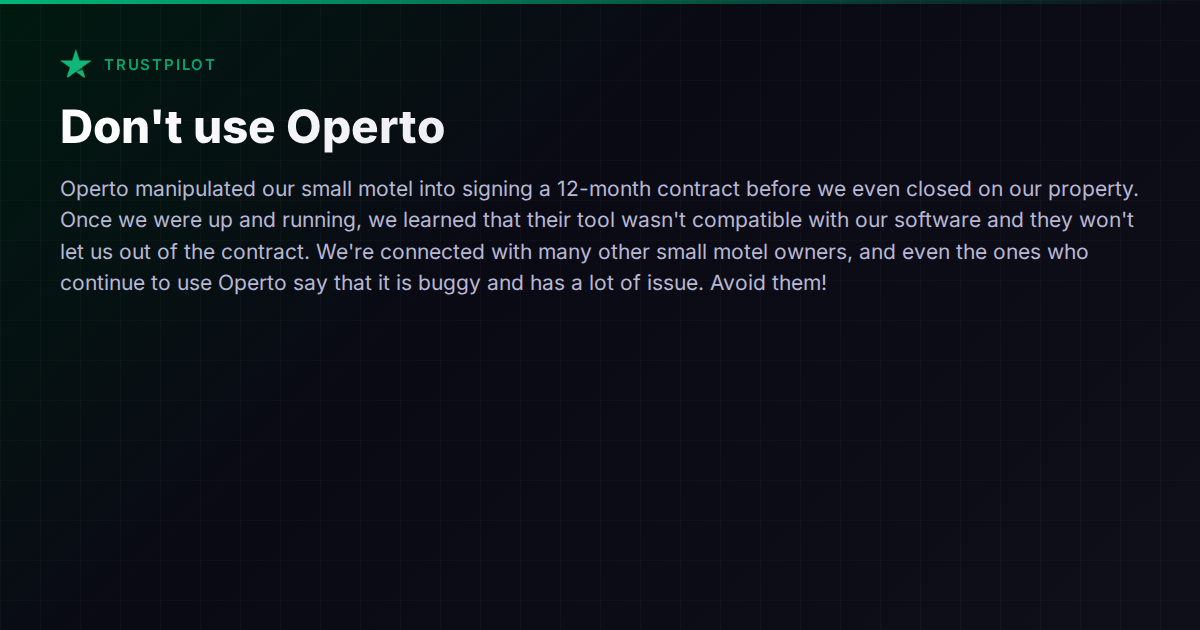
A small motel owner recently shared a cautionary tale on Trustpilot: they signed a 12-month contract with Operto before even closing on their property, only to discover the tool was incompatible with their existing software stack. Operto wouldn’t let them out. Other motel operators in their network confirmed ongoing bugs and reliability issues. It’s the kind of story that makes experienced operators wince — not because it’s rare, but because it’s depressingly common.
Vendor lock-in is one of the most expensive mistakes a short-term rental operator can make. And it doesn’t just happen to newcomers. It happens to seasoned managers who trust a sales demo, sign during a promo window, and discover the integration gaps after they’ve committed.
How Operators End Up Trapped
The pattern is predictable:
- The pre-launch sales push. A vendor catches you during acquisition, renovation, or pre-opening — the period when you’re most overwhelmed and least equipped to evaluate software deeply. They offer a “deal” if you sign now.
- The compatibility surprise. Once you start connecting your PMS, lock system, channel manager, or accounting software, you discover critical integrations don’t work as promised — or don’t work at all.
- The contract wall. You ask to cancel. The vendor points to the 12-month term. You’re stuck paying for software you can’t use, while also paying for whatever replacement you need.
This isn’t unique to Operto. Operators report similar friction with a range of tools across the STR ecosystem. The bigger the vendor’s sales team relative to their support team, the more likely this pattern shows up.
What “Compatibility” Actually Means in Practice
When a vendor says they integrate with Airbnb, Booking.com, or your smart lock brand, that can mean anything from “full two-way API sync with real-time updates” to “we support iCal import and it mostly works.” The gap between those two realities is where operators get burned.
Before signing anything, you need answers to specific questions:
- Which PMS/channel manager does this tool actually sync with via API? Not “we’re working on it” — today, in production.
- What data flows in which direction? Can the tool push and pull reservations, pricing, availability, and messages? Or just calendar blocks?
- What happens when the sync breaks? Is there a fallback? How fast is support response on integration issues?
- Does the vendor have a sandbox or trial that lets you test with your real stack? If the answer is no, that’s a red flag.
The Contract Question: What to Look For
Not all annual contracts are predatory. Some vendors offer meaningful discounts for annual commitment, and that’s a fair trade when the product works. The problem is contracts that lock you in before you’ve had a chance to validate the tool in production.
Here’s what to negotiate before signing:
- A meaningful trial period. 14 days minimum, ideally 30, with no credit card required or with a money-back guarantee. If a vendor won’t let you test before committing, ask yourself why.
- An out clause for integration failure. If the tool demonstrably doesn’t work with your declared software stack, you should be able to exit without penalty.
- Month-to-month availability. Even if it costs more per month, starting month-to-month until you’ve confirmed the tool works in your environment is almost always worth the premium.
- Clear cancellation terms. Written down, not verbal. “We’ll work something out” is not a cancellation policy.
How the Major Platforms Handle This
The STR software market is wide, and vendors vary significantly in how they approach contracts, trials, and integration depth.
Guesty targets larger professional operators and offers deep integrations with major OTAs. However, Guesty doesn’t publicly disclose pricing, which means you’re negotiating custom contracts — and that can cut both ways. The depth is there for operators who need enterprise-grade channel management, but the opacity of pricing means you need to read every clause carefully.
Hostaway similarly uses quote-based pricing with no public rates. Their channel manager and unified inbox are well-regarded among mid-to-large operators, but the lack of transparent pricing means the contract conversation matters more, not less. Operators who’ve gone through Hostaway onboarding report mixed experiences — some smooth, some stalled — so confirming your specific integration needs before signing is critical.
Hospitable takes a different approach, with tiered plans and a focus on messaging automation across Airbnb, Vrbo, and Booking.com. Their automation layer is strong for hosts who want to reduce guest communication overhead. Smart device support covers thermostats from Honeywell and Ecobee, but the lock and IoT ecosystem is narrower than some competitors. Worth evaluating if messaging automation is your primary pain point.
Lodgify emphasizes ease of use and offers free one-on-one onboarding support, which directly addresses the “signed before I understood it” problem. Their focus on direct booking websites and channel sync is solid for smaller operators, though the platform’s depth in operations management (task dispatch, lock management, cleaning coordination) is more limited compared to all-in-one systems.
Operto itself focuses heavily on smart lock and IoT management — it’s not a full PMS but rather a guest experience layer. When it works with your existing stack, operators find value in the hardware automation. When it doesn’t, you’re paying for a tool that can’t do its job, which is exactly the situation described in the Trustpilot review.
The All-in-One Trade-Off
One way to reduce compatibility risk is to consolidate your stack into fewer tools. If your PMS, channel manager, lock management, guest messaging, and task dispatch all live in one system, you eliminate most of the integration surface area where things break.
Vanio AI takes this approach to its logical conclusion — it’s built as a single system where AI has native access to reservations, locks, payments, messaging, and cleaning coordination without middleware. The 14-day free trial with no credit card required means you can validate compatibility with your Airbnb, Booking.com, and VRBO listings before committing. The per-reservation pricing model ($5/reservation) also means you’re not locked into paying for capacity you haven’t used.
That said, all-in-one platforms carry their own risk: you’re betting on one vendor across every operational domain. If that vendor has a bad day, everything is affected. The trade-off is real, and operators should weigh it honestly against the integration fragility of a multi-tool stack.
Before You Sign Anything
The motel owner’s story isn’t really about Operto specifically. It’s about what happens when the sales cycle moves faster than the evaluation cycle. A few principles that apply regardless of which vendor you’re considering:
- Never sign an annual contract during pre-opening. You don’t know what you need yet.
- Test integrations with your actual software, not a demo environment. If the vendor can’t support this, walk.
- Talk to operators with a similar setup. Not the vendor’s hand-picked references — find them in host communities, forums, or industry groups.
- Read the cancellation terms before you read the feature list. The features don’t matter if you can’t leave when they don’t work.
For a broader look at how the major platforms compare on pricing transparency, contract flexibility, and integration depth, the comparison hub covers 25+ tools side by side.