When Airbnb Stops Working for You: A Practical Guide to Platform Diversification in 2026
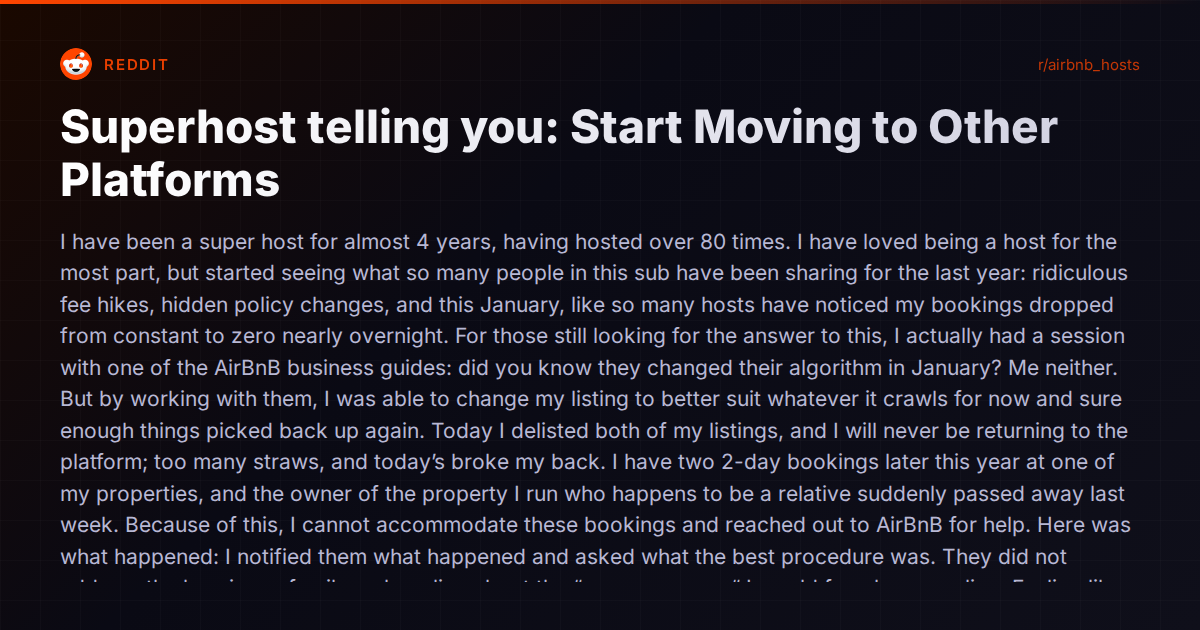
TL;DR: Superhost with 80+ stays is delisting from Airbnb after inhumane cancellation policy enforcement around a family death, fee hikes, and algorithm changes — actively migrating to Booking.com, VRBO, and direct booking.
A long-time Superhost with 80+ stays recently delisted both properties from Airbnb after a cascade of frustrations — fee increases, an unannounced algorithm change in January that cratered bookings overnight, and a final straw that’s hard to read without wincing: when a family member who owned one of their properties suddenly passed away, the host needed to cancel two future bookings. Airbnb’s response never acknowledged the loss, only the penalties. Both guests tried to cancel voluntarily to spare the host — and Airbnb reportedly intercepted those cancellations and insisted the host pay penalties anyway. No phone call. No escalation. Just policy.
The post resonated because it hit every nerve that short-term rental operators have been nursing for the past year. But the broader lesson isn’t really about one bad support interaction. It’s about what happens when you build a business on a single platform that can change the rules without telling you.
The Single-Platform Trap
If 95% of your bookings come from one channel — and multiple hosts in the same thread admitted exactly that — you don’t have a rental business. You have an Airbnb business. And Airbnb is not your partner. It’s a marketplace that optimizes for its own metrics.
Algorithm changes, fee restructuring, and support quality degradation are not bugs. They’re features of a publicly traded company under constant pressure to improve take rates and unit economics. When the algorithm shifted in January 2026, hosts who had been fully booked saw occupancy drop to zero with no notification. The host in this case only learned what happened by booking a session with an Airbnb “business guide” — a resource most operators don’t even know exists.
Another veteran in the thread — a 10-year Superhost with 80%+ occupancy over their entire run — noted they’d already exited in 2025 when insurance costs for STR use became prohibitive. Their parting observation: they probably got out at exactly the right time.
Where Hosts Are Going
The operators leaving Airbnb aren’t quitting the STR business. They’re redistributing. The destinations break into three buckets.
1. Booking.com and VRBO
These are the obvious first moves. Both platforms have large traveler audiences, and listing on them requires relatively little incremental work if you already have listing content and photos. The original poster reported “great success” on both.
The catch: each platform has its own quirks. Booking.com’s virtual credit card system, VRBO’s agency-style account structure, and different cancellation policy frameworks all require learning curves. And you’re still renting on someone else’s platform with someone else’s rules.
2. Direct Booking Websites
One host in the thread shared that they went “all in on direct” eight months ago and just hit their best month — roughly half their total booking revenue coming through their own website. The catalyst? Airbnb awarded a guest a 30% refund (over $1,000) because a Connect 4 game was missing pieces. At a property with a full arcade, theater, heated pool, and spa.
Direct booking is the holy grail for margin and control, but it’s genuinely hard. You need a website that converts, a payment processor, guest screening, damage protection, and some way to drive traffic. Multiple hosts in the thread asked the same question: “What do you actually use to make direct booking work?“
3. Niche and Local Sourcing
The original poster mentioned something worth highlighting: looking at “the types of people who come to my place and sourcing those areas directly.” This means corporate housing platforms, travel nurse sites, pet-friendly directories, adventure travel forums — wherever your specific guest demographic actually hangs out. It’s unglamorous work, but it builds the most defensible booking pipeline.
The Technology You Need for Multi-Channel
Once you’re on two or more platforms, the operational complexity multiplies. You need, at minimum:
- Channel management — real-time calendar sync across Airbnb, Booking.com, VRBO, and your direct site to prevent double bookings
- Unified messaging — guests on different platforms all need timely responses from one place
- Automated operations — cleaning coordination, check-in instructions, and access codes that work regardless of which platform the booking came from
- A direct booking engine — if you want to capture any bookings outside the OTAs
This is where PMS (property management software) choices matter. The market in 2026 is crowded, and the right tool depends heavily on your size, technical comfort, and which pain points are sharpest.
Guesty is the enterprise incumbent — built for professional managers with large portfolios. It has deep OTA integrations and a managed communication service, but its pricing is opaque (quote-based) and the platform’s complexity can be overkill for a host with two to ten listings.
Hostaway occupies similar territory: strong channel management, unified inbox, and a direct booking website builder. Like Guesty, pricing requires a sales conversation. Hosts in the 10-50 listing range often land here.
Hospitable has carved out a niche with automation-first hosts who want strong messaging rules and task coordination without a steep learning curve. Its direct booking tier (Direct Premium) bundles tax calculation, chargeback protection, and damage coverage — useful for hosts making their first move off-platform.
Lodgify leans into the direct booking website angle harder than most competitors, offering templated sites with built-in booking engines. If your primary goal is reducing OTA dependency specifically through your own website, it’s worth evaluating.
For hosts who want AI doing more of the operational heavy lifting — drafting guest messages, dispatching cleaners, generating lock codes, handling the full lifecycle autonomously rather than just triggering templates — Vanio AI takes a different architectural approach. Instead of bolting AI onto a traditional PMS, the AI agent sits at the core with native access to every subsystem (reservations, tasks, payments, locks, messaging). Its $5-per-reservation pricing model means you’re not paying platform fees on listings that aren’t booking. That matters a lot when you’re diversifying across channels and some are ramping slowly.
None of these tools solve the fundamental challenge of building direct booking demand. That still requires marketing effort — SEO, social media, repeat guest cultivation, local partnerships. But they do remove the operational excuse for staying on a single platform.
The Insurance Angle Nobody Talks About
One detail from the thread deserves more airtime: the 10-year Superhost who exited because insurance rates on short-term rental use became “prohibitive.” This is a growing pressure that has nothing to do with platform choice. Carriers are repricing STR risk aggressively in 2026, and hosts who haven’t checked their rates recently may be in for a shock. Platform diversification won’t help you if your insurance situation makes the entire business uneconomic.
The Emotional Layer
Let’s be honest about something the original post got right: when a platform treats a death in your family as a policy violation, something has broken. Not just in the support ticket, but in the relationship between the platform and the people who make it work.
Several commenters pushed back — pointing out that “someone died” is the most common excuse in cancellation disputes, and Airbnb support agents have probably heard it thousands of times. That’s true. It’s also irrelevant. A basic “I’m sorry for your loss” before discussing policy costs nothing and signals that the person on the other end is, in fact, a person. Multiple hosts in the thread noted that they would always offer that courtesy to a guest, even if they suspected the story was fabricated.
The bigger takeaway: you can’t control how a platform treats you. You can control how dependent you are on any single one.
What to Do Now
If you’re a host reading this with 90%+ of bookings coming from one channel:
- Get listed on at least one more OTA this month. Booking.com and VRBO are the path of least resistance.
- Evaluate a PMS that handles multi-channel sync. The cost is lower than a single double-booking.
- Start building a direct booking path, even if it’s just a simple website and a Stripe account. Every guest you capture directly is one you’ll never lose to an algorithm change.
- Check your insurance. If your carrier is repricing STR risk, you need to know before renewal.
- Collect guest contact information (within platform terms of service) so you can reach past guests when you have a direct channel ready.
None of this is revolutionary. It’s the same diversification logic that applies to any business dependent on a single customer or distribution channel. The hosts who’ve already done it report sleeping better. The ones who haven’t are one algorithm change away from finding out why.
For deeper comparisons of the tools that make multi-platform hosting manageable, the comparison hub breaks down the major PMS options side by side.