When Airbnb Guest Arrival Times Break Your Entire Operations Stack
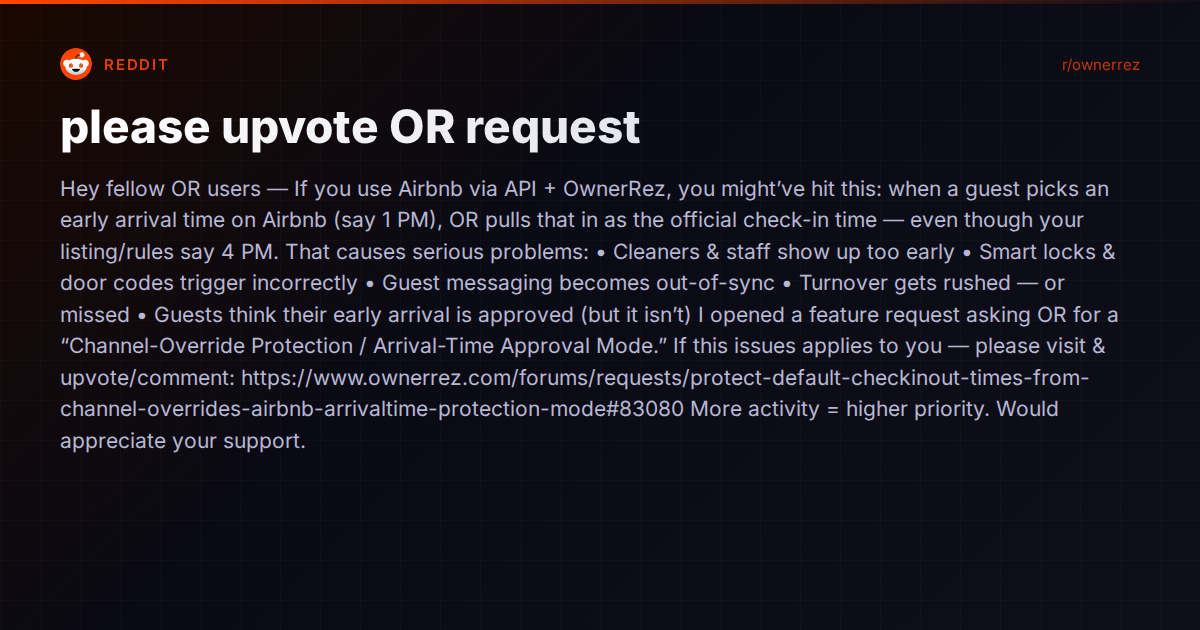
TL;DR: OwnerRez user reports that Airbnb guest-selected arrival times override their official check-in time in OR, causing cascading failures in cleaner scheduling, smart lock code timing, guest messaging sync, and turnover coordination.
There’s a subtle but destructive data sync issue that hits short-term rental operators who rely on automation: Airbnb lets guests select a preferred arrival time during booking, and some property management systems ingest that time as the official check-in time — overriding the host’s actual policy.
The result is a cascade of operational failures that can ruin a turnover day. Cleaners dispatched too early or too late. Smart lock codes activating at the wrong hour. Automated guest messages referencing times that don’t match reality. And guests who believe their early arrival was approved, because the system treated it that way.
One operator described the problem in a community forum in late 2025: a guest selected 1 PM as their preferred arrival on Airbnb, and their PMS (OwnerRez, in this case) pulled that in as the check-in time — despite the listing clearly stating 4 PM. Every downstream automation broke. Cleaning schedules compressed. Lock codes went live prematurely. The guest showed up expecting access three hours early.
This isn’t an edge case. It’s a structural mismatch between how Airbnb exposes guest preferences through its API and how PMS platforms decide what to do with that data.
Why This Happens
Airbnb’s API sends along a guest’s requested arrival time as part of the reservation payload. The problem is ambiguity: is this a confirmed check-in time, or a preference that still needs host approval?
Airbnb treats it as a preference. But many PMS platforms lack the logic to distinguish between “guest would like to arrive at 1 PM” and “check-in is at 1 PM.” If the PMS writes the guest’s preferred time into the check-in field without validation, every automation downstream — task scheduling, lock code generation, message triggers, turnover windows — inherits the wrong time.
The root cause is a missing layer: an approval or override-protection mechanism that says, “the listing’s check-in policy is 4 PM, and any channel-provided time that differs requires explicit host approval before it propagates to operations.”
The Downstream Damage
This isn’t just a cosmetic data issue. For operators running tight turnovers with automated systems, a wrong check-in time touches everything:
- Cleaning coordination: Tasks trigger based on checkout and check-in times. A phantom early check-in compresses the turnover window, sometimes to the point where the cleaner hasn’t even started when the guest expects access.
- Smart locks: If codes are generated or activated relative to check-in time, an overridden time means codes go live before the property is ready — or before cleaning staff have finished and locked up.
- Guest messaging: Automated check-in messages reference the wrong time, creating confusion or setting expectations the host can’t meet.
- Upsell logic: If you charge for early check-in, a system that silently approves early arrival times means you’re giving away a paid service for free.
- Guest expectations: The guest sees the early time reflected in their booking details and reasonably assumes it’s confirmed. When they arrive to a locked door and an unfinished clean, the review writes itself.
How Different Platforms Handle This
Not all PMS platforms treat this the same way, and the differences matter.
OwnerRez currently pulls the Airbnb arrival time directly into the reservation’s check-in time field. As of late 2025, the operator who surfaced this issue filed a feature request for a “Channel-Override Protection” mode that would block or flag channel-provided times that deviate from the listing’s default. The request is public and gathering votes, but the feature doesn’t exist yet.
Guesty has more granular control over how channel data maps to internal fields, partly because it targets larger operators who need stricter data governance. However, the specifics of how Guesty handles Airbnb arrival-time preferences versus policy check-in times depend on configuration, and operators have reported needing to set up custom rules to prevent similar override behavior.
Hostaway syncs reservation data from Airbnb including guest-provided times. Whether the arrival time overrides the listing’s default check-in varies by how the operator has configured their automation triggers. Hostaway’s automation system is event-based, so operators who anchor their triggers to fixed listing times rather than reservation-level check-in times can partially work around the issue — but it requires awareness of the problem in the first place.
Hospitable focuses heavily on automated messaging and task management. Its messaging triggers can be set relative to check-in time, which means the same override problem can surface if the platform inherits the guest’s preferred arrival time. Hospitable’s strength is in message automation, but message automation is only as good as the data feeding it.
Lodgify takes a somewhat simpler approach to channel management and may not expose this issue as visibly, partly because its automation layer is less granular — fewer automated systems means fewer things that break when the time is wrong, but also less operational power overall.
The Broader Pattern: Channel Data Isn’t Always Trustworthy
This arrival-time issue is one example of a larger problem in STR operations: channel-provided data doesn’t always mean what your PMS thinks it means.
Airbnb’s API sends guest phone numbers that may be masked. Booking.com sends virtual credit cards with specific charge windows. VRBO sends guest names that may be the account holder, not the actual guest. Each channel has its own data quirks, and a PMS that ingests everything at face value without validation layers will eventually create operational problems.
The operators who avoid these issues tend to share a few habits:
- They anchor automations to listing-level defaults, not reservation-level overrides. If your check-in is always 4 PM, your cleaning schedule and lock codes should reference 4 PM from the listing, not whatever the reservation says.
- They treat early arrivals as requests, not confirmations. This means having a workflow — manual or automated — that catches deviations and routes them through an approval step.
- They audit their PMS data mapping after connecting a new channel. The default sync settings are rarely the right settings for a tightly automated operation.
Where AI-Native Platforms Fit
One of the arguments for platforms where AI has native access to the full operational stack is exactly this kind of cross-domain coordination problem. When messaging, lock codes, cleaning tasks, and check-in policies all live in the same data layer, an AI system can catch contradictions — “the guest says 1 PM but the listing says 4 PM” — before they propagate.
Vanio AI, for example, treats its AI agent as the core coordinator across reservations, tasks, locks, and messaging. Because it controls the full chain from channel data ingestion to lock code generation to guest messaging, it can enforce listing-level check-in times as the authoritative source and treat guest-provided arrival preferences as inputs that require approval — or route them through an early check-in upsell flow — rather than silently overriding operational schedules. The Operations Watchdog feature runs daily checks across messaging, access codes, smart locks, and cleaning to catch exactly these kinds of mismatches before they become guest-facing problems.
That said, architectural advantage only matters if the platform actually handles your specific channel integration correctly. Any operator evaluating a PMS switch should explicitly test how arrival-time data flows from Airbnb through to downstream automations.
What to Do Right Now
If you’re running into this issue today, regardless of which PMS you use:
- Check your automation triggers. Are they referencing the reservation’s check-in time (which may be overridden) or the listing’s default check-in time? Switch to listing-level where possible.
- Add a validation step for early arrivals. Even a simple workflow that flags reservations where the check-in time doesn’t match the listing default can prevent the worst failures.
- Test with a dummy booking. Have someone book your listing on Airbnb with a non-standard arrival time and trace how that data flows through your PMS to cleaning, locks, and messaging.
- Make noise with your PMS provider. If the platform doesn’t have override protection, request it. Feature requests with community backing get prioritized — the OwnerRez request linked in the original post is a good model.
The arrival-time override problem is a reminder that automation is only as reliable as the data flowing through it. In 2026, with most serious operators running multi-tool or all-in-one stacks that depend on accurate check-in times, a silent data override from a channel API can cascade into a genuinely bad guest experience. The fix isn’t more automation — it’s smarter data validation at the point of ingestion.
For a broader look at how different platforms handle channel sync, data validation, and operational automation, the comparison hub at /compare/ covers the major PMS options side by side.