When Platforms Don't Keep Up With Policy: The Problem of Country-Level Blocking in Short-Term Rentals
Airbnb Community
TL;DR: Syrian property owner is locked out of Airbnb despite U.S. sanctions being formally lifted 9+ months ago, with repeated support contacts yielding no resolution — seeking a way to list and operate his properties.
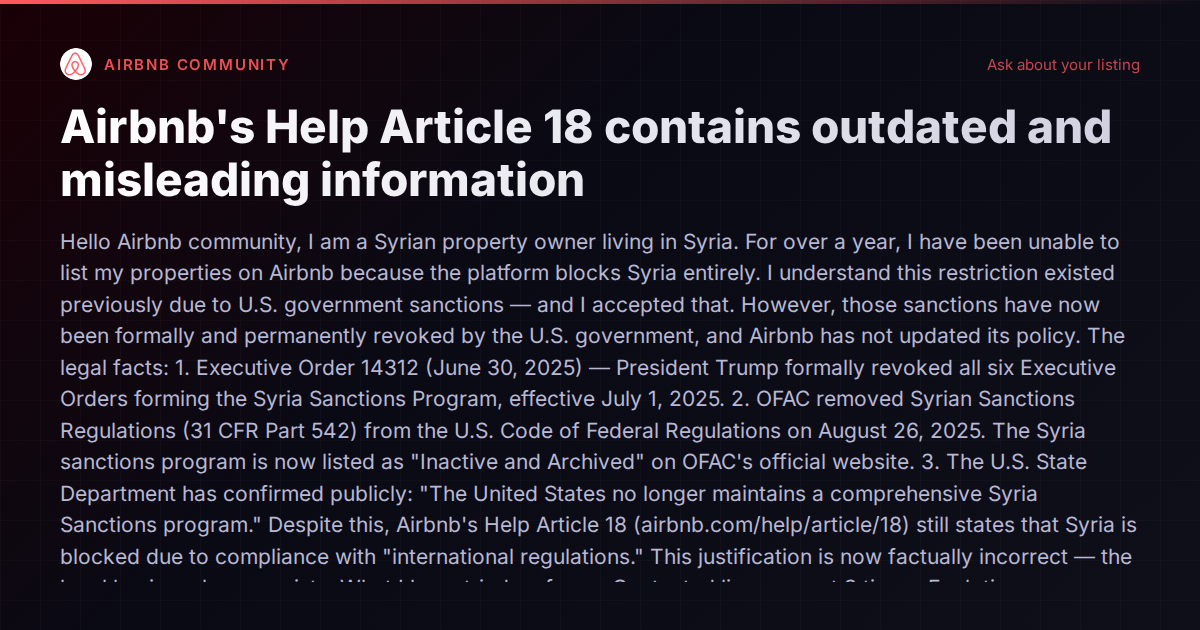
A property owner in Syria recently posted a detailed, well-sourced complaint on Airbnb’s community forum. The core issue: U.S. sanctions against Syria were formally revoked in mid-2025, OFAC archived the sanctions program, and the State Department confirmed the U.S. no longer maintains a comprehensive Syria sanctions regime. Yet more than nine months later, Airbnb still blocks all Syrian listings. The host contacted support three times, called by phone, and sent a formal written complaint to Airbnb’s legal department. Each attempt was either closed without resolution or met with a generic “policy updates may take up to a month.”
This isn’t just a story about one host in one country. It’s a case study in a broader problem that affects short-term rental operators around the world: what happens when platforms’ compliance and policy layers lag behind the legal and regulatory reality on the ground?
The Broader Pattern: Platform Policy Drift
Large platforms like Airbnb, Booking.com, and Vrbo maintain country-level restrictions, payment processing rules, and identity verification requirements that are shaped by sanctions law, anti-money-laundering regulations, and internal risk assessments. When a government lifts a restriction, the platform doesn’t automatically follow. There’s usually a review cycle involving legal, compliance, product, and engineering teams — and sometimes that cycle stalls.
This isn’t unique to Syria. Hosts and property managers in countries across the Middle East, Africa, and parts of Southeast Asia have reported difficulty listing or receiving payouts due to blanket country restrictions that don’t always reflect current law. Cuba, Iran, and North Korea remain under active U.S. sanctions, but the gray areas — countries where sanctions have been partially lifted, restructured, or moved to targeted (rather than comprehensive) regimes — create a gap where platforms may err on the side of caution indefinitely.
The frustration is compounded when the platform’s own published help articles cite a legal basis that no longer exists. In this case, Airbnb’s Help Article 18 still references compliance with “international regulations” as the reason for blocking Syria — a justification the host argues is now factually incorrect.
Why This Matters for STR Operators
Most hosts reading this are not in sanctioned countries. But the underlying dynamic — a platform making a policy decision that affects your business, and then being unresponsive when you challenge it with evidence — is universal. Property managers deal with versions of this constantly:
- Listing suspensions based on automated policy enforcement that doesn’t account for context.
- Payout holds triggered by compliance flags that take weeks or months to clear.
- Regulatory changes at the city or country level that platforms are slow to incorporate, leaving hosts in limbo.
- Help center articles that are months or years out of date, creating confusion about what’s actually required.
The common thread is that large OTAs operate at scale, and scale creates inertia. Policy updates require coordination across legal, engineering, and support teams. When you’re one host in a country that represents a tiny fraction of global bookings, your ticket is easy to deprioritize.
Can You Work Around Country-Level Blocking?
The honest answer is: not easily, and not always ethically or legally.
If a platform has made a business decision to block a country — whether for legal, compliance, risk, or commercial reasons — there’s no technical workaround that doesn’t carry risk. Using a proxy entity in another country, listing under someone else’s account, or misrepresenting your property’s location are all violations of platform terms and could result in permanent bans.
One commenter on the original thread made a blunt point: “As a business Airbnb has a right, provided they are not discriminating, to do business (or not do business) with whomever they please.” That’s legally true in most jurisdictions. The distinction between a sanctions-driven restriction and a business-driven restriction matters a lot — but from the host’s perspective, the outcome is the same.
What Options Exist?
For operators in countries or regions where major OTAs restrict access, there are a few realistic paths:
1. Direct Booking Infrastructure
The most obvious alternative is to bypass OTAs entirely. A direct booking website with its own payment processing can operate independently of Airbnb’s or Booking.com’s country restrictions — provided your payment processor (Stripe, PayPal, or a regional alternative) supports transactions in your country.
Several PMS platforms offer built-in direct booking website builders. Lodgify has long positioned its website builder as a core feature. Hostaway offers expert-designed direct booking templates. Hospitable provides both a basic and premium direct booking tier. Vanio AI includes a branded direct booking website with Stripe payment processing as part of its platform.
The challenge for a host in a newly opened market like Syria is that payment processing infrastructure may still lag behind policy changes. Stripe, for example, maintains its own list of supported countries that doesn’t always align with sanctions policy changes.
2. Regional or Niche Platforms
Some booking platforms operate with different geographic coverage or compliance frameworks. Regional OTAs in the Middle East and North Africa may be more responsive to sanctions changes affecting their markets. This is worth exploring for hosts in countries that major Western platforms are slow to re-enable.
3. Persistent, Documented Escalation
The host in this case has already done much of this: formal written complaints, citation of specific legal sources, engagement with the community. If you’re in a similar situation, document everything. Reference specific executive orders, regulatory actions, and government statements. Escalate beyond front-line support to legal and compliance teams. If the platform has a formal dispute resolution or ombudsman process, use it.
Media attention and community advocacy can also create pressure. A well-documented case on a public forum creates a record that’s harder to ignore than a support ticket.
4. Legal Channels
In some jurisdictions, a host may have grounds to argue that a platform’s refusal to update a policy after the legal basis has been removed constitutes an unfair business practice. This is jurisdiction-specific and expensive, but it’s worth noting that the host’s complaint isn’t just about inconvenience — it’s about a platform publishing information that the host argues is factually false.
The Bigger Picture for Platform-Dependent Operators
This situation highlights a structural risk that every STR operator carries: platform dependency. When your entire business runs through one or two OTAs, any policy change — or failure to change — can shut you down overnight.
The operators who weather these disruptions best are the ones who’ve built diversified distribution. That means listing across multiple OTAs, investing in direct booking capability, building an email list of past guests, and maintaining enough operational independence that losing one channel doesn’t mean losing the business.
For hosts in markets that major platforms are slow to serve, this isn’t optional — it’s the starting point.
Where to Go From Here
If you’re dealing with country-level restrictions, outdated platform policies, or unresponsive support escalations, start by understanding the specific legal and regulatory landscape in your country. U.S. sanctions are only one factor; EU sanctions, UK sanctions, and platform-specific risk assessments all play a role.
For a broader look at how different property management platforms compare on channel support, direct booking capabilities, and geographic coverage, the comparison hub at /compare/ covers over 25 tools across these dimensions. No single platform solves every geographic restriction, but understanding what each one offers — and where each one draws its lines — is the first step toward building a business that doesn’t depend on any one of them.