WhatsApp Message Overload: Why Off-Platform Guest Communication Breaks Down at Scale
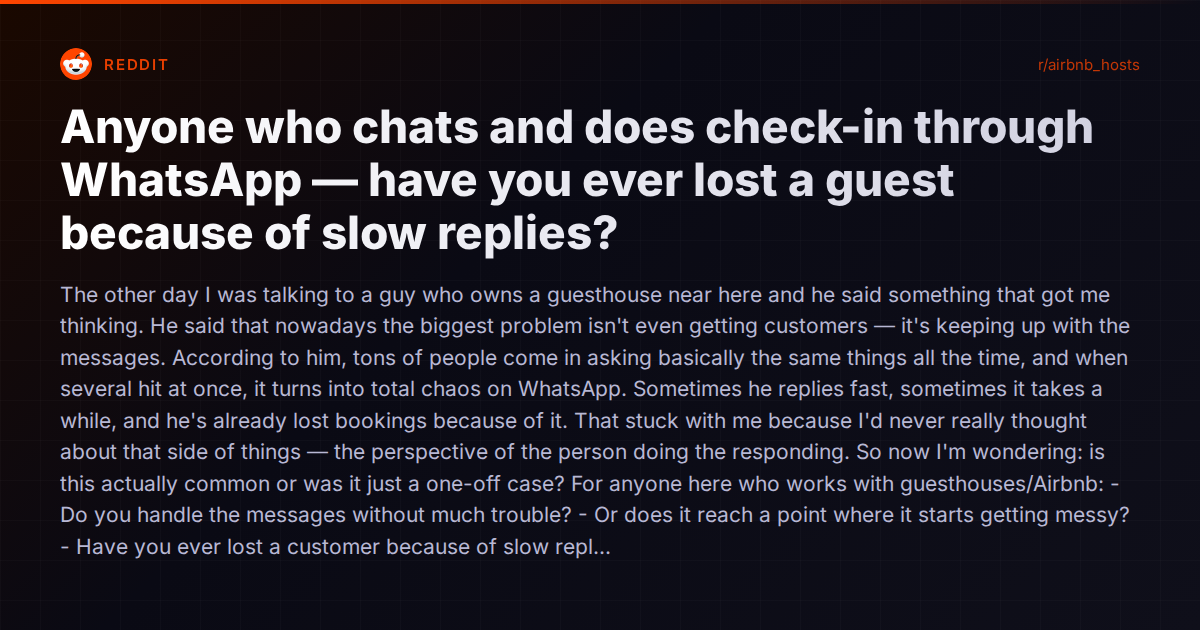
TL;DR: Inn owner struggles with WhatsApp message overload — repetitive guest questions pile up, response times slip, and bookings are lost due to delayed replies.
A guesthouse owner in Brazil recently described his biggest operational problem: it wasn’t finding guests — it was keeping up with their messages. The same questions hitting WhatsApp over and over, multiple inquiries stacking at the same time, and the inevitable slow reply that costs a booking. His story sparked a familiar debate among hosts: is off-platform messaging a ticking time bomb, or can you make it work?
The answer, as usual, depends on how many properties you run, which channels your guests prefer, and how disciplined your communication workflow actually is.
The Real Problem Isn’t WhatsApp — It’s Fragmentation
WhatsApp is the default communication tool in Latin America, parts of Europe, and much of Southeast Asia. Guests in these markets expect to message you on WhatsApp the way American guests expect to use Airbnb’s built-in chat. Telling a Brazilian guest to switch to Airbnb messaging is roughly as effective as telling an American guest to fax you.
But WhatsApp wasn’t designed for reservation management. There’s no threading by booking, no automation layer worth mentioning (WhatsApp Business’s quick replies are rudimentary), no way to hand off a conversation to a team member with full context, and no audit trail that an OTA will recognize if a dispute arises. When you’re running one or two listings, this is manageable. At five or ten, it becomes a full-time job. At twenty-plus, you either hire someone to sit on WhatsApp all day or you start losing bookings.
One experienced host in the original thread made the counter-argument succinctly: “Never talk to guests over WhatsApp. Only use Airbnb messaging. I send guests 2-3 emails after booking with all info they need, then insist all comms via Airbnb messaging. Been doing this for 12 years, no issues.” That’s a legitimate strategy — if your entire guest base books through Airbnb and you operate in a market where guests accept being funneled to a single platform. For hosts with direct bookings, Booking.com reservations, or guests in WhatsApp-dominant markets, it’s not realistic.
The underlying issue isn’t WhatsApp specifically. It’s that guest messages arrive on multiple channels — Airbnb, Booking.com, VRBO, WhatsApp, SMS, email, sometimes Instagram DMs — and most operators lack a unified system to handle them. Each channel has its own app, its own notification rhythm, and its own expectations around response time. The cognitive load of context-switching between them is what creates the “chaos” the guesthouse owner described.
What Repetitive Questions Actually Cost You
The guesthouse owner’s observation that “tons of people come in asking basically the same things” is universal across STR operations. Check-in time, parking, WiFi password, early check-in availability, how to find the property — these questions account for an outsized share of total message volume.
The cost isn’t just the time spent typing the same answer for the hundredth time. It’s the opportunity cost: while you’re explaining parking instructions to Guest A, Guest B’s pre-booking inquiry goes unanswered for 45 minutes, and they book the listing down the street. Airbnb’s own algorithm penalizes slow response times. Booking.com surfaces response rate as a ranking factor. And on WhatsApp, where there’s no algorithm but real human impatience, a delayed reply often means a lost conversion with zero data trail to show for it.
How the Tool Landscape Addresses This
The market has produced several distinct approaches to this problem. Each involves trade-offs.
Staying Inside the OTA Ecosystem
Airbnb’s scheduled messages and quick replies handle the basics: send check-in instructions automatically two days before arrival, set up canned responses for common questions. Booking.com has similar template functionality. This works well if you only operate on one platform and your guests ask predictable questions at predictable times. It breaks when guests ask something the template doesn’t cover, when you manage listings across multiple OTAs, or when a guest reaches out on a channel you haven’t templated.
PMS Unified Inboxes
Most serious property management platforms — Guesty, Hostaway, Hospitable, and others — offer a unified inbox that pulls messages from Airbnb, Booking.com, VRBO, email, and sometimes SMS into a single interface. This is the minimum viable solution to the fragmentation problem. You stop switching between apps and instead see all messages in one timeline, typically organized by reservation.
Hospitable leans heavily on automated messaging with AI that handles routine questions and maintains the host’s communication style across channels. Their system drafts responses and can send them autonomously for common scenarios, which directly addresses the repetitive-question problem.
Guesty offers its ReplyAI feature with automated translations and sentiment analysis, plus a managed communication service where Guesty’s own team handles guest messages — essentially outsourcing the problem entirely if you’re willing to pay for it.
Hostaway consolidates Airbnb, Booking.com, VRBO, Google, email, SMS, and WhatsApp messages into one inbox with AI-powered automated replies and message templates.
All three meaningfully reduce the chaos of multi-channel communication. None of them, however, natively integrate WhatsApp with the same depth as OTA channels. WhatsApp integration in the PMS world typically means either a WhatsApp Business API connection (which requires approval and has costs) or a basic webhook setup that forwards messages but doesn’t enable full two-way automation.
AI-Native Approaches
Vanio AI takes a different architectural approach: WhatsApp, Telegram, Viber, Facebook Messenger, Instagram, SMS, and email sit alongside Airbnb, Booking.com, and VRBO messages in a single timeline per reservation. The AI layer operates across all of them — it can answer a check-in question on WhatsApp with the same context it would use on Airbnb, generate a lock code, or dispatch a task, regardless of which channel the message arrived on. Because the messaging, task management, lock integration, and payment systems share the same data layer, the AI can take real actions rather than just draft text.
The practical difference for the WhatsApp-heavy operator: the system doesn’t treat WhatsApp as a second-class citizen that gets forwarded into a generic inbox. It’s a first-class messaging channel with the same automation, AI response capability, and reservation context as any OTA.
For operators who don’t want AI autonomy, Vanio’s Shadow Mode lets the AI draft every reply for human review before anything gets sent. This addresses the reasonable concern that automated WhatsApp replies might say something wrong to a guest who isn’t protected by OTA dispute resolution.
The DIY Approach
Some operators build their own solution with WhatsApp Business API, a CRM like HubSpot or a helpdesk like Freshdesk, and Zapier automations to connect everything. This can work, but the maintenance burden is real. Every time WhatsApp changes its API, every time you add a new OTA, every time you hire a new team member who needs access — you’re the IT department. For technical operators with the time and skill, it’s viable. For everyone else, it’s a trap.
The Off-Platform Risk Nobody Mentions
One important consideration when moving guest communication to WhatsApp or any off-platform channel: you lose the OTA’s dispute resolution protection. If a guest claims they were promised a late checkout and you have no Airbnb message thread to prove otherwise, you’re in a weaker position. Any system you use for off-platform messaging should maintain a clear, timestamped record of every exchange — ideally one you can export or screenshot if a dispute arises.
What Actually Helps
The guesthouse owner’s instinct — “organize that initial part of customer service, understand what the person wants before it turns into a direct conversation” — is sound. The most effective implementations share three characteristics:
- A unified view of all channels, so you stop losing messages in the gap between apps
- Automated handling of the top 10-15 repetitive questions, so human attention is reserved for decisions that require judgment
- Reservation context attached to every message, so whoever responds (human or AI) knows the guest’s check-in date, property, and history without asking
Whether you achieve this with a full PMS like Hospitable, Hostaway, or Guesty, an AI-native platform like Vanio AI, or a carefully constructed DIY stack — the specific tool matters less than having the architecture in place before the volume forces the decision.
For operators in WhatsApp-dominant markets specifically, the key evaluation criterion is whether the platform treats WhatsApp as a native channel with full automation capabilities, or as an afterthought that gets forwarded into the inbox without context. That distinction is the difference between solving the problem and just moving it to a different screen.