When Guest Messaging Breaks Down: The Offshore Support Problem Nobody Wants to Talk About
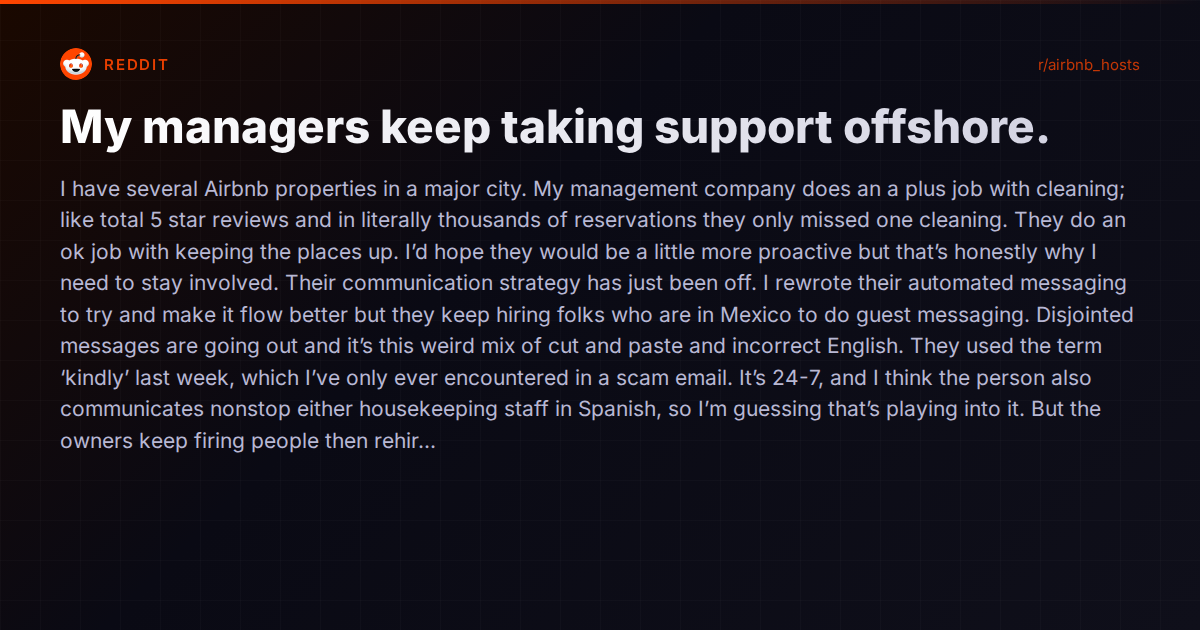
TL;DR: Owner frustrated that management company keeps hiring offshore staff for guest messaging, resulting in disjointed, unnatural English messages that read like scam emails.
A host recently posted about a recurring frustration that’s quietly plaguing short-term rental operations: their management company nails cleaning — thousands of reservations with only one missed turnover — but can’t get guest messaging right. The company keeps hiring offshore staff who send disjointed, copy-paste messages with awkward phrasing. The word “kindly” showed up in a guest message last week, a term most native English speakers associate with phishing emails, not hospitality.
The host rewrote the automated messaging templates. It didn’t stick. The company keeps cycling through offshore agents. The tone shifts from message to message. The guest experience suffers even though the physical product is excellent.
This isn’t an edge case. It’s one of the most common failure modes in scaled STR operations.
Why Guest Messaging Is the First Thing to Break
When a management company or host scales from 5 to 15 to 50 properties, cleaning is usually the operation that gets the most attention. And rightly so — a dirty unit generates an immediate one-star review. But messaging degrades more slowly and insidiously.
At small scale, the owner or a trusted team member handles all communication. The tone is consistent, the context is personal, the responses are fast. At larger scale, that person becomes a bottleneck. The standard playbook is to bring on support — often offshore, because 24/7 coverage for $4-6/hour is financially attractive compared to $18-25/hour for US-based staff.
The problem isn’t geography. As one commenter put it: “Plenty of offshore teams handle guest messaging well if the templates and tone are clearly defined. If they keep rehiring offshore, it’s probably a cost decision.” The problem is that guest messaging requires contextual judgment — recognizing when a template applies and when you need to think on your feet.
The host in question described this perfectly: most questions come from guests who don’t read anything (templates work fine), but the genuinely interesting situations — like a midnight text saying there’s a possum in the dumpster — require a real, human, adaptive response. And that’s exactly where undertrained or poorly supervised agents fall apart.
The Real Root Cause: No Messaging System
Most management companies don’t have a messaging system. They have a collection of templates, a Slack channel, and a hope that whoever is on shift can piece together a coherent reply. When that person is also coordinating with housekeeping staff in a different language, handling multiple properties, and working a graveyard shift, quality slides.
The structural issues are usually the same:
- No defined voice or tone guide. Templates exist, but they’re not calibrated for brand consistency. Different agents default to different registers (formal, casual, stilted).
- No thread ownership. Multiple people touch the same guest conversation. The guest receives one message that’s warm and colloquial, then a follow-up that reads like a legal notice.
- No escalation protocol. Unusual situations (possums, plumbing emergencies, noise complaints at 2 AM) don’t fit any template, and agents without clear escalation paths either wing it or go silent.
- No quality review loop. Nobody is reading outbound messages after they’re sent. Errors compound. Bad patterns become habits.
This isn’t an offshore problem — it’s an operations design problem that manifests with offshore staff because the consequences of poor systems become more visible when agents are working in a second language.
What Actually Works
There are several approaches that operators have used to solve this. They aren’t mutually exclusive.
Tighten the Playbook (Low Cost, Medium Effort)
The most practical advice from the thread: “Make the messaging playbook tight enough that the person sending it matters less.” This means:
- Write templates for 90%+ of scenarios with exact phrasing, not bullet points
- Assign one person per guest thread to maintain tonal consistency
- Create a clear escalation path for anything that doesn’t fit a template
- Review outbound messages weekly and retrain based on actual errors
This is the right first move for anyone who has an otherwise good management company. It’s also the most labor-intensive to maintain as you scale.
Use a Co-Host or Boutique Manager (Higher Cost, Lower Effort)
One commenter suggested hiring a co-host who doesn’t use virtual assistants. Companies like Evolve were mentioned for handling messaging with English-speaking support teams. This shifts the cost burden — you’re paying more per property for messaging quality — but removes the system design burden from you.
The trade-off is real: you lose granular control over tone, and you’re trusting another company’s brand voice to represent yours.
AI-Powered Messaging (Medium Cost, Requires Setup)
This is where the tool landscape has shifted significantly in the past two years. Several platforms now offer AI guest messaging that goes well beyond template auto-responses.
Hospitable has long been one of the more capable options for automated guest messaging. Its AI handles routine questions, drafts responses, and maintains conversational consistency across Airbnb, Vrbo, Booking.com, and direct bookings. If your primary need is reliable, natural-sounding responses to common questions with a unified inbox, Hospitable is a solid, proven choice. Its “Copilot” feature is expanding into task assignment and pricing, though its AI capabilities beyond messaging are still maturing.
Hostaway offers AI-powered automated replies within its unified inbox (covering Airbnb, Vrbo, Booking.com, email, SMS, and WhatsApp). It’s more of a full PMS with AI bolted on than an AI-first messaging tool, but for operators who want channel management and messaging in one platform, it handles the basics well.
Guesty has invested in AI through its “ReplyAI” feature, which provides automated translations, sentiment analysis, and personalized response suggestions. For larger portfolios (Guesty generally targets professional managers at scale), the combination of managed communication services and AI suggestions can meaningfully reduce the offshore staffing problem. Guesty also offers a managed guest communication service where their own team handles messaging, which is essentially outsourcing to a company with tighter quality controls than your average offshore hire.
Vanio AI takes a structurally different approach. Rather than adding AI to a PMS, the AI is the operating layer — it reads from the same database as the task system, lock manager, and payment processor, so it can take real actions (generate access codes, dispatch cleaners, process payments) in addition to drafting contextual replies. The Shadow Mode feature lets you review every AI-drafted message before it goes out, which directly addresses the “what if it says something wrong” concern. Once you trust the output, you can switch to autonomous mode per property or per channel. It supports 100+ languages with auto-detection, which is relevant for operations where staff communicate in Spanish and guests communicate in English — the AI handles both without the tonal whiplash of a bilingual agent context-switching between conversations.
The key differentiator across all of these is whether the AI can handle the possum in the dumpster scenario — the genuinely novel, unscripted situation. Template-based automation handles the 80%. AI that has access to your property knowledge base, house rules, and reservation context handles the next 15%. The final 5% still needs a human, but with proper escalation, that human only deals with the genuinely interesting problems.
The Honest Trade-Offs
| Approach | Cost | Quality Control | Scalability | Setup Effort |
|---|---|---|---|---|
| Tighter playbook + offshore staff | Low | Requires ongoing QA | Degrades past ~20 properties | High (ongoing) |
| Co-host / boutique manager | High | Varies by provider | Limited by provider capacity | Low |
| AI messaging (bolt-on) | Medium | Depends on template quality | Good | Medium |
| AI messaging (native/contextual) | Medium | High if trained properly | Excellent | Medium-High (initial) |
No approach eliminates the need for human oversight entirely. But the right system reduces the volume and stakes of human decisions, which is the actual goal when your management company keeps cycling through agents.
Where to Dig Deeper
If your primary pain is messaging quality and you want to evaluate AI options:
- Hospitable’s automated messaging docs are a good starting point for understanding template-based AI: Hospitable
- Vanio’s AI Skills and Shadow Mode documentation explains the contextual, action-capable approach: Vanio AI
- Guesty’s ReplyAI and managed communication services are worth evaluating if you’re already in their ecosystem: Guesty
The deeper question isn’t which tool to pick — it’s whether your operation has a messaging system or just a collection of people improvising. Fix the system first. Then decide whether humans, AI, or a hybrid runs it.