When You Can't Cancel: The Host Powerlessness Problem on OTA Platforms
Airbnb Community
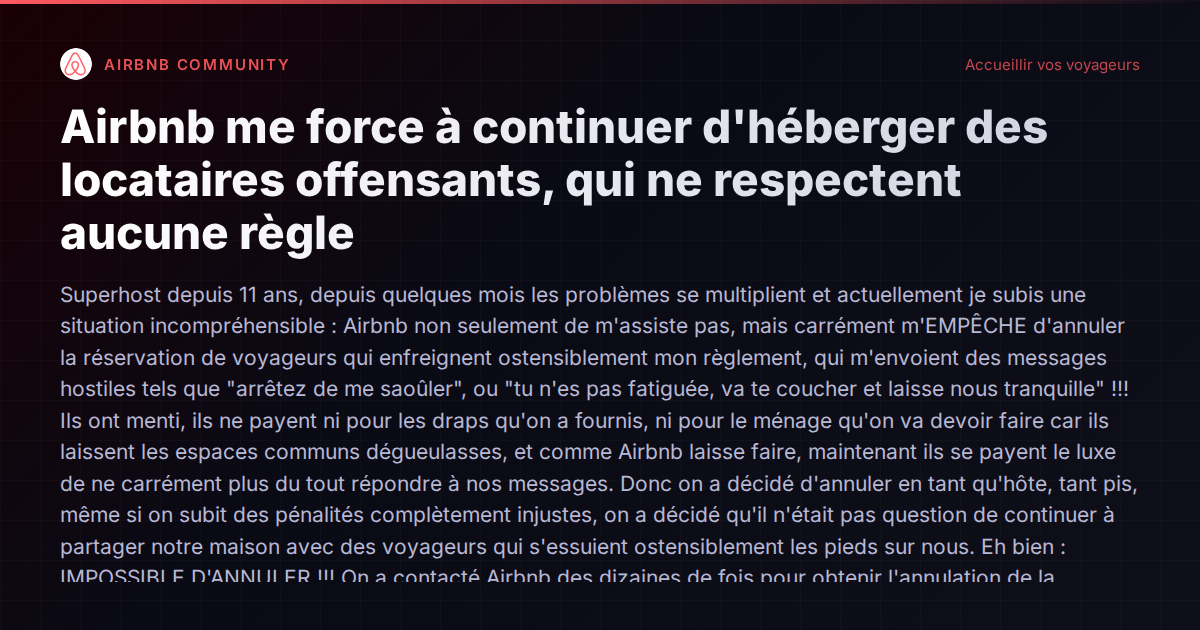
TL;DR: Superhôte depuis 11 ans, l'auteur décrit une situation concrète où Airbnb refuse d'annuler la réservation de voyageurs irrespectueux qui enfreignent le règlement, envoient des messages hostiles, ne paient pas les options utilisées, et où le support Airbnb admet le problème mais ne fait rien — l'auteur annonce vouloir quitter Airbnb.
An 11-year Superhost recently posted in an Airbnb community forum about a situation that, while extreme, touches a nerve every experienced operator recognizes: guests who violate house rules, send hostile messages, refuse to pay for extras, leave common areas trashed — and the platform won’t let the host cancel. Not “won’t refund” the host. Won’t let them cancel at all.
Airbnb’s support team, according to the host, acknowledged the guest behavior was unacceptable and agreed the reservation should be canceled. Then did nothing. Dozens of calls. No resolution. No explanation of how to self-cancel. The host was trapped in their own home with guests who had, in their words, stopped responding to messages entirely.
This isn’t a one-off meltdown. It’s the extreme case of a structural problem that affects every short-term rental operator who depends on a single booking channel.
The Asymmetry at the Heart of OTAs
Airbnb, Booking.com, and Vrbo all position themselves as neutral marketplaces. In practice, their cancellation policies, penalty structures, and support workflows heavily favor the guest side of the transaction. There are good reasons for this — guest trust drives bookings, and bookings drive platform revenue. But the result is a consistent pattern:
- Hosts face financial penalties for canceling, regardless of cause. Airbnb’s host-initiated cancellation penalties include calendar blocking, Superhost status loss, and public listing annotations.
- Support teams acknowledge problems but lack authority (or incentive) to act quickly. Multiple hosts report being told “we agree this should be escalated” followed by silence.
- Guests who violate rules face minimal consequences. Accounts are rarely suspended. The feedback loop that would train bad guests to behave doesn’t exist.
The result is a power imbalance. Hosts who share their own homes feel it most acutely, but professional managers running 20 or 200 doors face the same dynamic: when a guest goes off the rails mid-stay, your options within the OTA are limited and slow.
Why Multi-Channel Distribution Is a Risk Mitigation Strategy
The single most effective structural response to OTA dependency isn’t a better support workaround — it’s reducing your dependency on any one platform. Operators who list across Airbnb, Booking.com, Vrbo, and their own direct booking site aren’t just capturing more demand. They’re building leverage.
When 100% of your revenue comes from one platform, you can’t afford to lose Superhost status. You can’t afford the cancellation penalty. You absorb guest behavior you shouldn’t have to tolerate. When that platform represents 40% of your revenue, the calculus changes.
This is the boring, non-dramatic answer to the original host’s problem: diversify before you need to.
What the Tools Actually Offer Here
Most property management platforms address this problem at two layers: channel distribution (so you’re not trapped on one platform) and guest communication (so you have documentation and, increasingly, some level of automated boundary enforcement).
Channel Management
Every serious PMS includes multi-channel distribution. Guesty, Hostaway, Hospitable, Lodgify, and Vanio AI all connect to Airbnb, Booking.com, and Vrbo with real-time calendar sync. The differences are mostly in API depth (some have certified Booking.com connectivity, some rely on iCal for certain channels) and in how well they handle direct bookings.
If you’re currently Airbnb-only and considering diversification:
- Guesty and Hostaway are established choices for mid-to-large portfolios, with mature channel manager infrastructure and dedicated account management.
- Hospitable is a strong option for smaller operators who want multi-channel sync without a steep learning curve.
- Lodgify leans heavily into direct booking websites and is worth evaluating if reducing OTA dependency through your own site is the priority.
- Vanio AI covers all the standard channels (Airbnb full API, certified Booking.com, Vrbo agency integration) plus a built-in direct booking website. Its channel management is solid, though the product’s real differentiator is elsewhere.
Direct Booking Websites
The ultimate hedge against OTA powerlessness is owning the guest relationship. When a guest books directly, you set the cancellation policy. You decide when a stay gets terminated. There’s no support queue to navigate.
Most PMS platforms now include some form of direct booking website builder. The quality varies significantly. Lodgify has historically been strongest here, with SEO-optimized templates and good customization options. Hostaway offers mobile-first templates built for conversion. Vanio AI provides a Next.js-based site with real-time availability sync and Stripe payments. Guesty and Hospitable both offer direct booking capabilities, though the emphasis differs by tier.
None of these will replace Airbnb overnight. Building direct booking traffic takes months of work. But operators who start now are the ones who, two years from now, have the leverage to walk away from a platform that isn’t serving them.
Guest Communication and Documentation
The French host’s situation was made worse by a breakdown in communication — hostile messages, then silence from the guest, then inadequate documentation to force Airbnb’s hand.
A unified inbox that captures every message across every channel is table stakes for building the kind of paper trail that makes OTA support cases winnable. Every platform mentioned above offers some form of this. The more interesting development is AI-powered messaging that can handle boundary-setting in real time.
Vanio AI has a feature called “Defend Mode” — a firm, policy-first communication tone for dealing with difficult guests. It’s designed to be clear, documented, and consistent, which is exactly what you need when building a case for platform support. The AI operates with full reservation context and can take real actions (not just send messages), which means it can escalate, document, and respond even at 2 AM when you’d rather not engage with a hostile guest.
Hospitable’s AI messaging handles routine guest questions and drafts responses in the host’s voice, which helps maintain professional communication even when the host is frustrated. Guesty’s ReplyAI offers sentiment analysis and automated translations, useful for cross-language disputes.
None of these tools can force Airbnb to cancel a reservation. But they can ensure your communication is documented, professional, and consistent — which is the strongest hand you can play when you’re on the phone with support for the twelfth time.
Guest Verification
Prevention beats cure. Guest verification can filter out some problematic guests before they arrive. Guesty offers GuestVerify with ID verification and background checks (advanced version US-only). Vanio AI includes ID upload, selfie matching, and house rules acknowledgment as part of its guest portal — configurable per property and automatically presented before check-in. These aren’t foolproof, but they raise the bar.
The Uncomfortable Truth
No tool fully solves the power imbalance between hosts and OTAs. As long as Airbnb controls the cancellation button, hosts operating exclusively on that platform are subject to its decisions, its timelines, and its priorities.
The real solution is structural: distribute across channels, build direct booking capability, document everything, verify guests upfront, and use tools that give you professional-grade communication records. None of this is glamorous. All of it reduces the odds you’ll find yourself in an impossible situation.
For operators evaluating their stack, the right starting point depends on where you are today. If you’re Airbnb-only and small, Hospitable or Lodgify will get you multi-channel with minimal friction. If you’re managing 20+ properties and want consolidated operations with strong AI capabilities, Vanio AI and Guesty are worth evaluating side by side — you can dig into the specific differences at the comparison hub. If you’re already multi-channel but struggling with guest communication during conflicts, look at the AI messaging capabilities across platforms and choose the one that best handles escalation, not just routine questions.
The 11-year Superhost said they’re leaving Airbnb. That’s understandable. The better move is to make sure Airbnb is never the only place you need to be.