When STR Turnovers Stop Being Simple: The Operational Wall Every Growing Host Hits
BiggerPockets
TL;DR: Operator asking how others handle the operational mess of turnovers at scale — cleanings, inspections, maintenance, team coordination — currently relying on a patchwork of PMS, cleaner messages, spreadsheets, and manual follow-up.
There’s a moment in every short-term rental operation where the job stops being about bookings and starts being about everything between them. Cleanings, inspections, maintenance calls, timing gaps, quality control, and the communication overhead that ties it all together. Most hosts don’t see it coming until they’re already drowning in it.
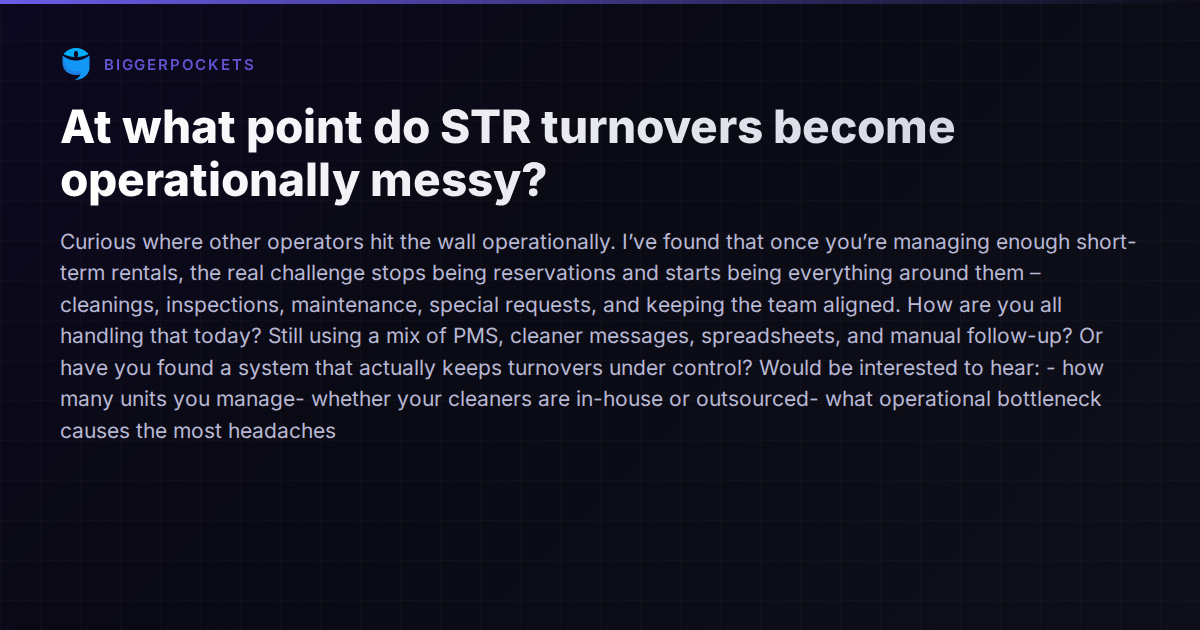
A recent thread on BiggerPockets captured this inflection point well. The original poster asked a deceptively simple question: at what point do turnovers become operationally messy? The answers were instructive — not because anyone had a silver bullet, but because the pain points were so consistent across different portfolio sizes.
The Real Bottleneck Isn’t Cleaning — It’s Coordination
One property manager running 60 units reported smooth sailing, attributing it to a well-assembled software stack. But others described a different reality. Even operators with small portfolios said they started feeling pressure once multiple turnovers landed in the same week. And the consensus was clear: the cleaning itself is rarely the problem. The coordination around it is.
As one commenter put it: “It’s usually not the cleaning itself that breaks things, it’s the gaps in communication and timing around it.” Late finishes, last-minute check-in changes, maintenance requests that surface mid-turnover — these are the failure modes that compound as you scale.
Another operator made a sharper distinction: there’s a difference between tracking whether something got done and verifying whether it was done to the standard you expect. That quality control gap — invisible to guests in process but obvious to them in outcome — is what separates a professional operation from one that’s barely holding together.
The Patchwork Problem
Most hosts managing turnovers today are working with some combination of:
- A PMS for reservations and calendar management
- A separate channel manager (or their PMS’s built-in one)
- Text messages, WhatsApp groups, or a cleaning app for dispatcher coordination
- Spreadsheets or shared calendars for scheduling
- Manual follow-up for quality verification
- A separate smart lock tool for access codes
The 60-unit operator in the thread, for example, listed Streamline for PMS, BookingPal for channel management, Lynx for access control, and RevMax for pricing. That’s four separate systems before you even get to cleaning coordination.
This isn’t unusual. It’s the norm. And it works — until it doesn’t. The failure mode isn’t any single tool breaking; it’s the gaps between tools where information falls through. A guest changes their check-in time on Airbnb. The PMS updates. But the cleaner doesn’t know because they’re getting instructions via a text thread that hasn’t been updated. The lock code is set for the original time. The guest arrives to a half-cleaned unit.
Every operator who’s scaled past a handful of units has a version of this story.
What “Shared Visibility” Actually Requires
One of the more interesting questions in the thread was about shared visibility — whether anyone had built a process where the cleaning team could see the incoming schedule and the operator could see real-time progress, without the constant back-and-forth.
This is the crux of the problem. Most tool stacks are designed around the host’s view: you see your calendar, your reservations, your inbox. But the people doing the physical work — cleaners, maintenance techs, inspectors — are often working from a completely different set of information, delivered through a completely different channel (usually their phone’s messaging app).
Several tools in the market tackle this coordination layer directly:
Turno (formerly TurnoverBnB) focuses specifically on cleaner marketplace and scheduling. It connects hosts with cleaning professionals and automates turnover scheduling based on your reservation calendar. It’s strong for operators whose primary bottleneck is finding and scheduling cleaners, though it’s a point solution — it doesn’t handle messaging, locks, or payments.
Breezeway goes deeper on the operations and quality control side: task management, customizable checklists, inspection workflows, and reporting. It’s popular with property managers who need to demonstrate quality standards to owners. But like Turno, it’s an additional tool layered on top of your existing PMS.
Guesty offers task automation within its PMS, auto-creating cleaning tasks from reservations and allowing team assignment. It’s positioned for mid-to-large operators who want fewer moving parts, though its pricing (custom quotes, not publicly listed) can be opaque.
Hostaway includes operational automation features tied to its PMS and channel manager — triggers for task creation, guest communication, and team coordination. It’s a solid all-in-one option, particularly for operators who also need strong OTA connectivity.
Hospitable has its Tasks feature for assigning and tracking work across properties, with a teammate portal for cleaners to manage their own workflows. It leans more toward the messaging-automation side but has been building out its operational toolset.
The Case for a Single System
The thread highlighted an underappreciated truth: the more tools you use, the more integration surface area you create, and the more opportunities for information to fall out of sync. A reservation change needs to cascade to the cleaning schedule, the lock code, the guest communication, and potentially the maintenance queue — ideally without a human having to manually update each system.
This is where all-in-one platforms have a structural advantage over point-solution stacks. When the PMS, task system, lock manager, and messaging layer share the same database, a check-in time change can automatically ripple through every downstream system.
Vanio AI takes this approach to its logical extreme — auto-creating cleaning tasks from reservations, dispatching them to cleaners via SMS (no app install required; reply “1” to accept, text “done” to complete), requiring photo verification with AI-based inspection scoring, and tying it all back to the same system that manages lock codes, guest messaging, and payments. The Operations Watchdog feature runs a daily scan across upcoming reservations to flag gaps in cleaning assignments, access codes, and guest communication before they become problems. For operators whose cleaners are tech-averse or multilingual, the SMS-first approach with auto-translation is a genuine differentiator.
But no platform is a complete answer if your operational processes aren’t sound. The operator running 60 smooth units likely succeeds not just because of software but because they’ve built clear standards, reliable teams, and consistent workflows.
Where the Quality Control Gap Still Exists
The hardest problem raised in the thread — verifying not just completion but quality — remains partially unsolved across the industry. Most tools can tell you a task was marked done. Fewer can tell you it was done well.
Photo verification with checklists is the current best practice. Breezeway, Vanio AI, and Properly all offer versions of this: cleaners photograph specific areas, the system checks them against standards, and flagged issues get escalated before the guest arrives. It’s not perfect, but it’s meaningfully better than trusting a “done” text message.
The next frontier is likely AI-powered visual inspection — analyzing photos against reference images to catch missed details automatically. Some platforms are experimenting with this now, though it’s early.
Honest Trade-Offs
If you’re hitting the operational wall:
- Point solutions (Turno, Breezeway, Properly) solve specific problems well but add integration complexity and cost.
- All-in-one PMS platforms (Guesty, Hostaway, Hospitable, Lodgify) reduce tool sprawl but may not go as deep on operations as dedicated tools.
- AI-native platforms (Vanio AI) offer the tightest integration and automation potential but require trusting a newer system with more of your stack.
- Custom stacks (like the Streamline + BookingPal + Lynx + RevMax setup) give you best-of-breed in each category but demand you be the integration layer.
The right choice depends on your scale, your team’s technical comfort, and which specific bottleneck is actually costing you the most. For most operators, the answer isn’t more tools — it’s fewer tools with better information flow between them.
If you’re evaluating options, Vanio AI’s operations documentation covers their task management and cleaning coordination approach in detail. For comparison, Breezeway’s and Turno’s sites are worth reviewing if your pain is specifically around cleaning quality or cleaner sourcing. Start with the bottleneck, not the brand.