When Onboarding Goes Wrong: The Hidden Cost of PMS Platforms That Don't Wait for You
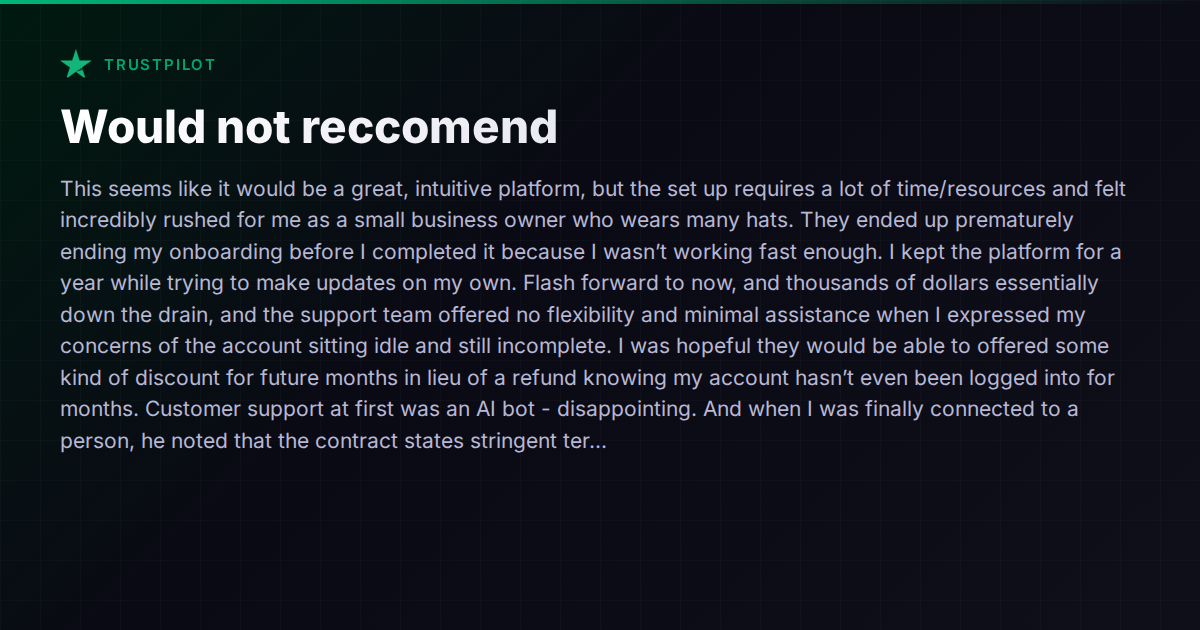
Trustpilot
TL;DR: Small business owner spent thousands on Hostaway over a year but never completed onboarding due to rushed setup, got no flexibility or refund, and feels the platform is a money grab that sets non-technical users up to fail.
A property manager recently shared a story on Trustpilot that will sound familiar to a lot of small STR operators: they signed up for a well-known PMS, started the onboarding process, couldn’t keep up with the pace, and then spent a year paying for a platform they never fully set up. When they finally asked for help — a discount, a partial refund, anything — the response was rigid contract terms and an AI chatbot.
The platform in question was Hostaway, but this isn’t a Hostaway-specific problem. It’s a structural pattern across the PMS industry: onboarding is designed for the vendor’s timeline, not yours. If you’re a one-person operation juggling guest communication, cleaning coordination, pricing, and maintenance, a two-week onboarding sprint is not realistic. And yet that’s what many platforms assume.
The Onboarding Gap Nobody Talks About
Most PMS vendors sell on features. The demo looks great. The sales call is smooth. Then you sign the contract and realize that actually getting your properties, channels, automations, and integrations configured is a project in itself — one that can take 20 to 40 hours of focused work depending on portfolio size and complexity.
Enterprise-grade platforms like Hostaway and Guesty typically offer structured onboarding with a dedicated specialist. That sounds good on paper. In practice, it often means a set number of sessions over a fixed window — say, four calls in two weeks. If you fall behind because you’re also running your business, the onboarding wraps up whether you’re ready or not.
The host who posted the Trustpilot review described exactly this: their onboarding was “prematurely ended” because they weren’t moving fast enough. They then spent a year trying to self-complete the setup, failed, and left with nothing to show for thousands of dollars in subscription fees.
This isn’t an edge case. Operators across Reddit and other host communities regularly report similar experiences — signing up for a platform, stalling during migration, and paying for months of a tool they barely use.
Why Small Operators Get Hit Hardest
The economics of PMS onboarding create a misalignment. Vendors make money from subscriptions, so their incentive is to get you through setup quickly and onto a billing cycle. But the people who most need a PMS — overwhelmed solo operators managing five to fifteen listings — are the least able to dedicate a focused week to migration.
The result is a kind of adverse selection: the operators who can breeze through onboarding are often the ones who already have systems and staff. The ones who struggle are the ones who would benefit most from the product.
A few specific friction points that trip people up:
- Channel API connections — Linking Airbnb, Booking.com, and VRBO accounts requires navigating each platform’s permission flow, which can involve delays, verification steps, and troubleshooting.
- Listing data migration — Descriptions, photos, pricing rules, availability settings, and custom fields rarely transfer cleanly. Manual review is almost always required.
- Automation setup — Automated messaging, task triggers, and pricing rules need to be built from scratch in most systems. This is where the value lives — and where the learning curve is steepest.
- Integration configuration — Connecting smart locks, payment processors, cleaning tools, and accounting software each adds another layer of setup complexity.
If you don’t finish all of this, you don’t get the value. But you still get the bill.
How Different Platforms Handle This
Not every PMS handles onboarding the same way, and the differences matter.
Hostaway offers dedicated onboarding with a specialist, but as the review illustrates, the window appears to be fixed. Once it closes, you’re on self-service support. Their pricing isn’t publicly listed — you need to request a quote — which also means contract terms aren’t visible until you’re already in the sales conversation.
Guesty takes a similar enterprise-oriented approach. They have a large R&D and support team and offer managed communication services as an add-on, but their pricing is also opaque, and the platform is built for scale. Small operators with five to ten listings often report feeling underserved.
Hospitable is designed more for independent hosts and emphasizes automation-first setup. The learning curve tends to be gentler because the product is narrower in scope — strong on messaging automation and channel sync, lighter on operational tools. For a solo host who mainly needs automated guest communication, this can mean faster time-to-value.
Lodgify promotes a free onboarding experience (valued at $700, per their site) that includes one-on-one specialist support. They appear to target the individual-host-to-small-PM segment, which may translate to more patience with operators who need extra time. That said, their feature set is more limited than the enterprise platforms.
Vanio AI takes a different architectural approach that’s relevant here: because the AI layer controls the entire system — messaging, locks, tasks, payments, calendar — it can handle a significant portion of what other platforms require you to configure manually. The setup wizard walks through channel connections and property details, and then the AI starts operating immediately in Shadow Mode (drafting responses for your review rather than sending autonomously). The idea is that you don’t need to build fifty automations because the AI figures out what to do from context. Whether that actually eliminates the onboarding bottleneck depends on your specific setup, but the 14-day free trial with no credit card required at least means you’re not paying while you figure it out.
The Contract Trap
Beyond onboarding pace, the Trustpilot review highlights another pain point: rigid contract terms. The host described being told that “the contract states stringent terms that make any level of human serviceability nearly impermissible.” Translation: no refunds, no credits, no flexibility — even when the account hadn’t been logged into for months.
This is unfortunately common with platforms that use annual contracts and custom pricing. When the price isn’t public and the terms aren’t standard, you’re negotiating blind. And once signed, the leverage shifts entirely to the vendor.
Before committing to any PMS, a few things worth checking:
- Is there a free trial? Can you actually test the onboarding experience before paying?
- Is pricing public? If not, ask why. Opacity usually benefits the seller.
- What happens if you don’t finish onboarding? Is there a pause option? Extended support? Or does the clock just run?
- What’s the cancellation policy? Monthly billing with no lock-in is the gold standard. Annual contracts should come with meaningful discounts to justify the risk.
- What does support look like post-onboarding? Is it AI chatbot only? Ticketed email? Live humans?
The Bigger Question
The host’s final line — “this feels like a huge money grab that sets people up to fail if not already code-savvy” — gets at something real. Many PMS platforms were built by engineers for technically fluent users. The marketing says “easy” and “intuitive,” but the product assumes comfort with API connections, webhook configurations, and automation logic trees.
The industry is slowly shifting. AI-native platforms are reducing the configuration burden. Simpler tools are carving out niches for small operators. But if you’re evaluating a PMS today, the most important question isn’t “what features does it have?” It’s “how long will it take me — specifically me, with my available time and technical skill — to get this thing actually working?”
If the honest answer is “longer than the onboarding window allows,” you’re setting yourself up for exactly the scenario described above: months of subscription fees for a tool that never delivered value.
Choose the platform that fits your actual capacity, not your aspirational one. And if a vendor won’t let you try before you buy, that tells you something about how much they trust their own onboarding experience.